Floating Dock Technical Specifications: A Guide to Drafting Procurement TOR
How to draft floating dock technical specifications for procurement terms of reference (TOR): function, site data, design load, pontoon parameters, frame, mooring and handover.
One vague sentence in a procurement document can produce three bids that cannot be compared with one another. "Floating dock measuring 10 × 3 metres", for example, says nothing about the load it must carry, the pontoon material, the type of frame or how the dock will be moored. That is why clear floating dock technical specifications are the foundation for an agency to obtain a structure that fits its function and to evaluate bids fairly.
This guide is general technical information, not legal advice. For procurement rules and domestic product requirements, refer to the latest regulations and consult the procurement unit at your agency.
Why Floating Dock Technical Specifications Determine Procurement Outcomes
The terms of reference (TOR) are the document that suppliers translate into a design, a price and a schedule. If the technical parameters are incomplete, each supplier fills the gaps with its own assumptions. As a result, the lowest bid is not necessarily equivalent to the others, and the risk of non-conformity only becomes visible at handover.
Clear floating dock technical specifications also benefit suppliers. Each supplier can calculate the pontoons, frame and mooring needed on the same basis, so differences between bids genuinely reflect different solutions rather than different interpretations.
Good floating dock technical specifications answer three questions: what the dock is built for, where it will be installed, and how its quality will be checked.
Main Components of the Terms of Reference
Purpose and function
Describe the function of the dock specifically: berthing for fishing boats, tourism access, inter-island transport or a work platform. State the type and size of boats served and the expected number of users.
Site data
Attach data on depth, water-level changes or tides, currents, waves, bed conditions and land access. If the data is not yet available, the TOR can require a survey as part of the works. The data commonly needed is discussed in the article on floating dock site surveys.
Design load
State the design loads to be carried, for example the live load of people per square metre, equipment loads and boat berthing loads, as well as the minimum deck height above the water required. These figures should be set by a competent designer.
Technical Requirements for Materials and Structure
This section is the core of the tender document. Write it as measurable parameters, not as brands:
- Pontoons: the shell material type and its UV resistance, whether there is a filled core, minimum wall thickness, dimensions and buoyancy per unit.
- Frame: material (for example aluminium or galvanised steel), corrosion protection and connection system.
- Decking: material, non-slip surface properties and installation method.
- Mooring system: type of anchors, guide piles or chains to suit site conditions.
- Safety accessories: railings, bollards, fenders, ladders, ring buoys and lighting where needed.
- Land access: a gangway or connecting bridge, including its width, railings and a slope that remains safe at the lowest water level.
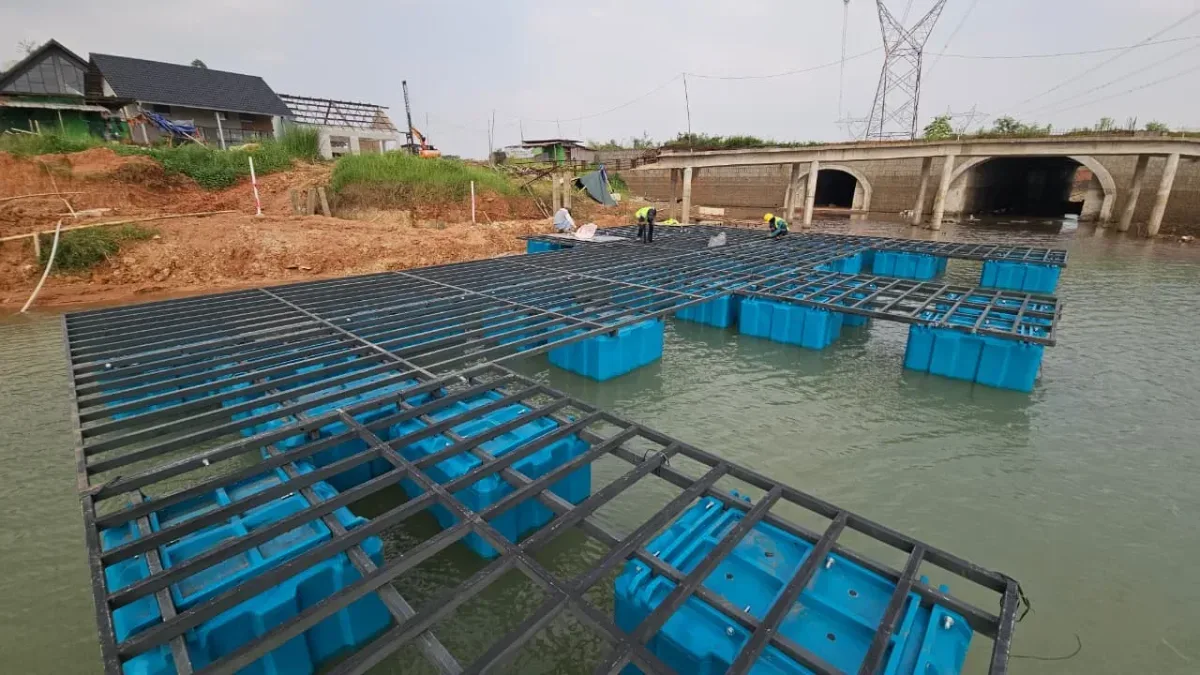
Grid-pattern steel frame installed on blue pontoons during installation at a floating dock project in Serpong, Banten. Source: Bajau Indo documentation
As an illustration of these parameters, Bajau Indo pontoons use a UV-resistant LLDPE shell with an 8 mm wall thickness and a CFC-free polyurethane core. For the mooring system, the basic principles can be read in the article on floating dock mooring systems.
Tender Documents: Working Drawings, Domestic Products and Handover
Working drawings
Request layout drawings, sections, connection details and mooring details. These drawings make it easier for the committee to compare bids and serve as a reference for site supervision.
Domestic product requirements
Government agencies generally have obligations relating to the use of domestic products and TKDN (local content) values. These are governed by regulations that can be updated, so refer to the latest version and ask suppliers to attach proof of a valid certificate. Bajau Indo pontoon products are TKDN-certified according to its official website. A broader discussion is available in the article on TKDN products for floating infrastructure.
Testing and handover
Set out what will be checked at handover: dimensional conformity, deck levelness, tightness of connections, mooring function, completeness of accessories, and supporting documents such as as-built drawings and maintenance instructions. Where needed, the TOR can also provide for brief training for operating staff in line with the contract terms.
Writing Technical Requirements Without Pointing to a Brand
A TOR that is too narrow can restrict competition, while a TOR that is too loose leaves room for unsuitable products. Some general principles that help:
- use minimum values or ranges, not figures that only fit one product;
- avoid trade names, product codes and colours specific to a particular brand;
- request technical data, sample units or project documentation as proof of compliance;
- separate mandatory requirements from requirements that add value;
- involve a designer or consultant so that every parameter written can be verified on site.
Frequently Asked Questions
May a TOR name a particular pontoon brand?
In procurement practice, specifications are generally written as technical parameters so that competition stays open. The exact rules follow the applicable procurement regulations, so this should be confirmed with your agency's procurement unit.
Should the pontoon wall thickness be stated?
Wall thickness is one of the parameters that affect pontoon durability, so it is worth stating as a minimum value. Ask suppliers to attach technical data showing that value.
Who determines the design load in floating dock technical specifications?
The design load should be determined by the designer or technical consultant based on the function of the dock and site conditions. The supplier then calculates a pontoon configuration that meets that load.
Drafting a TOR or tender document for a floating dock? The Bajau Indo team can help by providing product technical data as reference material. Contact marketing@bajauindo.com or WhatsApp 0878-5931-4314.
Written by
Tim Redaksi Bajau Indo
Tim Teknis & Redaksi
Tim teknis dan redaksi Bajau Indo — produsen dermaga apung, kubus apung, dan ponton modular LLDPE dari Sentul, Bogor.
Tags
Share this article: