Floating Docks for Tourist Lakes and Reservoirs: Water Levels, Boat Access, and Layout
Planning a floating dock for a tourist lake or reservoir? Learn how to deal with changing water levels, tourist boat access, and Nusa Dock layout options.
Picture a tourist reservoir at the height of the dry season. The concrete dock built when the water was high now hangs far above the surface, and visitors have to clamber down a slippery bank to board the boats. Situations like this are leading many operators to consider a lake floating dock as an alternative.
Natural lakes, reservoirs, and small retention ponds (embung) behave differently from the sea. That is why dock planning for lake tourism needs to account for water-level changes, boat requirements, and visitor flow from the very start.
Water-Level Challenges in Lakes and Reservoirs
In general, the water level in a reservoir is influenced by rainfall, water release patterns, and irrigation or power generation needs. The difference between the rainy and dry seasons can be considerable. Natural lakes also experience changes, although the pattern can be more gradual.
A fixed dock is built at a single elevation. When the water drops, the gap between the deck and the boat becomes too high; when the water rises, the deck can be submerged. A floating dock solves this problem in a simple way: the deck rises and falls with the water surface. In addition, a modular lake floating dock can be expanded with extra units as visitor numbers grow.
You can read a more detailed discussion of this flexibility in our article on why floating docks are the key to flexibility.
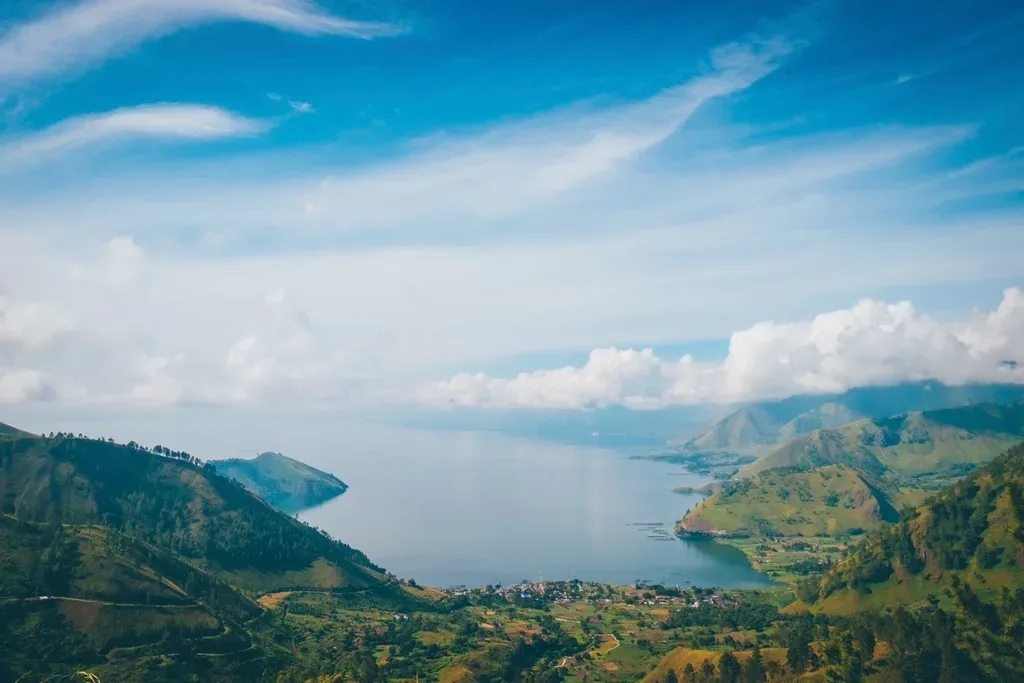
Illustration of a tourist lake landscape in Indonesia, not a Bajau Indo project. Photo: Lake Toba via rawpixel (CC0)
Comfortable and Orderly Tourist Boat Access
A tourist boat dock is essentially the meeting point between land, water, and passengers. Because the deck of a floating dock always sits at a relatively constant height above the water surface, the height difference between the deck and the boat is easier to control.
Consider the following to keep passenger boarding and disembarking running smoothly:
Deck height relative to the boat. Match it to the type of boat that will berth, such as a tourist catamaran or a rowing boat.
Walkway width. The main walkway needs to be wide enough for queuing passengers and staff.
Railings and handholds. Install them on the sides not used for berthing.
Waiting area. A small platform at the end of the dock helps manage visitor flow.
Boat mooring points. Position bollards or cleats according to the length and number of boats.
If your destination needs a higher-capacity boat, the Toba catamaran, measuring 7 × 5 m for 15–20 people, can serve as a reference when sizing the berthing area.
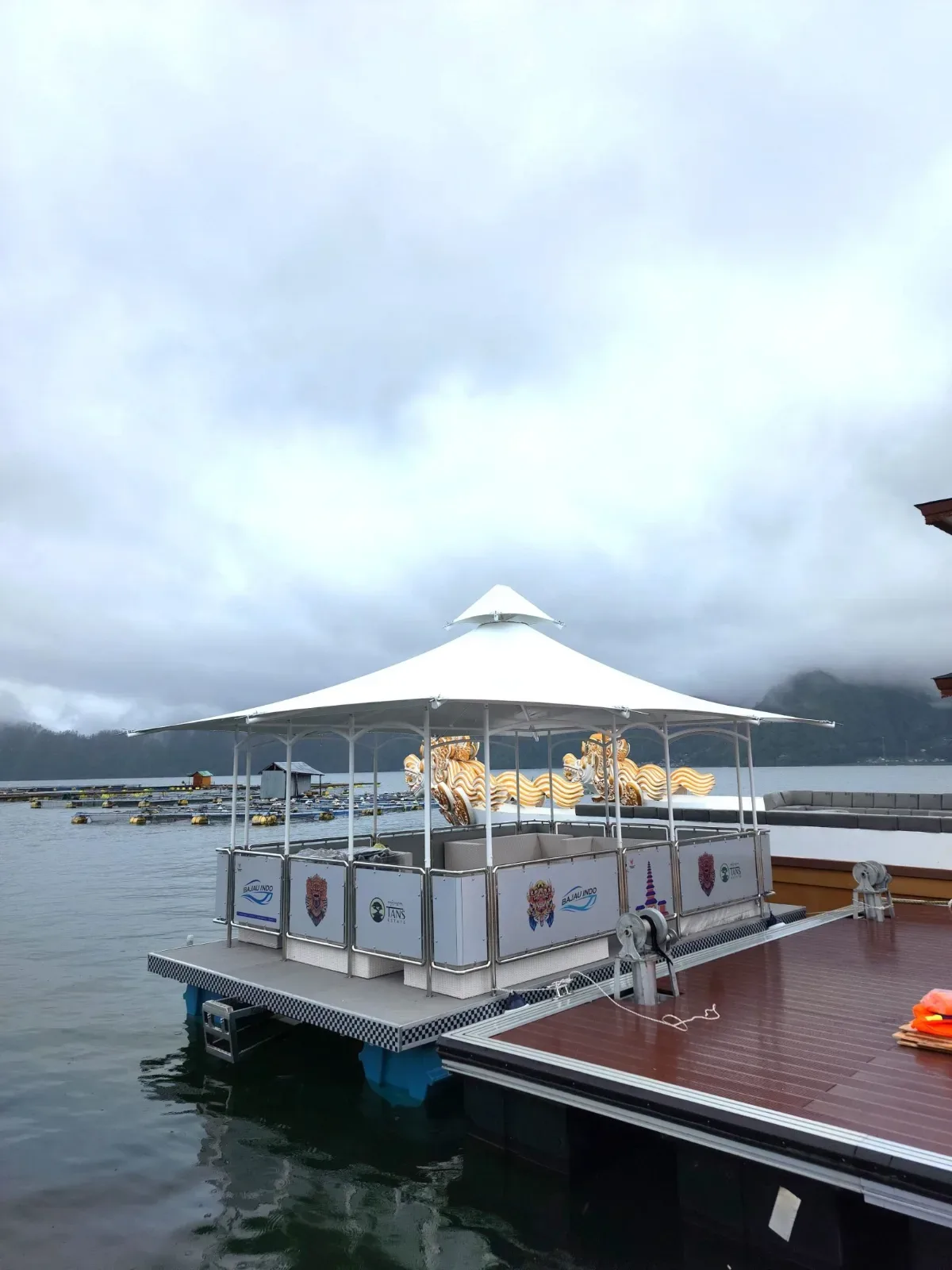
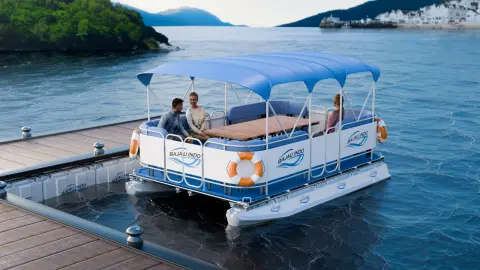
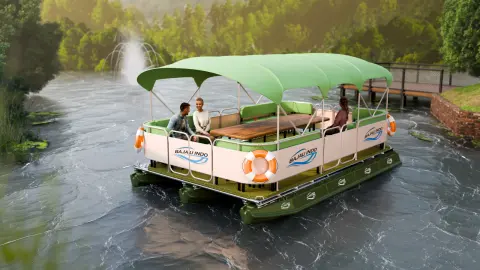
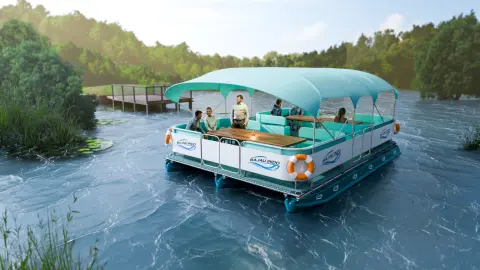
A tourist boat on a lake in Bali, one of Bajau Indo's projects. Source: Bajau Indo documentation
Designing a Lake Floating Dock Layout
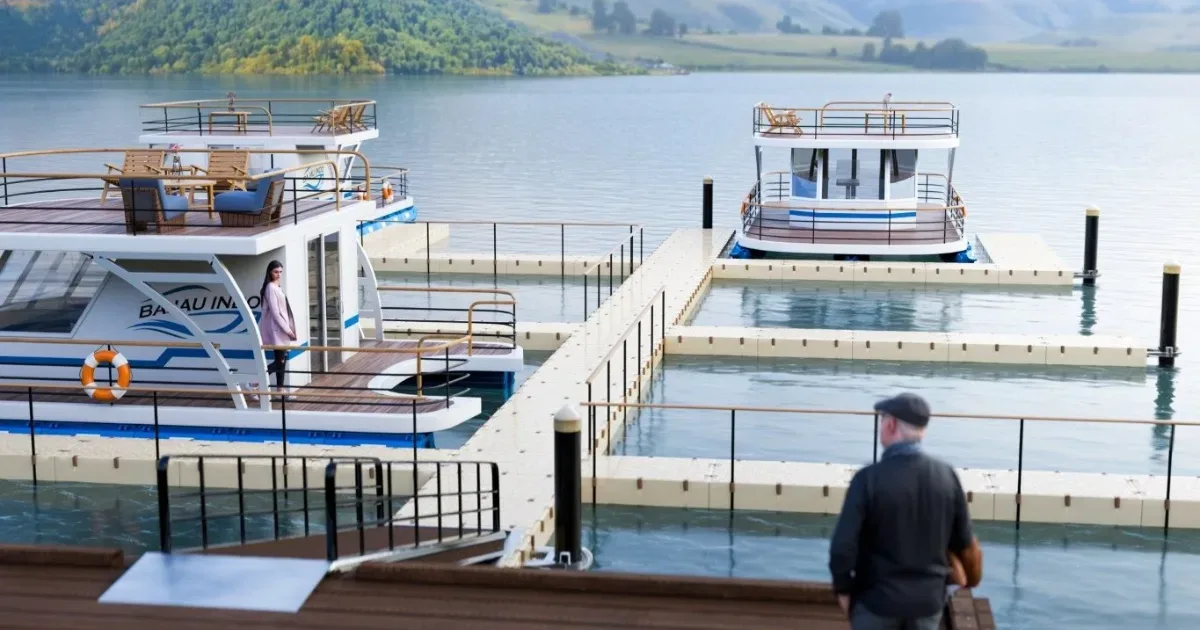
The layout determines how many boats can berth at once and how visitors move. Nusa Dock modules, measuring 150 × 100 × 40 cm per unit, can be arranged in several configurations.
Straight — Overview: A single walkway from the shore out to the water; Suitable for: Simple boarding points with few boats
L — Overview: A main walkway with one long berthing side; Suitable for: Narrow shorelines with a specific berthing direction
T — Overview: A main walkway ending in a cross platform; Suitable for: A waiting area at the end and berthing on two sides
U — Overview: Two walkways forming a berthing basin; Suitable for: Several boats with a more sheltered area
Start with visitor flow
When designing a lake floating dock, start from where visitors arrive on land. From there, determine the route to the berthing area, the position of the waiting area, and the space for boat maneuvering. Avoid routes that force disembarking and boarding passengers to cross paths at narrow points.
To try out arrangements visually, use the Nusa Dock Drawing Tool. It offers drag-and-drop unit placement, an adjustable grid, unit count estimates, and image export.
Mooring and Shore Connection
In general, a floating dock on a lake or reservoir is held in place by a mooring system such as anchors with chains, or guide piles that allow the dock to move vertically. The choice of system depends on depth, bed type, and the range of water-level change.
The shore connection also needs attention. A gangway hinged on the shore side can adjust its slope as the water level changes. Gangway length is generally chosen so the slope stays comfortable at the lowest water level.
Module material matters too. The LLDPE shell of Bajau Indo modules is UV-resistant, which is relevant for a lake floating dock exposed to the sun all day, while the core is CFC-free polyurethane. For ideas on future development, such as a lounge deck or a lakeside dining area, see the floating unit inspiration gallery, which features 3D model visualizations.
Frequently Asked Questions
Why are floating docks suitable for reservoirs?
Reservoir water levels can rise and fall considerably between the rainy and dry seasons. A floating dock moves with the water level, so the distance between the deck and the water surface stays relatively constant and boats can still berth.
What layouts can be built with Nusa Dock?
According to its product page, Nusa Dock can be arranged in straight, L, T, or U configurations. The choice of layout depends on the number of boats, the direction visitors arrive from, and the available water space.
What data should be prepared before a consultation?
Prepare an estimate of the range of water-level change, the depth at the dock location, the type and number of boats, and photos of the shoreline. This data helps the engineering team design the layout, mooring system, and shore access.
Do you manage a lake or reservoir tourist destination and want to rethink its boat access? Start by sketching in the Drawing Tool, then discuss the result with the Bajau Indo team via WhatsApp 0878-5931-4314. We will help adapt the design to the water conditions at your site.
Written by
Tim Redaksi Bajau Indo
Tim Teknis & Redaksi
Tim teknis dan redaksi Bajau Indo — produsen dermaga apung, kubus apung, dan ponton modular LLDPE dari Sentul, Bogor.
Share this article: