Planning a Floating Restaurant: Layout, Capacity, and Propulsion
Plan your floating restaurant carefully: layout, support facilities, capacity, and propulsion, with a project example on the Manggar River.
Enjoying a meal while feeling the floor move gently with the water is an experience that land-based restaurants find hard to match. That is why some businesses along rivers, lakes, and coastlines are turning to the floating restaurant concept. Behind the relaxed atmosphere, however, there are several technical decisions to make from the start: the building's shape, the number of guests, facilities, and how the unit moves or is moored.
This guide summarizes what to consider before building a floating restaurant, along with an example of a Bajau Indo project in Balikpapan.
Decide First: Moored or Able to Cruise?
This first decision shapes much of what follows. A floating restaurant moored at a single point functions like a building on a floating platform. The focus is on deck area, the mooring system, and access from shore.
By contrast, a restaurant that can cruise along a river or lake works like a large boat. The pontoon assembly must form a hull with a bow that cuts through the water. In the Bajau Indo system, this role is played by the Nose Pod as the front element, which is then connected to the Body Pod behind it. According to the official specifications, the buoyancy per unit is 130 kg for the Nose Pod and 230 kg for the Body Pod.
Planning the Layout and Guest Capacity
The layout of a floating restaurant differs from that of an ordinary restaurant because every chair, table, and guest adds load that the pontoons must support. In general, the zones to plan include:
Main dining area, with circulation paths wide enough for staff and guests.
Food preparation area, ideally compact and positioned so its load does not concentrate on one side.
Private or VIP room, if the business concept requires a private area.
Sanitation facilities, including waste holding so nothing is discharged into the water.
Guest boarding point, equipped with handholds and railings.
The capacity of a floating restaurant cannot be determined from the number of seats alone. The total load includes the weight of the structure, roof, furniture, equipment, and guests, which is then compared with the buoyancy of the pontoon assembly. For an initial overview, you can try the Platform Pontoon configurator, which shows an estimate of the number of units and buoyancy. The result is a preliminary estimate that will be verified by the engineering team.
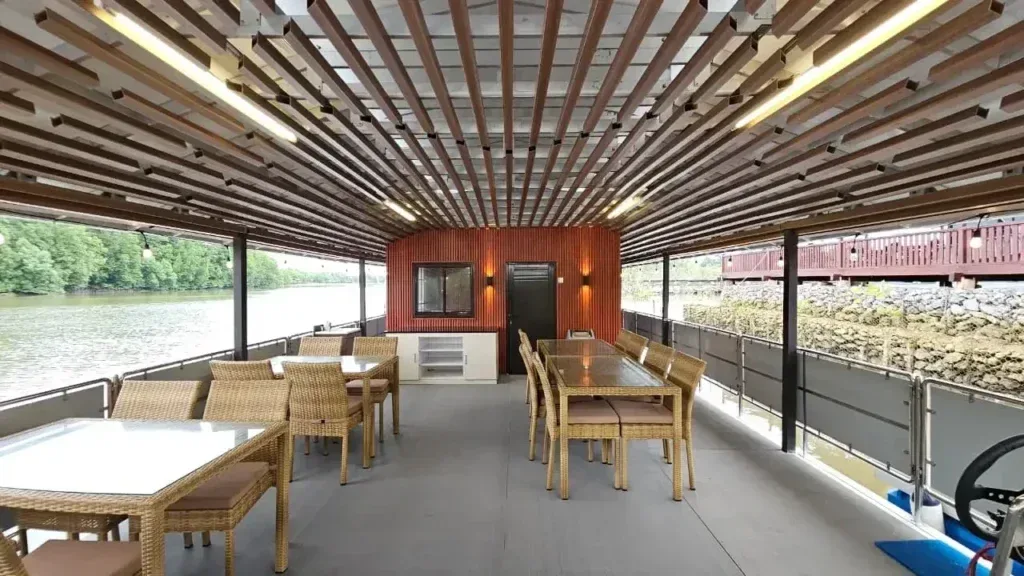
The interior of a floating restaurant in Balikpapan. Source: Bajau Indo documentation
Often-Overlooked Support Facilities
Beyond the dining area, several support facilities determine guest comfort and smooth operations:
Power supply for lights, air conditioning, and serving equipment, either from a generator or a shore connection when moored.
Clean water for handwashing and equipment hygiene.
Waste and wastewater management, collected on board and then taken ashore.
Safety equipment, such as life jackets, life rings, and railings around the deck.
Roof and shading to protect guests from heat and rain.
Every facility adds load, so it should be included from the design stage rather than added later. Heavy equipment such as generators, water tanks, and waste holding tanks also needs to be positioned in a balanced way so the floating restaurant does not tilt to one side when guests gather in a particular area.
Propulsion, Route, and Mooring
For units that cruise, outboard motors are generally chosen because they are relatively easy to install and maintain. The number and power of the engines are matched to the unit's size, the current, and the route. In general, the route needs to account for channel depth, river width, and vertical clearance under bridges.
A moored restaurant requires a mooring system that keeps the unit stable as the water level rises or falls. For both types, permits from the local water authority should be pursued in parallel with the design process. Early coordination also helps determine berthing points, guest access paths from shore, and operating hours that comply with local regulations.
A Real Example: The Floating Restaurant on the Manggar River, Balikpapan
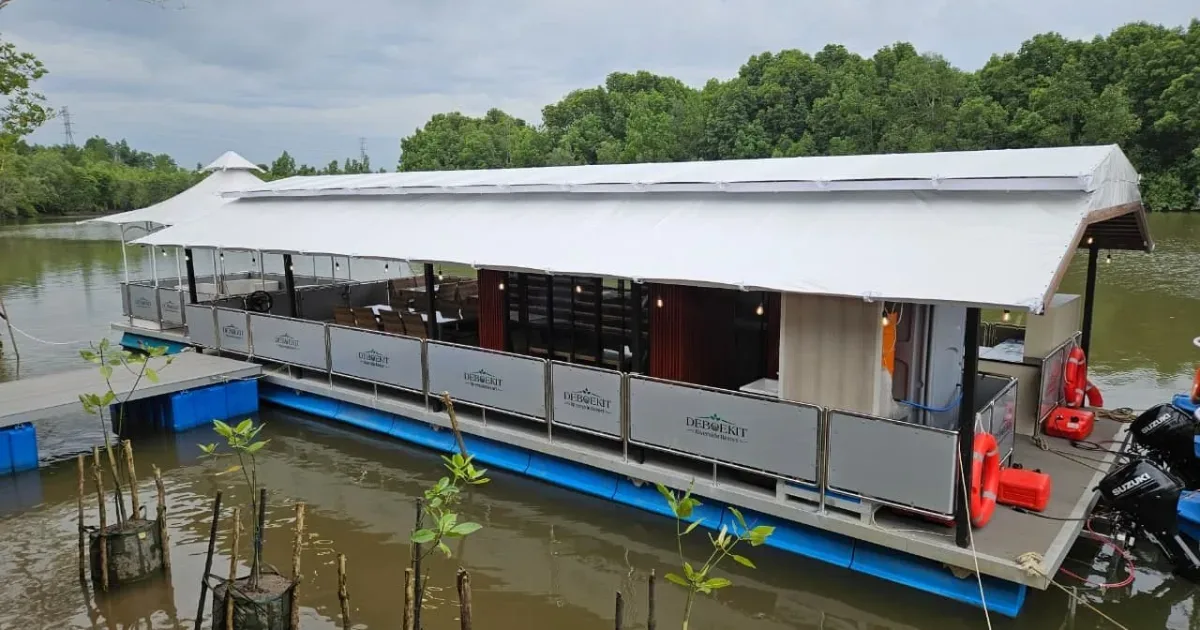
Bajau Indo built a floating restaurant for Deboekit Riverside on the Manggar River, Balikpapan. This 13 × 5 m unit can accommodate up to 30 people and features a 3 × 4 m air-conditioned VIP room. It is powered by two 20 HP outboard motors, allowing the restaurant to cruise along the river while serving guests.
This project is an example of how a food business on the water can enrich river culinary tourism. A full review is available in our article on the Bajau Indo floating restaurant on the Manggar River.
If you have a larger concept in mind, such as a two-story restaurant, the visuals on the Floating Unit Inspiration page can be a starting point for discussion.
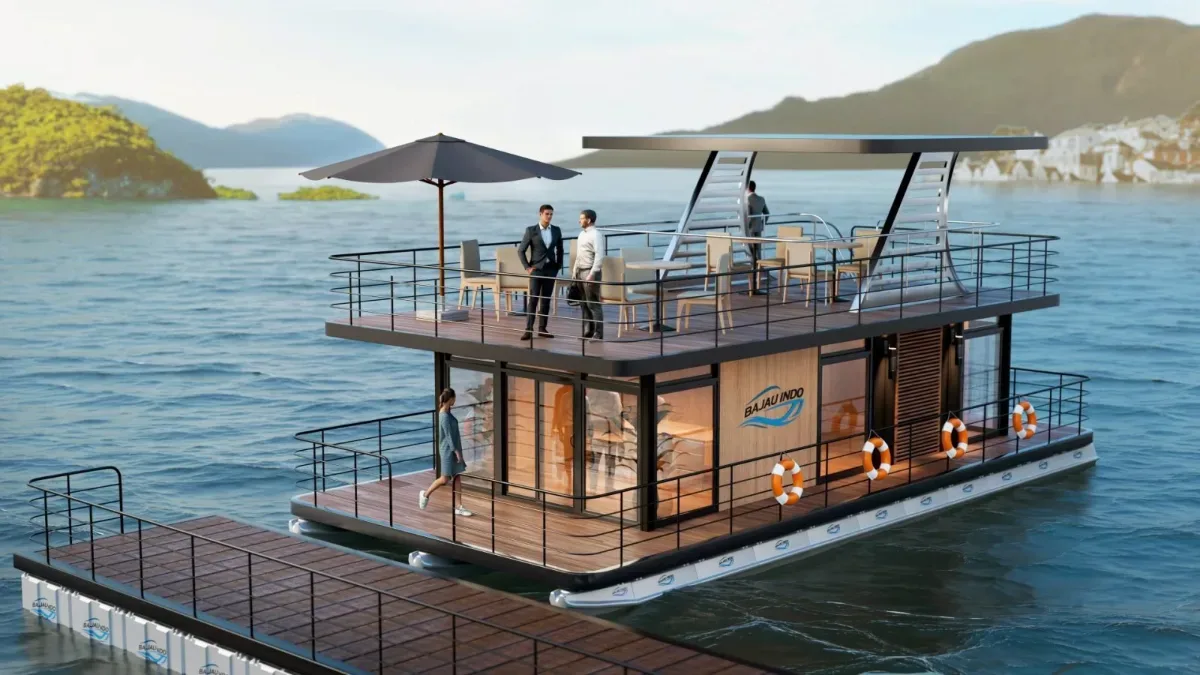
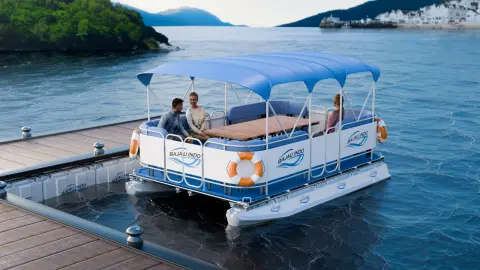
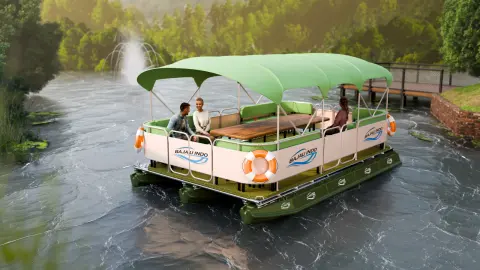
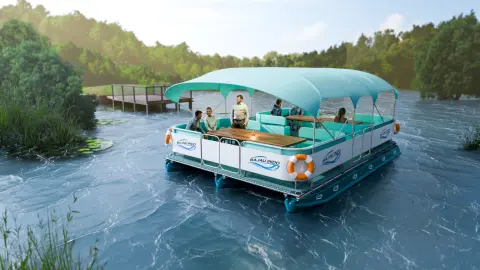
Concept illustration of a two-deck floating restaurant. Source: Bajau Indo 3D concept illustration — not a built project
Frequently Asked Questions
What capacity of floating restaurant can be built?
Capacity is calculated per project from the total load of the structure, furniture, equipment, and guests, compared with the buoyancy of the pontoon assembly. For example, the Bajau Indo floating restaurant on the Manggar River measures 13 × 5 m and accommodates up to 30 people. The size and capacity of your project are tailored after your requirements and site have been assessed.
Does a floating restaurant have to be able to cruise?
Not necessarily. A restaurant can be moored at a single point or designed to cruise the water. This choice affects the hull shape, engine requirements, mooring system, and permits, so it should be decided early in planning.
Which pontoons are used for a moving floating restaurant?
For moving units, Bajau Indo uses an assembly of Nose Pods at the front and Body Pods behind them. These pontoons, with a UV-resistant LLDPE shell and polyurethane core, are arranged to form a hull, with a frame and deck then installed on top.
Have a riverside or lakeside site and want to bring a floating restaurant to life? Send your concept, estimated number of guests, and location to marketing@bajauindo.com, or contact WhatsApp 0878-5931-4314 to start a discussion with the Bajau Indo team.
Written by
Tim Redaksi Bajau Indo
Tim Teknis & Redaksi
Tim teknis dan redaksi Bajau Indo — produsen dermaga apung, kubus apung, dan ponton modular LLDPE dari Sentul, Bogor.
Tags
Share this article: