Village Water Tourism: Developing Reservoirs and Rivers Step by Step
A guide to village water tourism with modular floating units: starting with a small dock and a boat, management by BUMDes or pokdarwis, safety and maintenance.
In many villages, the reservoir or river has long been seen only as a source of water for rice fields or as a boundary. Yet the same waters often already have tourism assets: a calm view, trees along the banks and residents who know every corner. With step-by-step planning, village water tourism can be developed without having to build large facilities straight away.
This article covers general steps for village governments, BUMDes (village-owned enterprises) and tourism awareness groups (pokdarwis) that want to use modular floating units in a gradual and measured way.
The Potential of Village Water Tourism in Reservoirs, Lakes and Rivers
Each type of village water body has a different character. A village reservoir (embung) is usually calm and limited in size, making it suitable for relaxed activities such as short boat rides or photo spots on the water. A village lake offers more space, while a village river can become a river cruise route if the current and depth allow.
Village water tourism also does not have to depend on boats. A floating platform for sitting and watching the sunset, a walkway along the mangroves or a fishing area can be a simple first attraction that is relatively easy to manage.
Before planning anything, make sure the main function of the water body is maintained. A reservoir used for irrigation or water storage, for example, needs to be coordinated with its operator so tourism activities do not interfere with that function. An overview of the role of floating infrastructure across different waters is given in the article on Indonesian water tourism and floating infrastructure.
Start Step by Step: From a Small Dock to a Village Tourist Boat
The advantage of a modular system is that facilities can be added little by little. A village does not need to prepare everything at once. An example of common stages:
- Initial stage: a small floating dock as a boat boarding point that also serves as a place to sit and take photos on the water.
- Second stage: one village tourist boat for a short circuit route, with a clear schedule and capacity.
- Later stage: dock extensions, floating walkways or additional facilities, according to visitor interest and the operator's capacity.
For the dock, the Nusa Dock module measures 150 × 100 × 40 cm per unit and can be arranged in straight, L, T or U layouts. Because it is modular, the arrangement can be extended as needs grow.
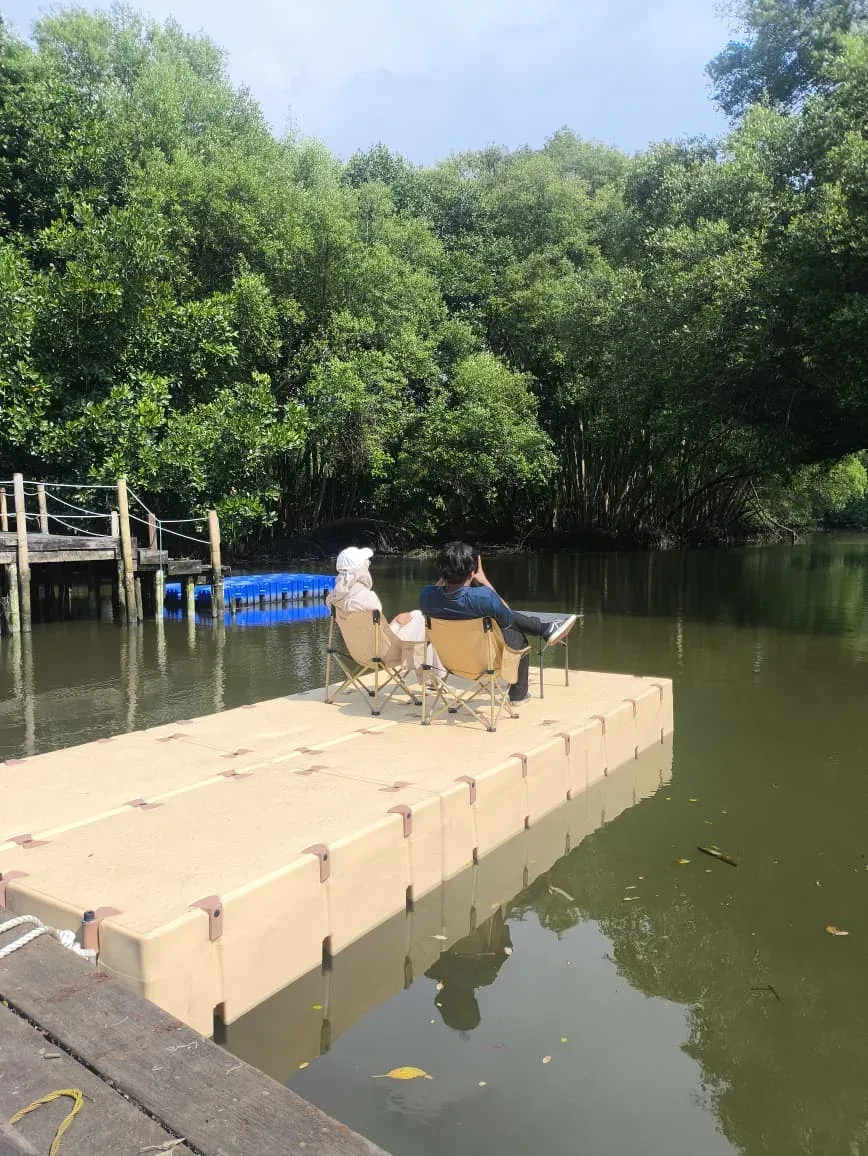
Two people relaxing on a Nusa Dock platform at the edge of a mangrove forest. Source: Bajau Indo documentation
The photo above shows how a simple floating platform can already become a place to relax at the edge of the mangroves. For a village, a similar concept can be a first step before adding a boat.
Choosing a Suitable Village Tourist Boat
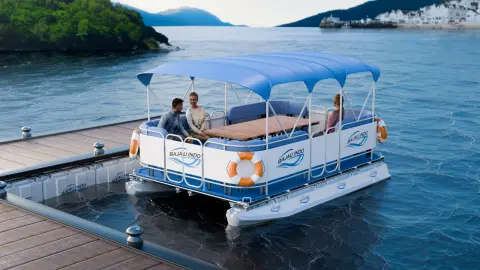
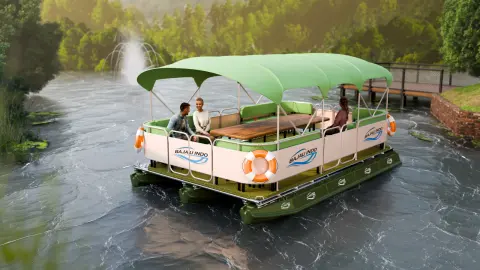
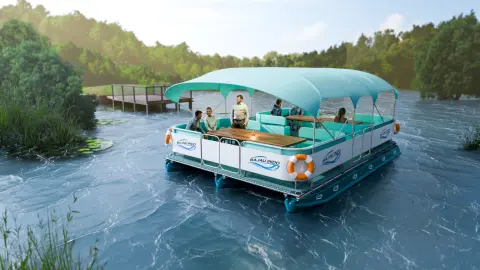
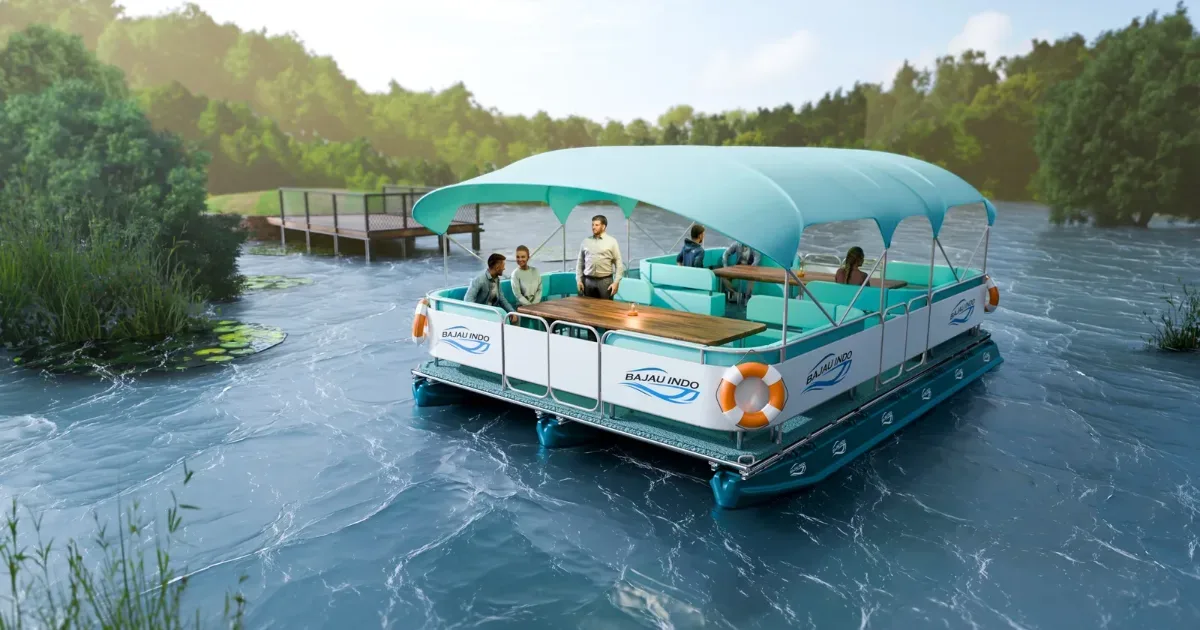
For calm village waters, a compact boat with a small capacity is usually easier to manage. The Kelimutu catamaran measures 4.6 × 3 m for 7–10 people according to the official specifications. Like the other Bajau Indo catamaran types, it uses LLDPE pontoons with polyurethane insulation, a marine-grade aluminium frame, synthetic rattan seats with water-resistant cushions, and a roof.
As an example of a compact boat already in operation, Kebun Raya Bogor uses the electric boat "Perahu Tutur Danau", measuring 3 × 4.5 m, for up to 10 passengers on Danau Gunting since December 2024. The choice of boat for a village still needs to be matched to the size of the water body, its depth and the expected number of visitors.
Management by BUMDes and Pokdarwis
Good village water tourism facilities need a ready operator. In many tourism villages, this role is taken by the BUMDes, the pokdarwis, or a partnership of both. Matters to agree on from the outset:
- Management structure: who is responsible for operations, finances and maintenance.
- Boat operators: residents trained to operate the boat and familiar with safety procedures.
- Visit rules: operating hours, capacity per trip and a ban on trips in bad weather.
- Record-keeping: visitor numbers, trips and daily checks as a basis for evaluation.
Safety, Water Cleanliness and Promotion
Safety
Life jackets for every passenger, capacity signs and staff supervising the dock area are basics that must not be skipped. Safe village water tourism will more easily earn the trust of visitors and the support of the local government.
Water cleanliness
Clean water is the main attraction. Provide bins on land, set a cleaning schedule and involve residents in keeping the river or reservoir free of rubbish.
Promotion and maintenance
Village social media, school visit packages and seasonal events can help introduce the destination. Highlight local character, such as food, crafts or traditions, so that the village water tourism has an identity distinct from other destinations. At the same time, routine maintenance of the dock and boat needs to be budgeted from the start so the facilities remain fit for use.
Frequently Asked Questions
Can a small village reservoir be fitted with a floating dock?
It can be considered, depending on the size, depth and water-level changes of the reservoir. A floating dock follows the rise and fall of the water, but the main function of the reservoir still needs to be coordinated with its operator before installation.
What is the procurement mechanism for a BUMDes or village?
The procurement mechanism follows the rules that apply to villages and BUMDes, which can change over time. It is best to consult the village facilitator or the relevant agency, then prepare the required technical data together with the supplier.
Does a village tourist boat have to be motorised?
Not necessarily. The propulsion is chosen according to the size of the water body, the route and the operator's needs. For calm waters, quiet propulsion such as an electric motor can be considered, as used in the Kebun Raya Bogor example.
Does your village have a reservoir, lake or river that you want to develop into water tourism? Send photos of the water body and an outline of your management plan to WhatsApp 0878-5931-4314 or marketing@bajauindo.com, and discuss a realistic first stage with the Bajau Indo team.
Written by
Tim Redaksi Bajau Indo
Tim Teknis & Redaksi
Tim teknis dan redaksi Bajau Indo — produsen dermaga apung, kubus apung, dan ponton modular LLDPE dari Sentul, Bogor.
Share this article: