Small Floating Docks for Ponds, Canals and Fishing Areas
A guide to small floating docks for ponds, canals, fishing spots and waterside villas: minimum requirements, Nusa Dock module layouts, mooring, access and upkeep.
Not every dock is built for ships. A fishing pond owner only needs a few square metres so visitors can sit close to the water. A housing estate on a canal wants a boarding point for small boats, while a lakeside villa needs a terrace over the water for relaxing. For needs like these, a small floating dock often makes more sense than a permanent piled structure.
This article covers minimum requirements, module layout, simple mooring, access from the bank and light maintenance, so you can draw up an initial plan before talking to a technical team.
When a Small Floating Dock Is the Right Choice
Small floating docks are generally used on calm water with limited requirements, for example:
- Pond docks: a seating area, a feeding point or access for rowing boats on a tourist pond.
- Canal docks: a boarding point for small boats in housing estates or canal tourism areas.
- Fishing docks: a fishing platform that reaches deeper water than the bank.
- Waterside villa terraces: a relaxing space that blends with the lake or mangrove view.
In general, the advantage of a floating structure is that it follows the rise and fall of the water, so the distance between the deck surface and the water stays relatively constant. Its modular nature also makes it easier to extend or reshape later. However, a small floating dock is not the answer for every condition. Waters with strong currents, large waves, or that almost dry out in the dry season need a separate assessment before a decision is made.
Minimum Requirements to Define
Even at a small scale, several things still need to be settled from the start:
- Function and number of users: how many people are usually on the dock at the same time.
- Size and shape: the length needed to reach sufficiently deep water and a width that is comfortable to walk on.
- Water conditions: the minimum depth in the dry season and the expected rise in water level during rain.
- Access from the bank: whether the pond or canal edge is flat, sloping or a vertical wall.
- Mooring points: locations where the dock can be secured safely.
- Additional fittings: any need for handrails, lights or a ladder into the water, because all of them add weight and must be included in the calculation.
Arranging Nusa Dock Modules at a Small Scale
Nusa Dock is a pontoon module whose surface serves directly as the dock floor. Its official per-unit specifications are 150 × 100 × 40 cm, a weight of 32 kg and buoyancy of 275 kg. The modules can be assembled in straight, L, T or U configurations to suit the shape of the waterway.
As a layout illustration, not a load calculation, a 6 × 2 m dock can be made from four modules lengthwise and two modules widthwise, or eight Nusa Dock units. The dock's ability to carry loads still needs to be calculated per project by the technical team, taking into account the number of users and the equipment on it.
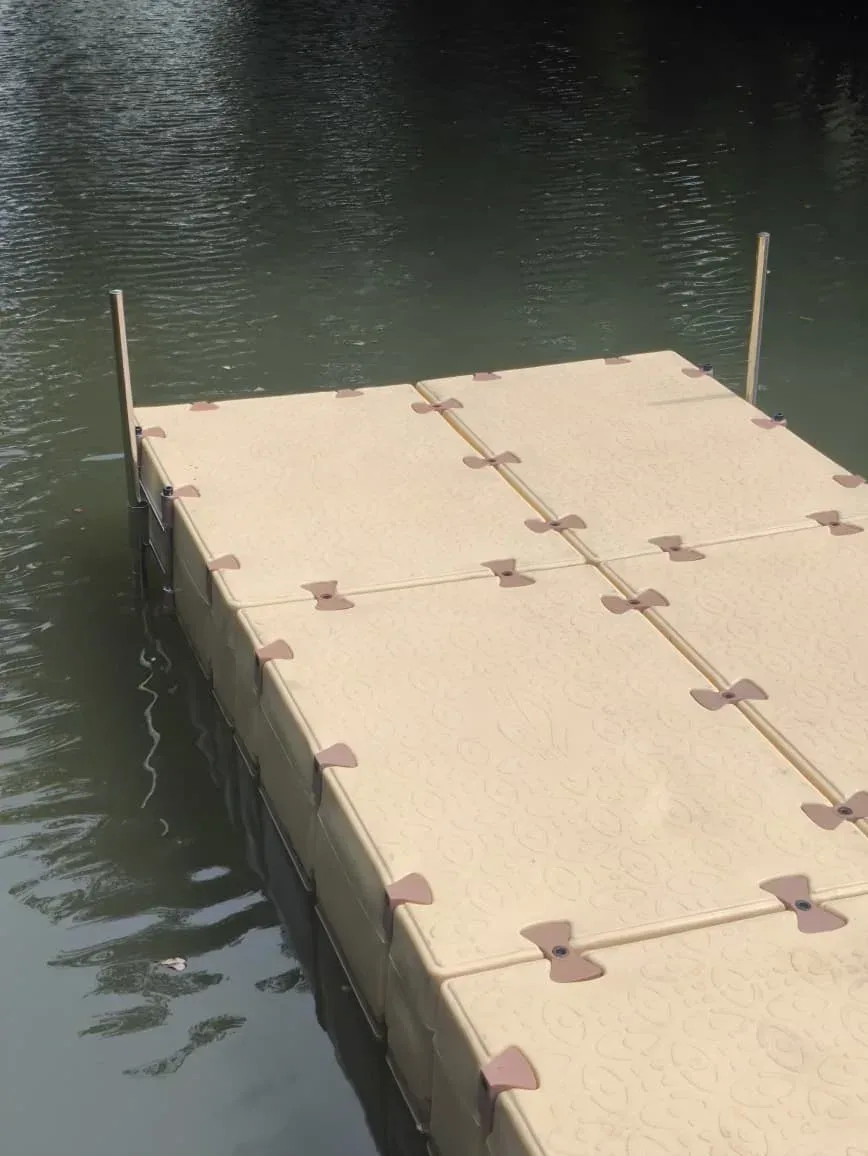
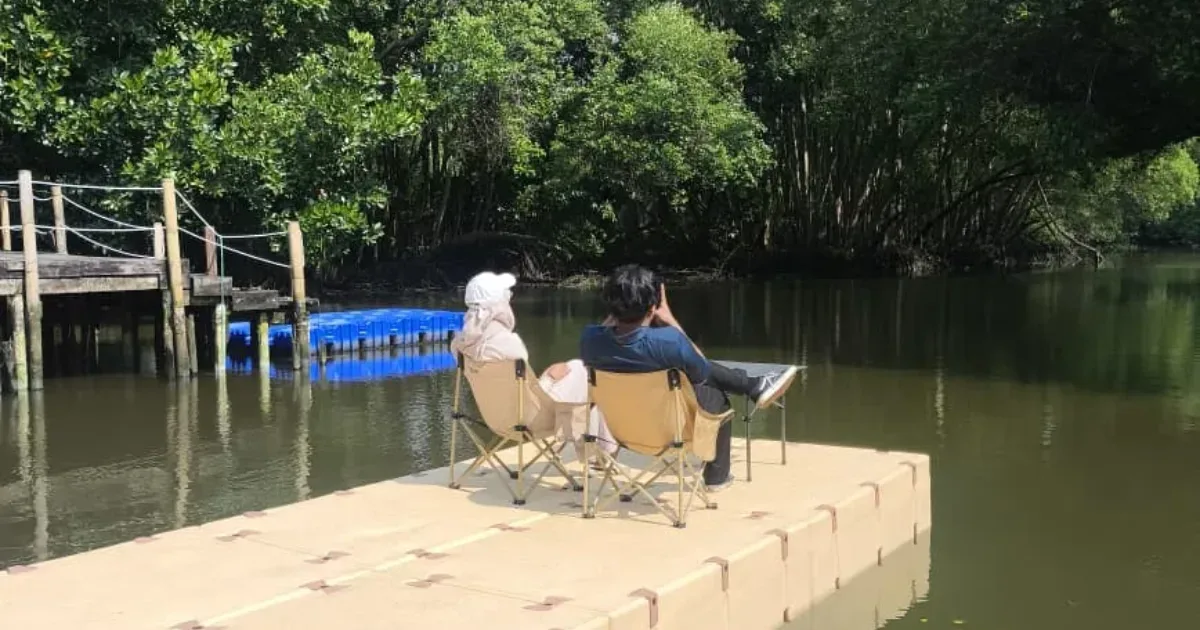
A string of cream Nusa Dock modules floating on the water with a pole at the side. Source: Bajau Indo documentation
The modules are joined with connector locks, so the string works as a single platform. L or T shapes are often used for fishing docks because they provide fishing space on several sides without extending the dock too far.
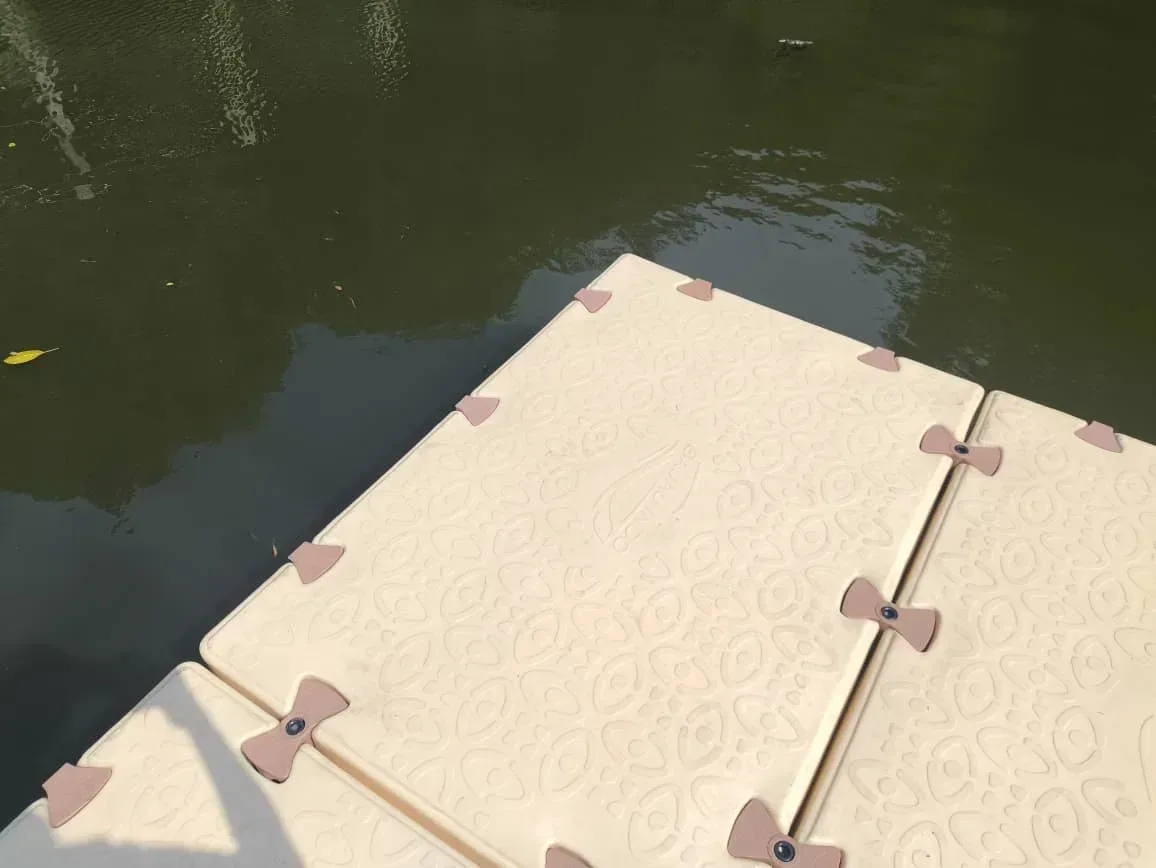
Close-up of the textured cream Nusa Dock surface and the connector locks between modules. Source: Bajau Indo documentation
Simple Mooring and Access from the Bank
A small floating dock on calm water still needs to be moored so it does not drift. In general, the common options are guide piles driven into the bed of the pond or canal, or ropes and chains tied to anchors. Guide piles let the dock move up and down vertically without shifting position. The full principles are covered in the article on floating dock mooring systems.
For access from the bank, pay attention to the height difference between the land and the deck surface. If the water level is fairly stable, the dock can be connected directly to the bank. If it changes significantly, a connecting bridge that can adjust its angle is safer. For busy fishing docks, also provide a waiting area on land so the number of people on the dock stays under control.
Light Maintenance and Sketching in the Drawing Tool
Maintaining a small dock is relatively simple, but it should be routine:
- Check the connector locks between modules and tighten any that are loose.
- Clean off moss or dirt so the surface does not become slippery.
- Check the mooring ties after heavy rain or strong wind.
- Watch for any module sitting lower than the others, as this can indicate uneven loading or a problem with the module.
Before contacting the team, you can make your own sketch in the Nusa Dock Drawing Tool. Its drag-and-drop, custom grid, unit estimate and image export features help you try out several shapes. For vegetated sites such as mangroves, the article on mangrove docks with modular floating structures can serve as an additional reference.
Frequently Asked Questions
What is the minimum size of a small floating dock?
There is no standard size. A dock for one or two people fishing can be very compact, while a dock for boarding boats needs more generous length and width. The size should be based on function and the number of users.
Can a small floating dock be installed in a shallow pond?
Yes, as long as the water depth in the dry season is still enough to keep the modules afloat. For that reason, record the pond's lowest depth before planning the dock.
Can the dock be extended later?
Yes. Because it is modular, Nusa Dock units can be added to lengthen or reshape the dock. Make sure the mooring system is also adjusted to the new size.
Already have an idea of your dock's shape? Save the sketch from the Drawing Tool, then send it with photos of the site via WhatsApp 0878-5931-4314 so the Bajau Indo team can help check the module layout and mooring requirements.
Written by
Tim Redaksi Bajau Indo
Tim Teknis & Redaksi
Tim teknis dan redaksi Bajau Indo — produsen dermaga apung, kubus apung, dan ponton modular LLDPE dari Sentul, Bogor.
Tags
Share this article: