Floating Docks for Water Sports: A Guide for Kayaks, Rowing and SUP
Planning a floating dock for water sports such as kayaking, canoeing, rowing and SUP: low deck height, safe edges, launch areas, safety equipment and maintenance.
Anyone who has tried to climb out of a kayak onto a dock that is too high knows the feeling: knees bend awkwardly, the boat drifts away, and one wrong move can end in the water. A dock that works well for motorboats is not necessarily comfortable for kayaks, canoes, rowing boats or stand up paddle boards. That is why a floating dock for water sports needs to be planned with a different logic, centred on the distance between the deck and the water surface.
This general guide is intended for managers of tourist lakes, water sports clubs, resorts and local governments that want to provide a safe boarding point for users of small craft.
Why a Floating Dock for Water Sports Needs a Specific Design
Kayak and SUP users sit or stand very close to the water. When boarding or getting off, they shift their body weight from the deck to a light craft that tips easily. The greater the height difference between the two, the harder it is to make that move steadily.
In addition, a floating dock for water sports is usually used repeatedly by many people in a single session, for example kayak classes, rowing club training or SUP rentals. This frequency means small details such as edge height, walkway width and the position of life buoys have a direct effect on how smoothly and safely operations run.
A floating dock has a basic advantage for this need: the deck rises and falls with the water level, so the distance from deck to water stays relatively consistent throughout the day and across seasons. This general principle is why floating docks are often chosen for lakes, reservoirs and rivers with changing water levels, as discussed in the article on floating docks for tourist lakes and reservoirs.
Low Deck Height and Safe Edges for Boarding
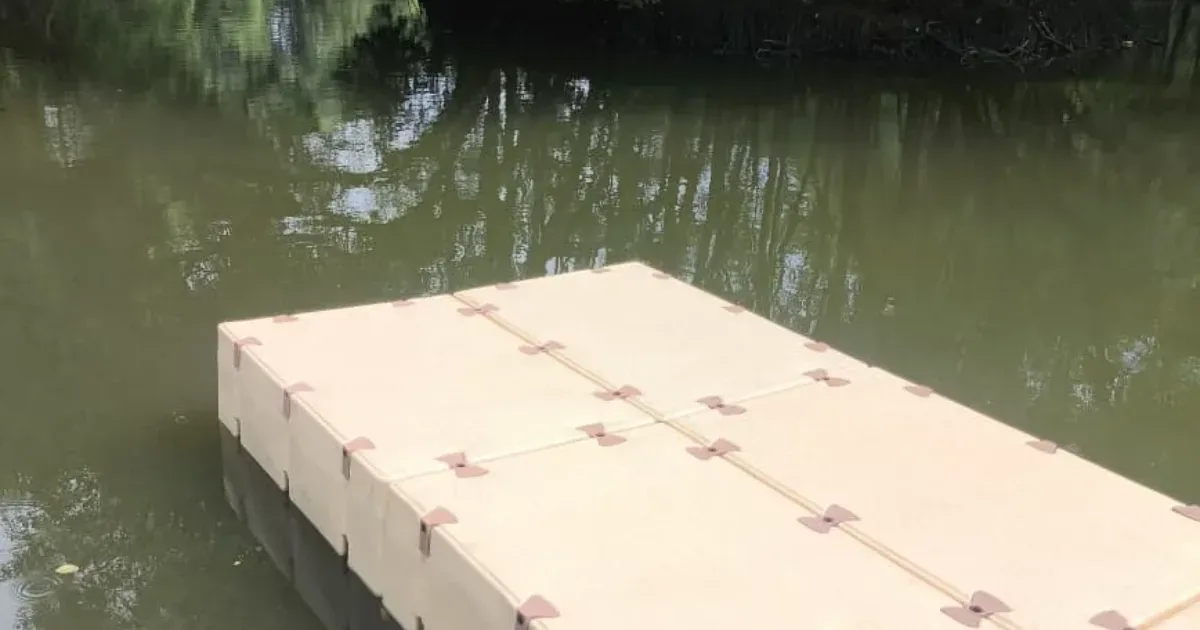
The Nusa Dock module is 40 cm high, lower than the other Bajau Indo pontoon modules. According to the official specifications, it measures 150 × 100 × 40 cm, weighs 32 kg and has a buoyancy of 275 kg per unit. This low profile helps keep the deck close to the water surface, although the actual deck height still depends on the load and configuration.
Kayak and canoe docks
Users usually sit on the edge of the dock and then slide into the cockpit. An even edge, with no sharp corners and wide enough to sit on, helps a great deal. Handholds can be added at certain points, as long as they do not obstruct the hull of the boat.
Rowing docks
Rowing boats have long oars that extend out to the sides. The dock edge should be straight and free of posts, railings or accessories on the berthing side, so the oars can pass over the deck as the boat comes alongside.
Stand up paddle
An SUP board is usually placed in the water, and the user kneels on it before standing up. A low deck with a gentle edge on the launch side makes this easier, especially for beginners.
Layout: Launch, Storage and Queuing Areas
A busy water sports dock needs a clear flow so users do not get in each other's way. In general, a good layout separates several zones:
- Launch zone: an unobstructed side of the dock for launching small boats and boards.
- Storage zone: racks or a flat area for kayaks, boards and paddles, ideally on land or on a part of the dock that is not a through route.
- Queuing and briefing zone: space for participants to wait, put on life jackets and receive instructions.
- Entry and exit route: access from land that is separate from the launch zone.
For launching small boats that are carried by hand, provide enough clear space for two people to carry a boat without crossing paths with other users.
Because Nusa Dock can be arranged in straight, L, T or U layouts, these zones can be set out to suit the shape of the bank. To try several arrangements, use the Nusa Dock Drawing Tool.
Safety Equipment and Non-Slip Surfaces
A wet deck, bare feet and users carrying equipment are a combination that needs to be anticipated. The deck surface should be textured so it is not slippery, and it should be kept clean of moss or deposits.
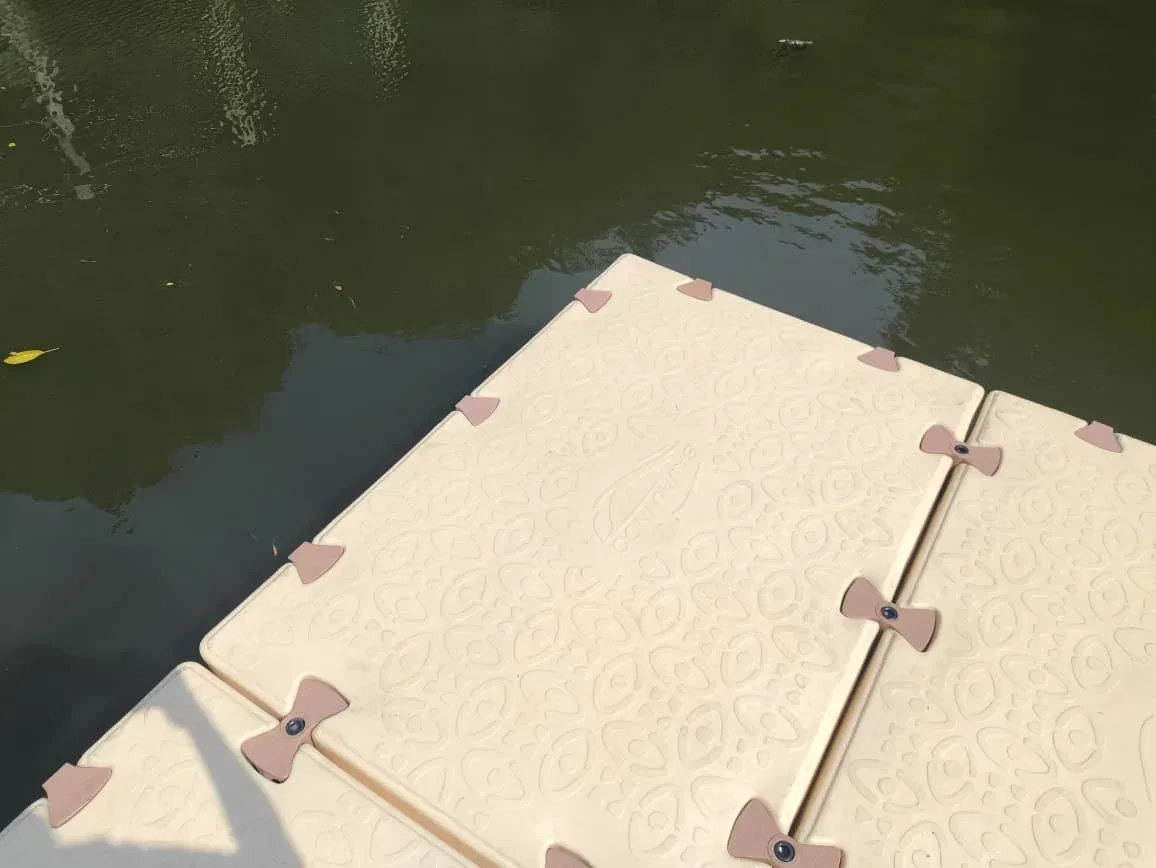
Close-up of the textured Nusa Dock surface and the inter-module connection locks. Source: Bajau Indo documentation
Safety equipment commonly provided includes signs with usage rules, ring buoys within easy reach, throw lines, a life jacket station and markers for the boundaries of the activity area. Railings can still be installed on the sides that are not launch zones. A more detailed guide is available in the article on floating dock safety.
Routine maintenance
Check the inter-module connection locks, the condition of the mooring and the cleanliness of the surface regularly. After heavy rain or strong winds, carry out another check before the dock is used again. On a floating dock for water sports, also pay attention to the launch edge, as this part is often rubbed by boats and boards.
Frequently Asked Questions
Does a floating dock for water sports need railings on every side?
Not necessarily. The launch side actually needs to be unobstructed so boats and boards can come alongside. Other sides that are not used for boarding can be fitted with railings according to user safety needs.
Is Nusa Dock also suitable for motorboats?
According to its product page, Nusa Dock is intended for a range of dock applications, including marinas, yacht clubs and floating resorts. Its suitability for a particular boat needs to be calculated by the engineering team based on the boat size, load and water conditions.
What if the lake water level changes often?
A floating dock follows changes in water level, so the deck height relative to the water is relatively maintained. What needs planning is the mooring system and access from land, such as a gangway, so it stays safe at both high and low water.
Want to provide a comfortable boarding point for kayaks, rowing boats or SUP on your waters? Tell us the type of activity and the expected number of users via marketing@bajauindo.com or WhatsApp 0878-5931-4314 to discuss a suitable dock layout.
Written by
Tim Redaksi Bajau Indo
Tim Teknis & Redaksi
Tim teknis dan redaksi Bajau Indo — produsen dermaga apung, kubus apung, dan ponton modular LLDPE dari Sentul, Bogor.
Tags
Share this article: