Mangrove Docks: Educational Tourism Access with Modular Floating Structures
Floating mangrove docks provide educational tourism access with few permanent structures. Learn how to plan one and see Nusa Dock at TWA Mangrove PIK.
Mangrove area managers often face the same dilemma. Visitors need safe access to see the ecosystem up close, yet the area is protected precisely because its roots, mud and water flows are easily disturbed. A carefully designed mangrove dock can offer a middle ground: opening space for educational tourism without adding excessive permanent structures inside the area.
This article covers the rationale, planning and an example of a floating dock installation at TWA Mangrove PIK.
Challenges of Building Access in Mangrove Areas
In general, mangrove ecosystems sit in the transition zone between land and sea. The water level changes with the tides, the bottom is muddy, and the vegetation grows densely. That is why building a mangrove dock cannot be treated the same as building a footpath on land.
Common challenges include:
Changes in water level that can leave a fixed dock deck feeling too high at low tide or flooded at high tide.
A muddy bottom that requires more intensive foundation work if the dock uses piles.
Limited access for heavy equipment, because entry routes are narrow and the vegetation must be protected.
Area regulations that generally restrict the type and size of buildings in conservation areas.
Why Floating Docks Suit Mangrove Tourism
A floating dock works on a simple principle: the platform floats and moves up and down with the water surface. For mangrove tourism, this offers several practical advantages.
First, the dock deck stays relatively level with the water surface, so visitors can board and leave boats or observe the vegetation from a consistent height. Second, the need for permanent structures in the water can be reduced, because the platform only needs to be held in place by a mooring and anchoring system suited to site conditions. Third, a modular system is assembled from small units that can be transported without large heavy equipment and then put together at the water's edge.
If the visitor route needs to change, modular units are generally easier to dismantle and rearrange than concrete structures. A broader explanation of this concept is available in the article why floating docks are the key to flexibility.
Example Installation: Nusa Dock at TWA Mangrove PIK
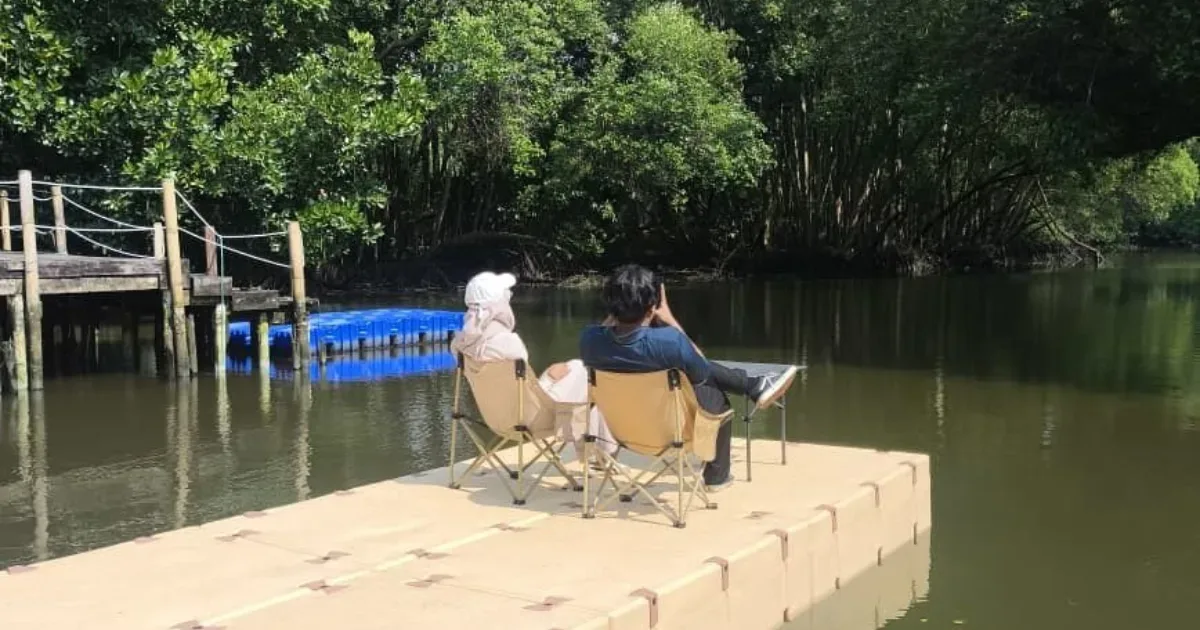
One of Bajau Indo's projects in a mangrove area is the Nusa Dock at the PIK Mangrove Nature Tourism Park (TWA Mangrove PIK). The cream-colored platform is made up of interconnected Nusa Dock modules floating on the area's waters.
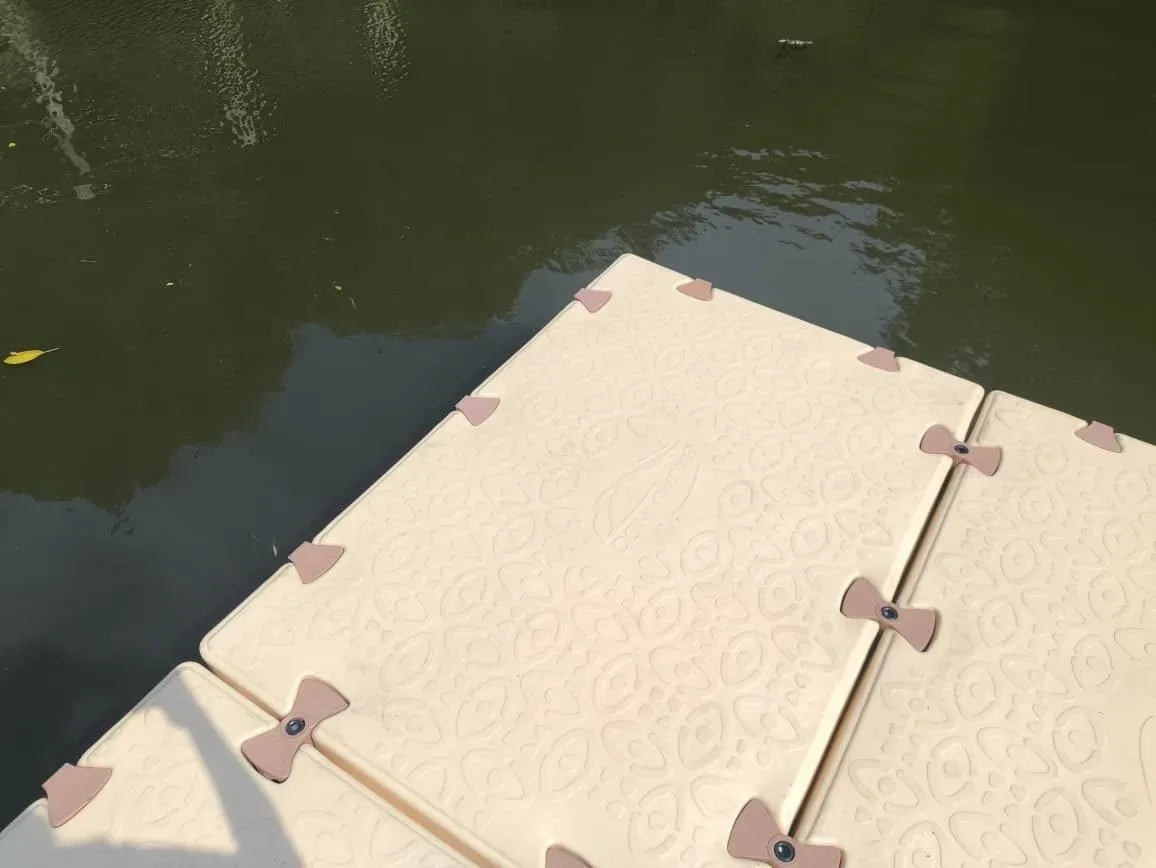
Overall view of the Nusa Dock platform at TWA Mangrove PIK. Source: Bajau Indo documentation
According to the official specifications, one Nusa Dock unit measures 150 × 100 × 40 cm, weighs 32 kg and has a buoyancy of 275 kg per unit. The units can be arranged in straight, L, T or U configurations, so the dock's shape can adapt to the space available between the vegetation. The overall capacity of the dock is still calculated per project based on area, load and water conditions.
You can see documentation of other work on the Bajau Indo project portfolio page.
What to Consider Before Building an Ecotourism Dock
An ecotourism dock in a conservation area should be planned together with the area manager from the outset. The following summarizes the questions generally discussed at the planning stage.
Function — Key question: Is the dock for boat mooring, an observation point, or a group education area?
Water conditions — Key question: How large is the tidal range and what are the currents like at the site?
Bottom conditions — Key question: Is the bottom muddy, sandy or mixed? This affects the choice of anchor.
Number of visitors — Key question: How many people are expected to be on the dock at the same time?
Land access — Key question: How will the units be brought to the water's edge without damaging the vegetation?
Permits — Key question: Which agencies need to be involved for activities in a conservation area?
The answers to these questions will determine the number of units, the layout and the mooring system of your mangrove dock. To create an initial sketch, try the Nusa Dock floating dock Drawing Tool, which offers drag-and-drop unit arrangement, a custom grid, unit count estimates and image export.
Operational Tips for Docks in Conservation Areas
Once installed, a dock in a conservation area needs to be managed so that it stays safe and in line with the area's protection goals. Some common practices that can be applied:
Set a limit on the number of visitors on the dock and put up easy-to-read information signs.
Routinely inspect the connections between units, the mooring lines and the anchors, especially after high tides or bad weather.
Clear away waste caught around the platform so it does not drift into the gaps between mangrove roots.
Use the dock as an education point, for example with interpretation boards about the role of mangroves for coastal areas.
With consistent management, a mangrove dock can become a learning facility that brings visitors closer to efforts to protect coastal ecosystems.
Frequently Asked Questions
Can a floating dock be installed in muddy mangrove waters?
Generally yes, because a floating platform does not rest directly on the bottom. What needs to be adapted is the mooring and anchoring system, which is chosen based on a survey of bottom conditions and tides at the site.
What is the buoyancy of one Nusa Dock unit?
According to the official specifications, one Nusa Dock unit has a buoyancy of 275 kg and weighs 32 kg per unit. The overall capacity of the dock is calculated per project, taking into account area, frame, number of visitors and site conditions.
Can a modular mangrove dock be expanded later?
The modular system allows units to be added to expand or change the dock layout. Changes should still be discussed with the technical team and the area manager so that the mooring system and permits are adjusted accordingly.
Planning tourism access in a mangrove or conservation area? Discuss your site's needs with the Bajau Indo team via WhatsApp 0878-5931-4314 or email marketing@bajauindo.com. Include photos of the site and an estimated number of visitors so the team can provide more accurate initial input.
Written by
Tim Redaksi Bajau Indo
Tim Teknis & Redaksi
Tim teknis dan redaksi Bajau Indo — produsen dermaga apung, kubus apung, dan ponton modular LLDPE dari Sentul, Bogor.
Share this article: