Industrial Pond Dredging: Restoring Settling Ponds and WWTP Ponds
Industrial pond dredging from a floating platform: why pond capacity shrinks, choosing a suction system, dewatering, safety, and the data to prepare.
The pond is still full of water and looks normal from the bank. Yet the water leaving the far end is getting murkier, and during heavy rain the surface quickly rises towards the top of the embankment. The problem is hidden below the surface: sediment has filled much of the pond's volume. This is where industrial pond dredging comes in, restoring the function of settling ponds, retention ponds and treatment ponds in industrial estates, mines and wastewater treatment plants (WWTP).
This article covers why pond capacity shrinks, the advantages of working from a floating platform, choosing a suction system, dewatering, and the data to prepare before work begins.
Why Industrial Pond Capacity Keeps Shrinking
A settling pond is designed to hold water long enough for solid particles to sink to the bottom. Precisely because it works well, the pond slowly fills with industrial sludge, sand or other fine material. In general, as the effective volume shrinks, the water's residence time in the pond also gets shorter and particles leave before they have time to settle.
Common symptoms include:
- Murkier outflow compared with when the pond was last cleaned.
- Water level rising quickly during rain, especially in retention ponds.
- Sediment islands appearing at the surface, usually near the inlet.
- Lower WWTP pond performance because the space for the next process stage is shrinking.
On mining sites, runoff from open areas can carry large amounts of material into the pond. Meanwhile, a shallow retention pond loses its ability to hold rainwater, increasing the risk of overflow into the surrounding environment. For that reason, industrial pond dredging should be scheduled based on monitoring rather than waiting for problems to appear.
The Advantages of Industrial Pond Dredging from a Floating Platform
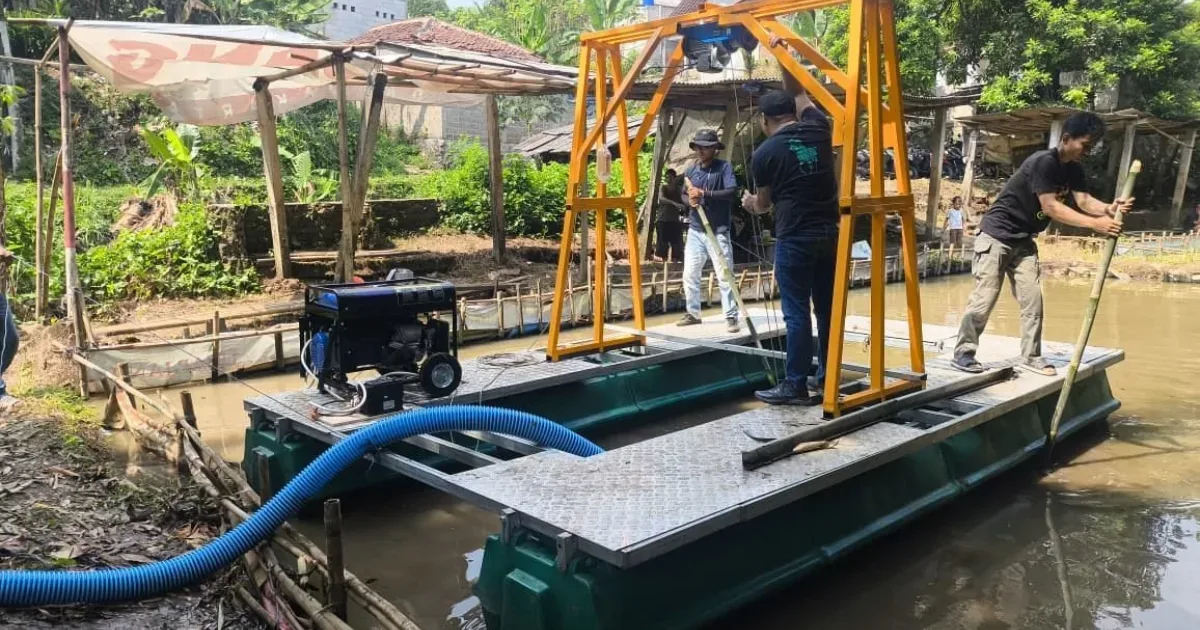
Conventional methods often require the pond to be drained before heavy equipment can enter. For estates that operate continuously, this step can disrupt the process. Industrial pond dredging from a floating platform works directly from the water surface, so in general the pond does not need to be emptied and the work can be done in stages, zone by zone. In general, it works like this: the unit is positioned in the zone to be dredged, the pump sucks sediment from the bottom, and the material is pumped through a pipe to a containment site or a dewatering stage. Once one zone is finished, the platform is moved to the next.
A floating platform also does not need heavy-equipment access along pond banks that are often soft or narrow. The Bajauindo Dredger uses a suction-pump system on a stable pontoon platform, with applications that include industrial estates. In the Bajau Indo product line, the Modular Dredger / Dewatering Boat is a 3 × 5 m modular platform that integrates pumps, dredging and dewatering, with work locations that include ponds, retention ponds and water treatment plants. Documentation of the floating dredger project in Bogor can be found on the Bajau Indo projects page.
Choosing the Right Suction System
The character of sediment in industrial ponds can vary greatly from site to site. For that reason, the system should be chosen based on material samples.
Plain suction
This system sucks up sediment directly with a simple, efficient flow. It suits mud, sand and fine sediment, for example deposits that have formed recently in a settling pond.
Double crusher
This system uses a double crusher and agitator to break up compacted sediment before suction. It is effective for mud, sand and hard deposits, for example material that has settled and compacted over a long time, with more stable operation.
If the pond contains a mix of fine and compacted deposits, discuss with the technical team whether one system is enough or whether the work should be divided by zone.
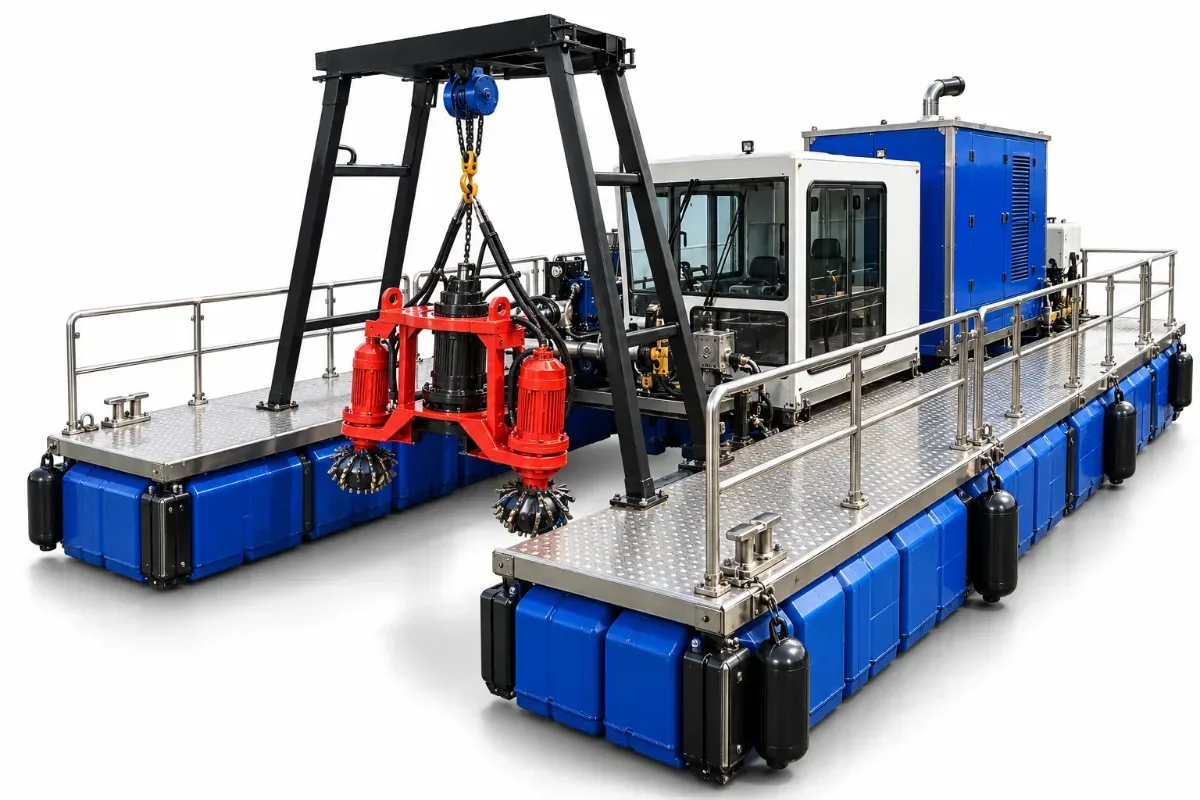
Bajauindo Dredger product visual with two red crusher pumps on a gantry, an operator cabin and a railed deck on a pontoon platform. Source: Bajau Indo product visual (illustration)
Dewatering and Handling Industrial Sludge
Dredged material usually still contains a lot of water. The dewatering stage separates water from solids, reducing the volume that needs to be transported and making the material easier to handle. This principle is also discussed in the article on sediment management in reservoirs and retention ponds.
For WWTP and process ponds, treat the sludge with care. Sludge from industrial activity may require testing and handling in line with applicable environmental regulations before it is disposed of or reused. Coordinate this with the estate's environmental officer from the planning stage.
Safety and the Data to Prepare
Work in industrial ponds must follow the estate's occupational health and safety procedures, including work permits, personal protective equipment, life jackets for operators and restricted access around the work area. To keep the technical discussion efficient, prepare the following data:
- Pond area, shape and estimated depth.
- Estimated sediment thickness and material samples.
- Pond function: settling, retention or part of a WWTP.
- Access to the pond bank and a candidate site for containing dredged material.
- Utilities available on site and the estate's operating hours.
Frequently Asked Questions
Can industrial pond dredging be done without stopping operations?
In many cases, yes. Because the work is done from a floating platform, the pond does not need to be drained and the work can be divided into zones. Feasibility still depends on the pond design and the process flow on the estate.
How do I know a pond needs dredging?
Common signs are increasingly murky outflow, the water level rising quickly during rain, or sediment starting to appear at the surface. Regular depth measurements give a clearer picture of sediment thickness.
What happens to the dredged sludge?
The sludge usually goes through a dewatering stage to reduce its water content. After that, it is handled according to test results and the environmental regulations that apply to the estate.
Is the settling pond or WWTP pond on your estate getting shallow? Send photos of the pond, its approximate size and the type of sediment via WhatsApp 0878-5931-4314 or marketing@bajauindo.com for an initial discussion with the Bajau Indo team.
Written by
Tim Redaksi Bajau Indo
Tim Teknis & Redaksi
Tim teknis dan redaksi Bajau Indo — produsen dermaga apung, kubus apung, dan ponton modular LLDPE dari Sentul, Bogor.
Tags
Share this article: