Pontoon Conveyor Platforms: Mounting Material-Handling Equipment on the Water
A pontoon conveyor platform combines rows of Nose Pods and Body Pods, a grid frame and a conveyor mounting so that material can be handled stably on the water.
Moving material on the water is never as simple as on land. There is no stationary working floor, every new load shifts the balance, and heavy equipment has to sit on something that constantly follows the movement of the water. For jobs such as lifting floating waste, transferring dredged material or handling bulk material, many operators are starting to consider a pontoon conveyor platform: a modular floating platform designed as a mounting for conveyors and material-handling equipment.
This article covers the general principles of putting such a platform together, from the pontoon rows, grid frame and conveyor mounting to the assembly flow from workshop to site. The final figures are still calculated per project by the engineering team.
When Is a Pontoon Conveyor Platform Needed?
In general, a pontoon conveyor platform is relevant when material has to be moved repeatedly in waters that heavy equipment cannot reach from land. Some common situations:
- Handling waste and aquatic weeds: an inclined conveyor lifts waste or water hyacinth from the water surface onto the deck or to the bank.
- Dredged material: sediment that has been lifted needs to be transferred to a barge, dewatering bags or an unloading point.
- Waterside project logistics: moving bulk material at construction sites, reservoirs or aquaculture areas.
- Multipurpose floating work platforms: mountings for control panels or other equipment that needs maintenance access.
For platforms focused on pumps and utilities, see the article on utility pontoons for pumps and equipment. Here, the focus is on moving equipment and material that changes position.
Rows of Nose Pods and Body Pods as the Floating Base
Pontoons for material-handling equipment are usually arranged in several parallel rows. Each row starts with a Nose Pod at the front, followed by Body Pods behind it. According to the official specifications, the Nose Pod measures 100 × 82 × 75 cm with a buoyancy of 130 kg per unit, while the Body Pod measures 125 × 82 × 75 cm with a buoyancy of 230 kg per unit.
The pontoon shell is LLDPE with an 8 mm wall thickness, and the core is CFC-free polyurethane. The number of rows and the length of each row depend on the platform width, the equipment weight, the weight of material that will sit on the deck, and the desired buoyancy reserve. Because the Nose Pod is designed as the front element of mobile floating units, this arrangement also suits platforms that occasionally need to be towed to another work point.
A Grid Frame to Spread Equipment Loads
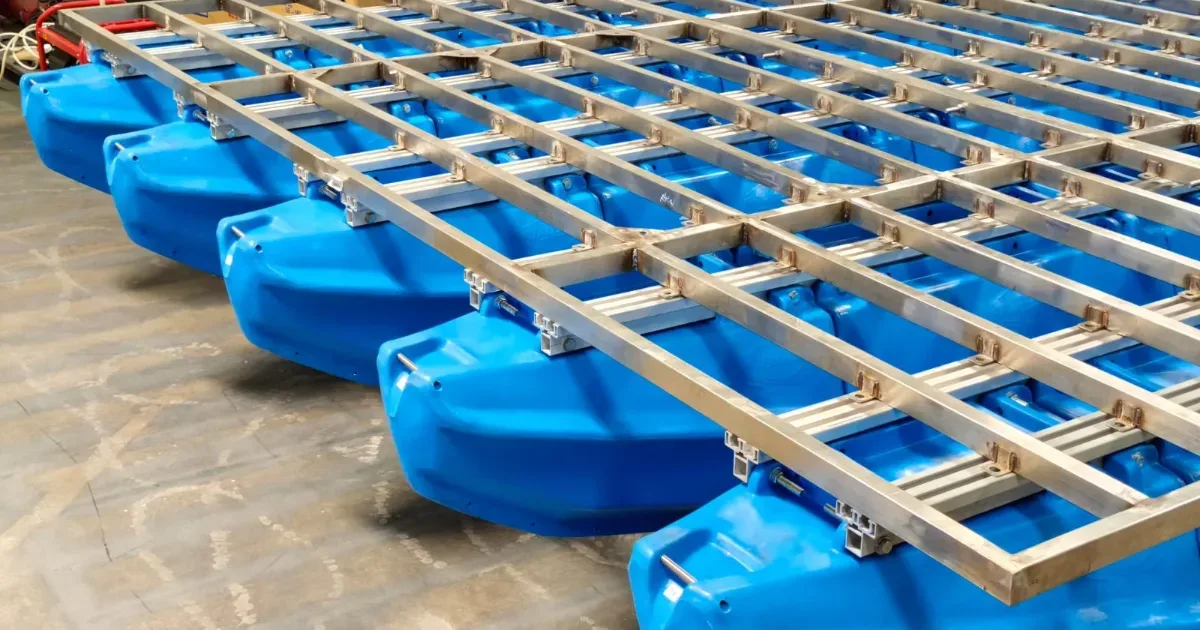
The conveyor, motor and supporting structure create concentrated loads at a few points. Without a load-spreading structure, those loads are carried only by the pontoons directly beneath them. That is why, on a pontoon conveyor platform, a grid-pattern frame is installed on top of the pontoon rows, tying all rows into a single unit and distributing the load across more pontoons.
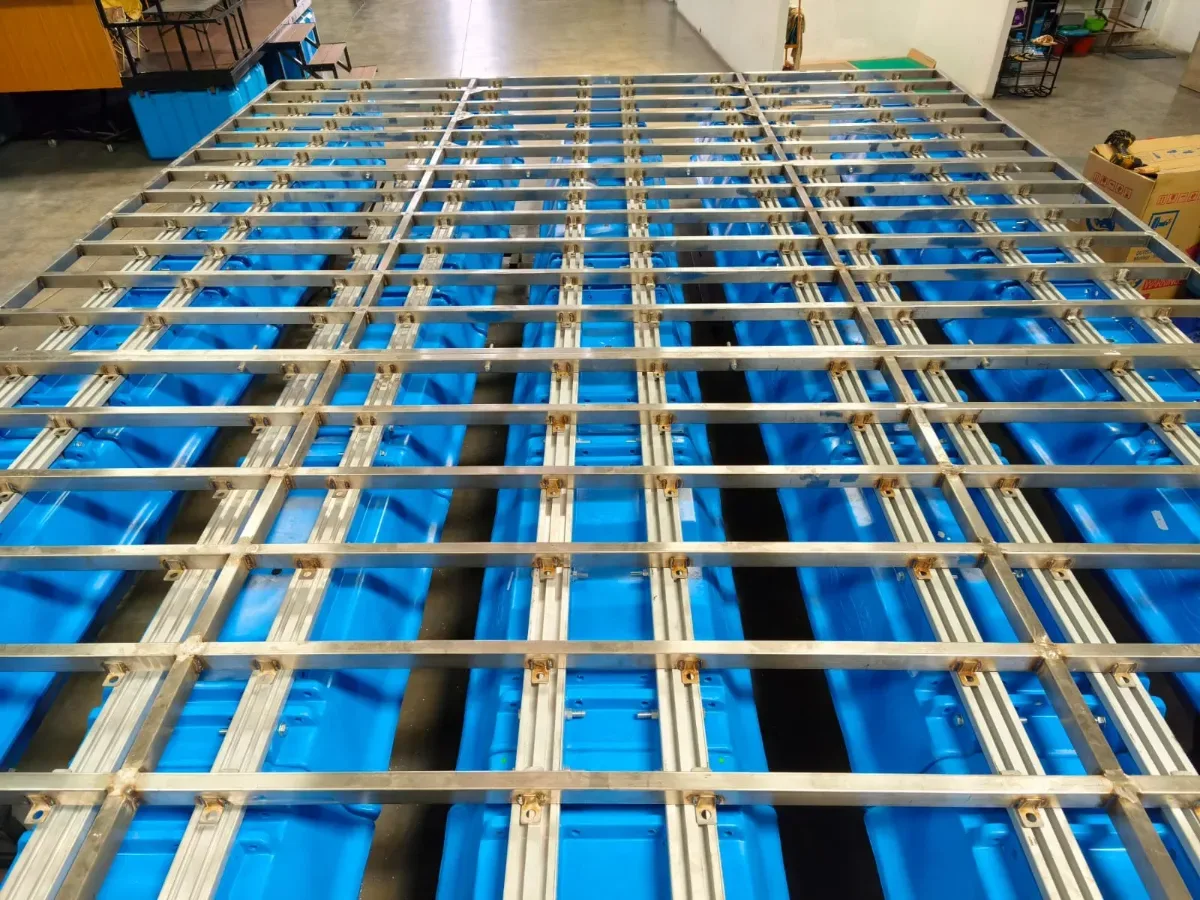
Grid-pattern aluminium frame on rows of blue pontoons, seen from above, during assembly in the workshop. Source: Bajau Indo documentation
The frame can be made of aluminium or galvanised steel, depending on strength requirements, water conditions and budget. Points to consider at the design stage:
- the spacing of the grid members is matched to the positions of the conveyor legs and equipment;
- equipment mounting points should fall where frame members meet, not in the middle of a span;
- frame-to-pontoon connections must be easy to inspect and retighten;
- a walkway is left clear for operators to carry out inspection and maintenance.
Conveyor Mounting and the Balance of a Floating Work Platform
On a pontoon conveyor platform, the conveyor faces a particular challenge because its load is not static. Material enters at one end, moves, and then piles up at another point. In general, three aspects of balance need to be calculated.
Centre of gravity of the equipment
An inclined conveyor projecting forward shifts the centre of gravity towards the bow. The positions of the motor, panel and collection bin are usually arranged to offset it so the platform stays level.
Shifting material loads
As the collection bin fills, the weight in that area increases little by little. The design needs to account for both empty and full conditions, as well as the unloading sequence, so the platform does not tilt excessively.
Vibration and dynamic forces
The motor and conveyor belt create vibration. Sturdy mountings and locking bolts that are checked regularly help keep connections tight.
From Workshop to Site: The Assembly Flow
A pontoon conveyor platform is usually assembled and checked in the workshop first, then shipped in sections to be reassembled near the water. The flow, in broad terms:
- arranging the rows of Nose Pods and Body Pods according to the working drawings;
- installing the grid frame and checking that it is level;
- installing the conveyor mounting and supporting equipment;
- reassembly on site, deck installation, then launching and functional testing.
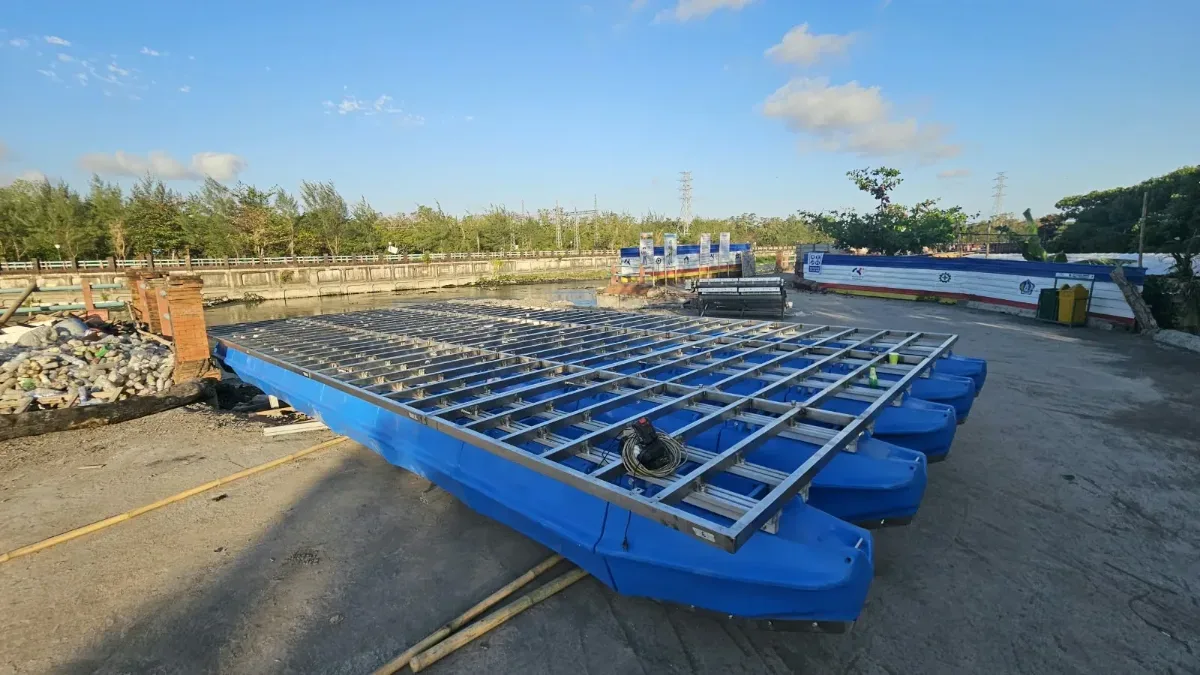
Blue pontoon platform with a grid frame in an open area near the water, ready for decking. Source: Bajau Indo documentation
One example in the Bajau Indo portfolio is the "Pontoon 7 Ton + Conveyor" project in Badung, Bali (2026), which uses rows of Nose Pods and Body Pods with a grid frame. Other projects can be seen on the Bajau Indo project portfolio page.
Frequently Asked Questions
Can a pontoon conveyor platform be moved to another location?
Because it is built from pontoon modules and a connected frame, the platform can in principle be dismantled and reassembled. How easy this is depends on the platform size, the type of connections and road access to the water. This is best discussed from the design stage.
How many pontoons are needed for one conveyor?
The number cannot be determined without data on the weight of the conveyor, supporting equipment, material on deck and platform dimensions. For an initial idea of dimensions and unit count, you can try the platform pontoon configurator, and the result is then verified by the engineering team.
Does the frame have to be aluminium?
Not necessarily. Both aluminium and galvanised frames can be used, with different trade-offs in weight, corrosion resistance and budget. The final choice should follow the water conditions and the design load.
Planning to install a conveyor or material-handling equipment on the water? Send a site sketch, the estimated equipment weight and the type of material to be handled to WhatsApp 0878-5931-4314 or marketing@bajauindo.com, so the Bajau Indo team can help develop a suitable platform concept.
Written by
Tim Redaksi Bajau Indo
Tim Teknis & Redaksi
Tim teknis dan redaksi Bajau Indo — produsen dermaga apung, kubus apung, dan ponton modular LLDPE dari Sentul, Bogor.
Tags
Share this article: