Floating Houses for Tourism: Overwater Villa Concepts and Technical Considerations
Planning a floating house or villa for tourism? Learn the concepts and key considerations: building load, utilities, mooring systems, and permits.
Many resort operators on lakeshores or coastlines have limited land, while their main views are actually over the water. That raises a question: can rooms or villas be placed directly on the water? The floating house concept for tourism answers this need by offering a stay experience that differs from land-based accommodation.
This article discusses various overwater tourism accommodation concepts and the technical considerations to understand before turning the idea into reality. All visuals in this article are concept illustrations, not built projects.
From Raft Houses to Modern Floating Villas
Living on the water is nothing new in Indonesia. In several regions, communities have long known raft houses, or rumah lanting, floating on rivers. The modern floating villa concept continues this idea but with a different function: serving as tourist accommodation that meets guest comfort standards.
The main difference lies in planning. Guest villas require proper calculation of loads, sanitation facilities, electricity, and access, so they need to be designed as a complete system.
Overwater Tourism Accommodation Concepts
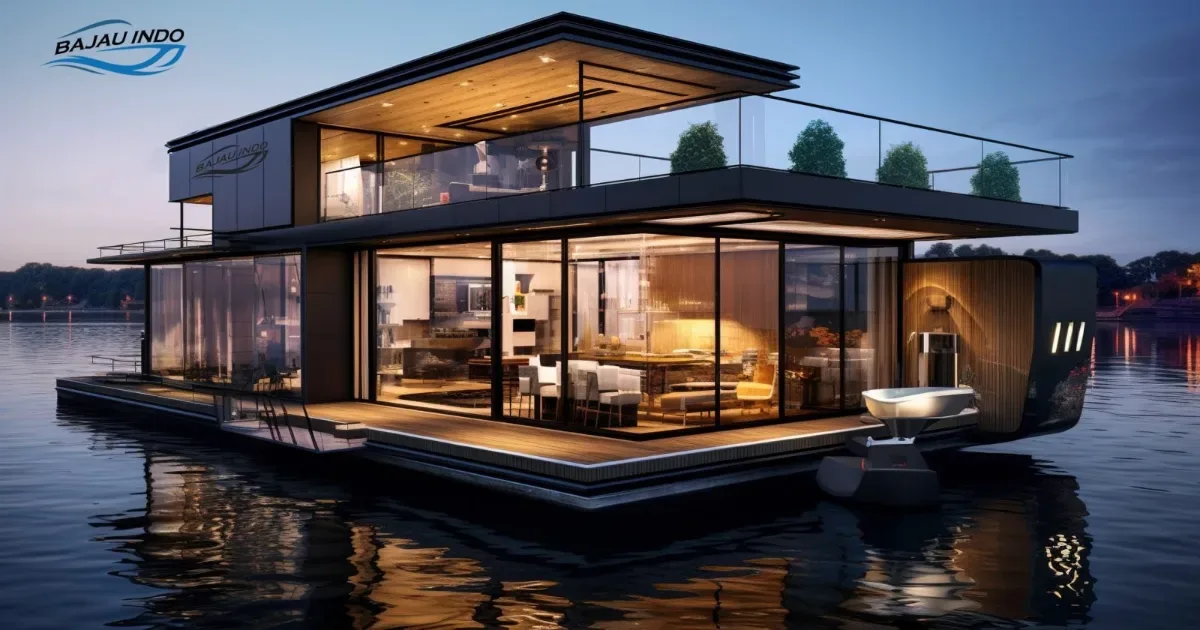
Bajau Indo's Floating Unit Inspiration gallery contains a number of 3D model visualisations for overwater tourism accommodation. Some concepts that can serve as a starting point for discussion include:
Floating villa: a one- or two-storey guest unit with a terrace facing the water.
Floating cottage: a more compact unit for tourism areas with many rooms.
Floating glamping: cabins or tents on floating platforms connected by walkways.
Floating resort: a combination of several accommodation units, public areas, and a dock within one complex.
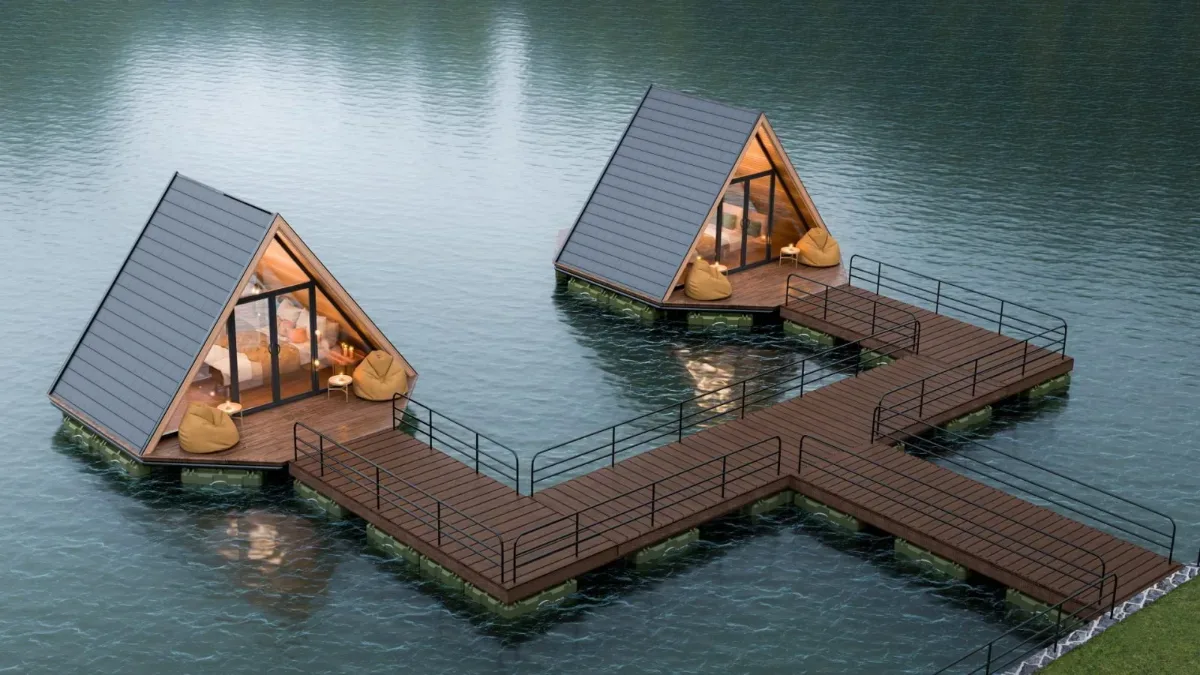
Visualisation of a floating glamping concept with A-frame cabins. Source: Bajau Indo 3D concept illustration — not a built project
The floating glamping concept often appeals to operators who want to start on a small scale. Lightweight cabin units are generally simpler to plan than two-storey villas, although they still require the same technical study.
Technical Considerations Before Building a Floating House
Building load
The floating platform must support the weight of the building, furniture, water tanks, equipment, and occupants. Load distribution also matters; load concentrated on one side can cause the platform to tilt. In general, lightweight building materials are easier for a floating platform to accommodate than heavy materials such as brick walls. Pontoon and frame requirements for a floating house are always calculated per project based on the building design.
Utilities and sanitation
Clean water, electricity, and waste management need to be planned from the outset. In general, waste from overwater accommodation must not be discharged directly into the water, so a holding or treatment system that complies with local regulations is required.
Mooring system and access
A floating house must stay in position when wind, currents, or the water level change. The mooring and anchoring system is selected according to site conditions. Access from land, whether via a dock or a connecting bridge, also needs to be designed to be safe for guests.
Permits
Using water space for tourist accommodation generally requires permits from the relevant authorities. Make sure spatial planning, environmental, and tourism business aspects are consulted on from the concept stage.
The Role of Modular Pontoons in Floating Villa Concepts
According to official product information, Nusa Dock is intended for applications including marinas and floating resorts, with a buoyancy of 275 kg per unit. Meanwhile, Block Pod has a larger deck area and a buoyancy of 375 kg per unit, with applications that include marine tourism.
Bajau Indo's portfolio does not include any built floating villas. However, functional buildings on pontoons have been delivered in other forms, such as the floating restaurant on the Manggar River, Balikpapan and a floating spa in Balikpapan. These examples show that roofed spaces on the water can be planned with the right technical approach.
First Steps in Planning Overwater Tourism Accommodation
Before moving on to detailed design, there are several initial steps you can prepare so that discussions with consultants and the technical team are more focused:
Define the concept and number of units, for example one pilot villa or several glamping cabins.
Collect site data: photos, estimated depth, water level changes, and access from land.
Outline space and facility requirements, including bathrooms, terraces, and service areas.
Plan utilities, especially clean water sources, electricity, and waste handling.
Check permit requirements with the relevant authorities early on.
Starting with a pilot unit can help operators gauge guest interest and maintenance needs before expanding a floating house area.
Frequently Asked Questions
Can floating houses be built at sea as well as on lakes?
In general, the floating house concept can be considered on lakes, reservoirs, rivers, and relatively sheltered coastal waters. Feasibility depends on wave conditions, currents, water level changes, and local regulations, so it needs to be assessed per site.
Are the floating villa images in this article Bajau Indo projects?
No. The floating villa and glamping images in this article are 3D concept illustrations for inspiration, not built projects. Any real plan must first go through technical study and permitting.
How many pontoons are needed for one floating villa?
The number cannot be determined without design data, as it depends on the floor area, building weight, furniture, utilities, and number of occupants. Pontoon and frame requirements are calculated per project by the technical team based on that data.
Have an idea for a floating house or overwater glamping for your tourism area? Start by discussing it with the Bajau Indo team via WhatsApp 0878-5931-4314 or marketing@bajauindo.com. Tell us about the location, the number of units you have in mind, and the concept you are interested in so that technical discussions can start from a clear basis.
Written by
Tim Redaksi Bajau Indo
Tim Teknis & Redaksi
Tim teknis dan redaksi Bajau Indo — produsen dermaga apung, kubus apung, dan ponton modular LLDPE dari Sentul, Bogor.
Share this article: