How to Calculate Pontoons for a Floating Platform, with an 8 × 4 Meter Example
Learn how to calculate pontoons for a floating platform: structural load, target load, and buoyancy, with an 8 × 4 m example from our configurator.
"How many pontoons do I need?" This question comes up at the start of almost every floating platform project, whether for a work area, a tourist deck, or an equipment base. Calculating pontoons actually starts from simple logic: the buoyancy of all the units must exceed the total load they support.
This guide explains the calculation step by step, then shows a real example from the Platform Pontoon configurator on the Bajau Indo website. Understanding how to calculate pontoons early on helps you define realistic requirements before discussing them with the technical team.
The Basic Principle: Buoyancy Must Exceed Total Load
In general, every pontoon has a buoyancy rating, which is the maximum load it can support before it is fully submerged. This value comes from the volume of water the unit can displace, according to Archimedes' principle.
The total load on a platform consists of two groups. First, the structural load: the frame, decking, accessories, and the weight of the pontoons themselves. Second, the target load: the people, equipment, or goods that will be on the platform. A common mistake is to count only the target load and forget the weight of the structure.
To understand the role of each unit in a system, the article on the functions of pontoons and floating cubes is useful companion reading.
How to Calculate Pontoons Step by Step
Below is the sequence used by the Platform Pontoon configurator. You can also follow it manually as an exercise.
Determine the platform size. The configurator accepts lengths of 4–14 m in 0.5 m increments and widths of 2–6 m.
Calculate the structural load. The configurator assumes a frame of about 15 kg/m², WPC decking of about 25 kg/m², and Aluminium Bordes (aluminum checker plate) of about 15 kg/m². Multiply by the platform area.
Set the target load. Enter the estimated load of users or equipment, in the range of 100–5000 kg.
Add up the total load. Structural load plus target load.
Arrange the pontoon rows. Each row consists of 1 Nose Pod (about 1 m) and a number of Body Pods (about 1.2 m per unit). Platforms up to 3.5 m wide use 2 rows, while wider ones use 3 rows.
Calculate the estimated buoyancy. The configurator assumes 1 Nose Pod equals about 130 kg and 1 Body Pod about 230 kg.
Compare the results. If the estimated buoyancy exceeds the total load, the indicator shows "sufficient" (cukup); if not, "insufficient" (kurang).
Tips for a more accurate estimate
Enter the target load realistically, including equipment that may be added later. Also list the accessories you actually need, such as railings, canopies, or storage boxes, because they all add to the structural load.
A Real Example: An 8 × 4 m Platform with a 2,000 kg Target Load
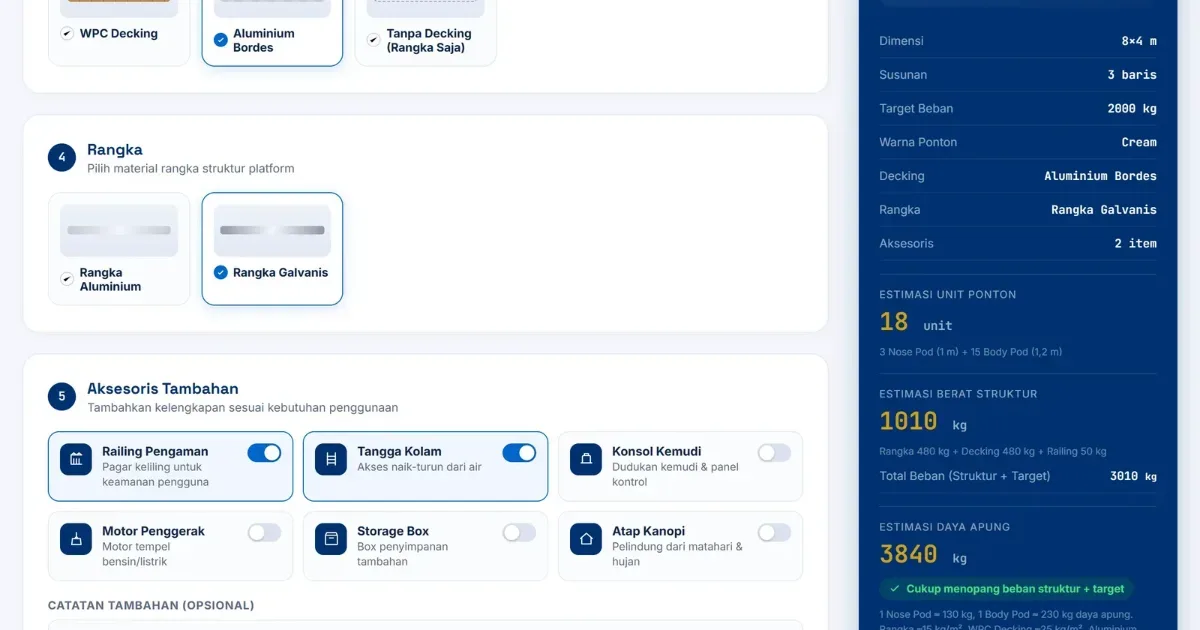
To see how this pontoon calculator works, here is an example we recorded directly from the configurator. The inputs are an 8 × 4 m platform, a 2,000 kg target load, Aluminium Bordes decking, a galvanized frame, and railing and ladder accessories.
Number of rows — Configurator result: 3 rows (a 4 m width exceeds 3.5 m)
Estimated number of pontoons — Configurator result: 18 units: 3 Nose Pods + 15 Body Pods
Estimated structural weight — Configurator result: ± 1,010 kg
Total load (structure + target) — Configurator result: ± 3,010 kg
Estimated buoyancy — Configurator result: ± 3,840 kg
Indicator — Configurator result: Sufficient to support the structural + target load
The buoyancy figure is easy to trace: 3 × 130 kg plus 15 × 230 kg gives 3,840 kg. This result is above the total load of 3,010 kg, so the indicator shows sufficient.
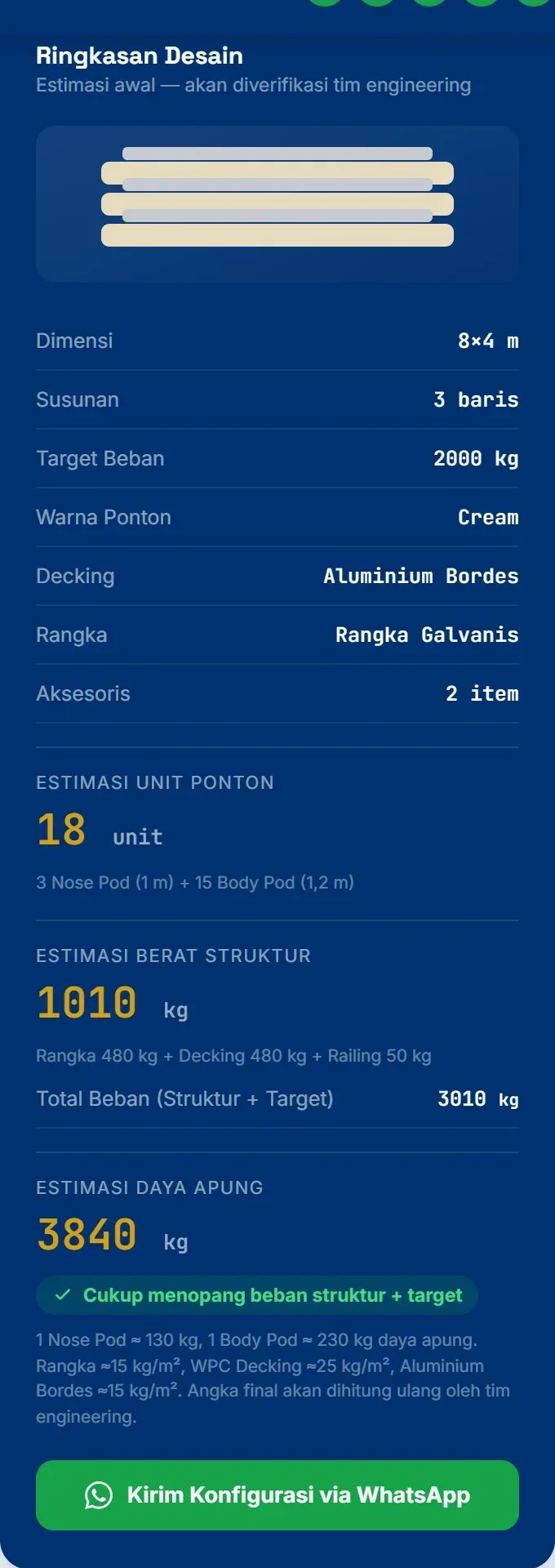
Configurator summary: 3 rows, 18 units (3 Nose Pods + 15 Body Pods), estimated buoyancy 3,840 kg. Source: bajauindo.com screenshot
This example shows that calculating pontoons does not stop at the target load figure. The structural weight reaches about half of the target load. This is why the choice of decking and frame needs to be considered from the start, as both directly affect the estimated number of pontoons.
Why the Result Is Still Called a Preliminary Estimate
The configurator labels every result "Preliminary estimate — to be verified by the engineering team". This label matters because a simple calculation does not yet include a number of site factors.
In general, the engineering team will review things such as:
load distribution, for example heavy equipment concentrated on one side;
the desired freeboard, so the deck is not too close to the water surface;
dynamic loads from waves, currents, or people moving around;
mooring system requirements and connections between rows.
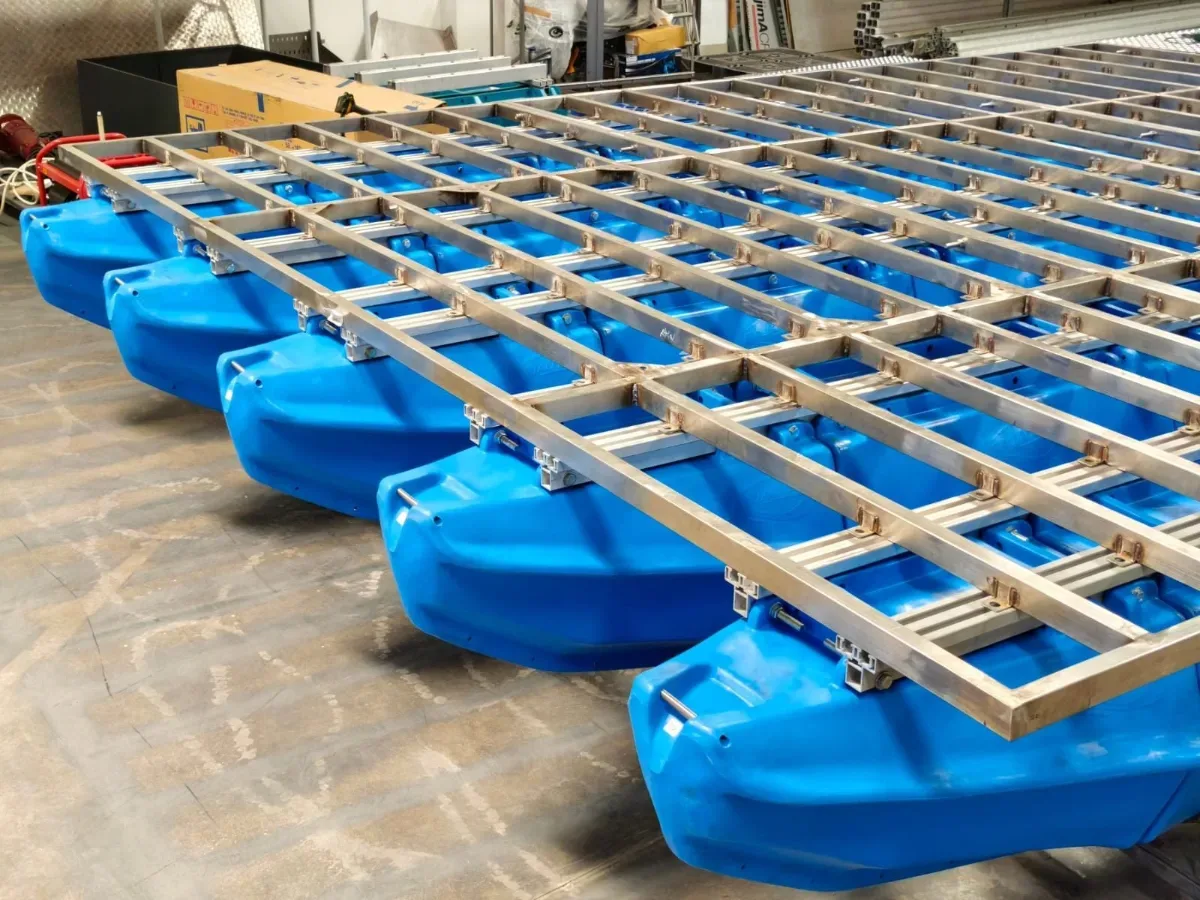
Frame assembly on a row of pontoons, the stage after the calculation has been verified. Source: Bajau Indo documentation
The buoyancy in the product specifications is a per-unit value. The overall capacity of the platform is still calculated per project once the site data and platform function are clear. In other words, the pontoon calculation above is useful for narrowing down options and aligning understanding, not for replacing a technical calculation.
Frequently Asked Questions
Can the configurator results be used directly for production?
Not yet. Configurator results are labeled as preliminary estimates and will be verified by the engineering team. This verification considers water conditions, load distribution, and structural details not covered by the calculator.
Why must the weight of the frame and decking be included?
Pontoons support the entire load above them, not just people or goods. The weight of the frame, decking, and accessories can be substantial, as in the 8 × 4 m example, where the estimated structural weight is about 1,010 kg.
What happens if the configurator indicator shows insufficient?
It means the estimated buoyancy is not yet enough for the total structural and target load. You can adjust the platform size, choose lighter decking, or reduce the target load, then discuss the results with the Bajau Indo team.
Want to try it yourself? Open the Platform Pontoon configurator, enter your platform size and target load, then press the "Send Configuration via WhatsApp" (Kirim Konfigurasi via WhatsApp) button. WhatsApp will open with a configuration summary ready for you to send to the Bajau Indo team for review together with your project site data.
Written by
Tim Redaksi Bajau Indo
Tim Teknis & Redaksi
Tim teknis dan redaksi Bajau Indo — produsen dermaga apung, kubus apung, dan ponton modular LLDPE dari Sentul, Bogor.
Tags
Share this article: