Floating Trash Conveyors: How the Ramp Works, Its Components and Maintenance
How does a floating trash conveyor lift waste from the water onto the deck? Learn how the inclined ramp and perforated belt work, the design considerations and the maintenance it needs.
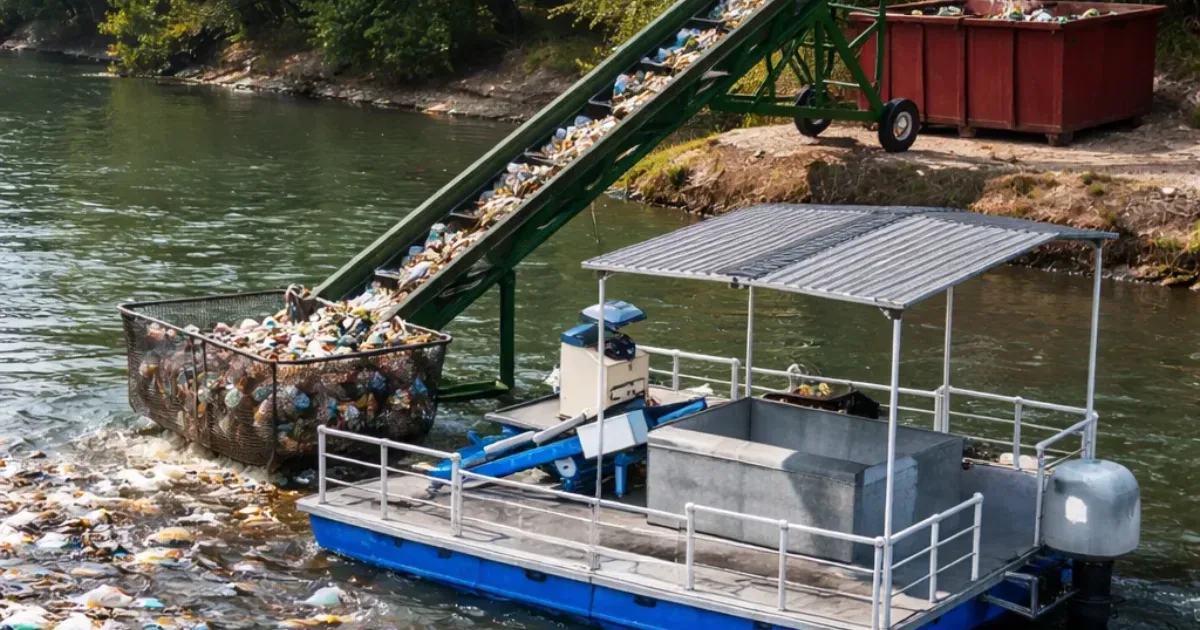
Try lifting a bundle of wet twigs out of a river with a shovel. Most of the weight you feel turns out to be water, and some of the debris slides back before it reaches the bank. This is the challenge a floating trash conveyor addresses: a constantly moving inclined ramp that lifts waste from the surface, drains off the water and drops it into a storage area on the deck. This article explains how the conveyor on a floating trash collector works, its components, design considerations and maintenance.
How a Floating Trash Conveyor Works
In general, the process takes place in several stages:
- The unit moves forward towards the waste so that the ramp mouth at the front sits right at the water surface.
- A perforated belt or chain pulls in the waste entering the ramp mouth and carries it upwards.
- Water falls back through the holes in the belt on the way up, so what reaches the top is mostly waste.
- The waste drops into the storage area on the deck at the upper end of the ramp.
- The unit heads to the unloading point once the storage area is full, and the waste is transferred to land.
An overview of the whole unit, including scale and the data to prepare, is covered in the article floating trash collectors: components, unit scale and the data to prepare. This article focuses on the conveyor itself.
Main Components of a Ramp Conveyor
Although each unit's design may differ, a floating trash conveyor is generally made up of the following components:
- Inclined ramp frame: a metal structure that supports the conveyor track from the water surface up to the deck.
- Perforated belt or chain: the moving surface that carries waste and lets water drain away.
- Drive: the system that turns the belt, placed in a position protected from splashes.
- Deck storage area: temporary holding space, ideally with a perforated deck so remaining water keeps dripping out.
- Pontoon hull: the floating support for all the components above it.
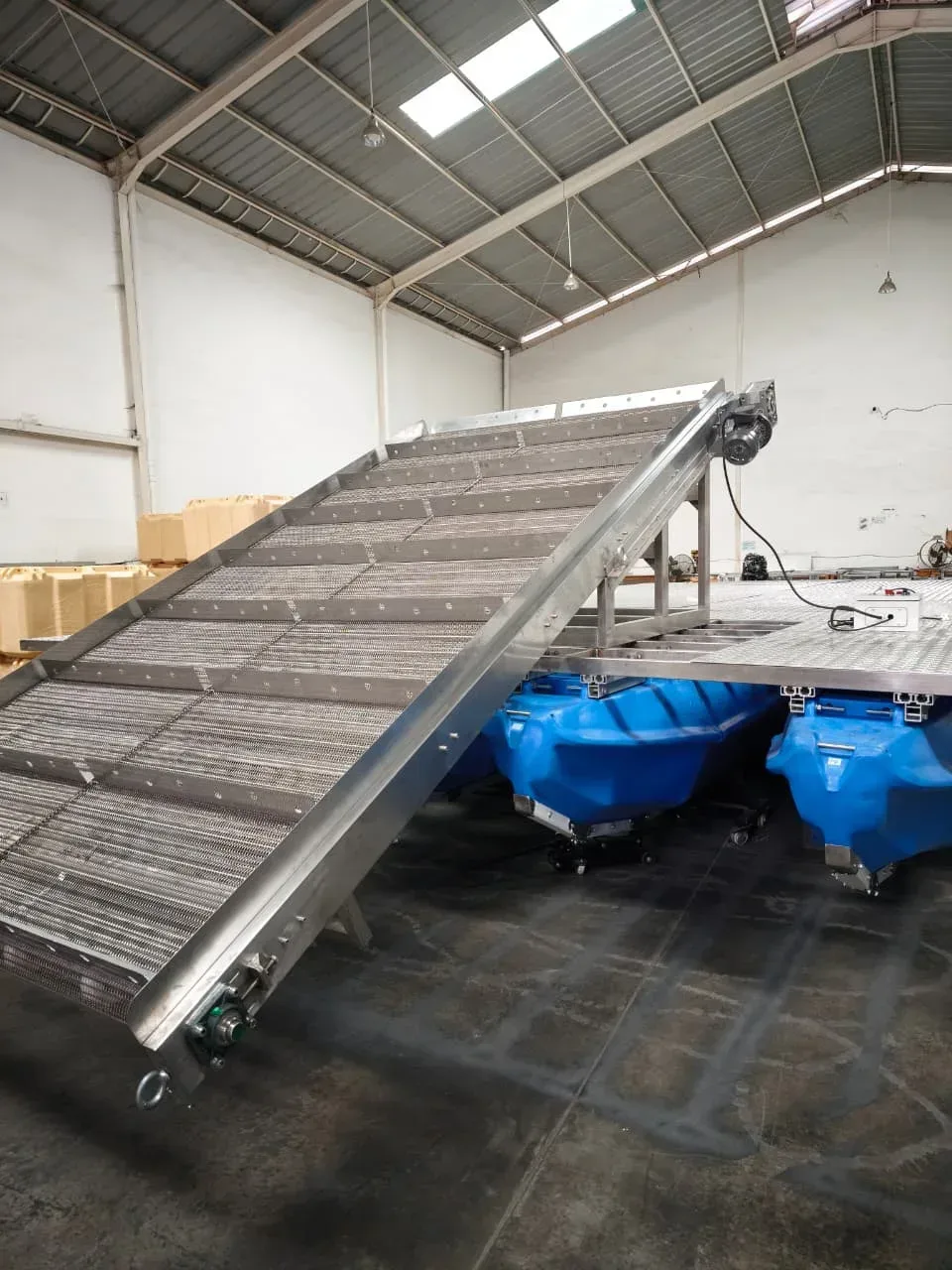
A metal conveyor being assembled on blue pontoons in the workshop. Source: Bajau Indo documentation
The photo above shows a metal conveyor being assembled directly on pontoons in the Bajau Indo workshop. Trash collector units with ramp conveyors have been delivered for Makassar and Bandung, as listed on the Bajau Indo projects page.
Design Considerations: Angle, Mouth Width and Balance
Several design decisions largely determine whether the conveyor runs smoothly in the field:
- Ramp angle: in general, a ramp that is too steep lets waste slide back down easily, while a ramp that is too shallow needs a longer track and adds weight at the front.
- Ramp mouth width: a wide mouth catches more waste per pass, but it must suit the width of the waterway, the clearance under bridges and the room to manoeuvre.
- Immersion position: the lower end of the ramp needs to sit precisely at the water surface. In some designs its height can be adjusted so the unit can still move in shallow water.
- Hull balance: the conveyor adds load at the bow, while waste piles up on the middle or rear deck. The pontoon arrangement needs to be calculated so the unit stays level both when empty and when full.
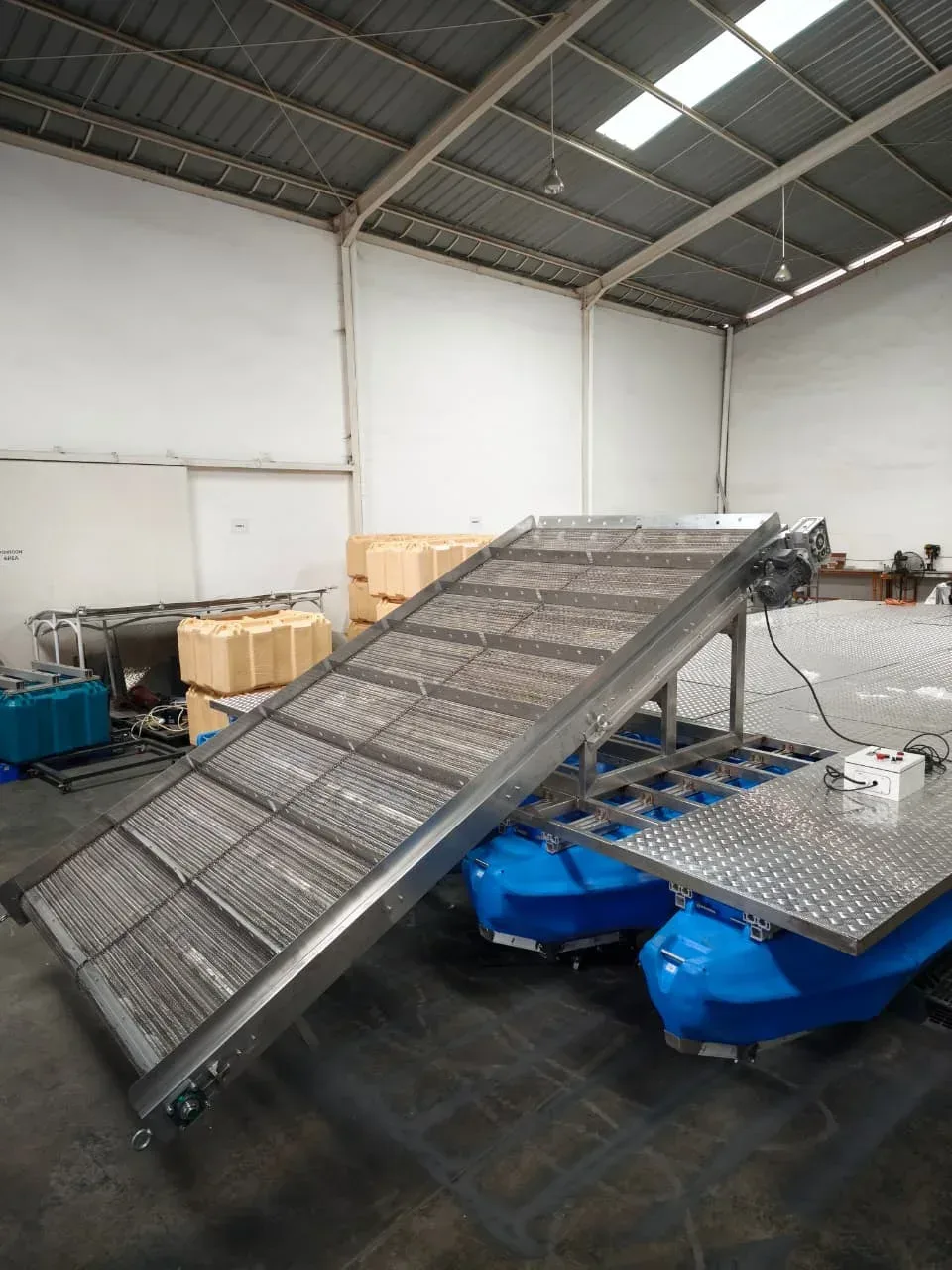
An inclined conveyor frame and perforated deck on blue pontoons during assembly in the workshop. Source: Bajau Indo documentation
As a reference, according to the official specification one Body Pod measures 125 × 82 × 75 cm, weighs 33 kg and has a buoyancy of 230 kg per unit. The number and arrangement of pontoons for a floating trash conveyor unit are still calculated per project by the engineering team.
Maintaining a Floating Trash Conveyor
The conveyor works in a wet, muddy environment full of foreign objects. Routine maintenance helps keep the unit ready for use:
- Rinse the belt, frame and deck after every operation to remove mud and organic residue.
- Check for plastic, rope or roots wrapped around shafts and sprockets, as wrapping can strain the drive.
- Check the tension of the belt or chain and the condition of bolts and frame joints.
- Lubricate and inspect the drive according to the component manufacturer's instructions.
- Make sure cables and electrical panels remain protected from water and splashes.
- Record the findings of every inspection so that wear patterns can be spotted early.
Safety Around the Conveyor
Moving parts are the main risk point on this type of unit. In general, the area around the ramp needs guards or clear boundaries, and workers must not clear blockages while the conveyor is still running. The machine is switched off first, and only then is the blockage removed. Life jackets remain mandatory while on board the unit.
Before the conveyor is switched on, the operator should make sure nobody is near the ramp and that communication with co-workers is working. This simple step deserves a permanent place in the operating procedure of every floating trash conveyor unit.
Frequently Asked Questions
Can a floating trash conveyor lift water hyacinth?
A ramp conveyor is basically designed to lift floating material, including aquatic plants such as water hyacinth. However, plants that interlock and are heavy with water require specific consideration of the mouth width and ramp angle. It is best to state the dominant material at the site from the outset.
Why is the conveyor belt perforated?
The holes in the belt or chain allow water to fall back into the waterway while the waste is carried up. This reduces the load reaching the deck and keeps the storage area from flooding quickly. The perforated deck in the storage area continues this draining process.
What is the lifting capacity of a conveyor?
Capacity cannot be stated in general terms because it depends on the type of waste, how densely it covers the surface, the ramp width and the operating pattern. The Bajau Indo team calculates unit requirements based on your site data.
Interested in designing a trash collector unit with a conveyor for a river, canal or lake in your area? Send site photos and the dominant type of waste via WhatsApp 0878-5931-4314, or email marketing@bajauindo.com to start a technical discussion.
Written by
Tim Redaksi Bajau Indo
Tim Teknis & Redaksi
Tim teknis dan redaksi Bajau Indo — produsen dermaga apung, kubus apung, dan ponton modular LLDPE dari Sentul, Bogor.
Share this article: