Pontoon Boats from Nose Pod and Body Pod: How the Assembly Forms a Hull
How are Nose Pod and Body Pod assembled into a pontoon boat hull for tourist boats and floating restaurants? Learn the principles and key considerations.
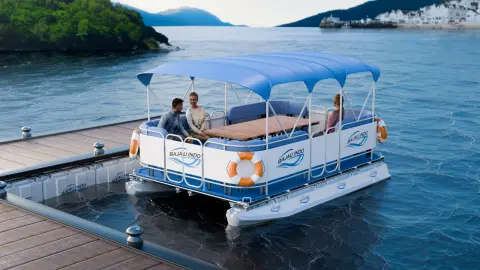
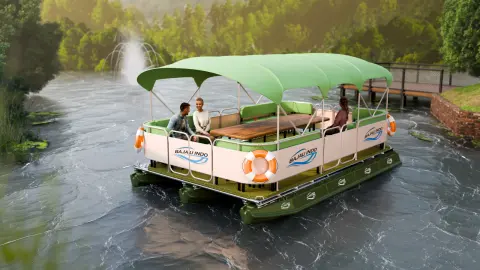
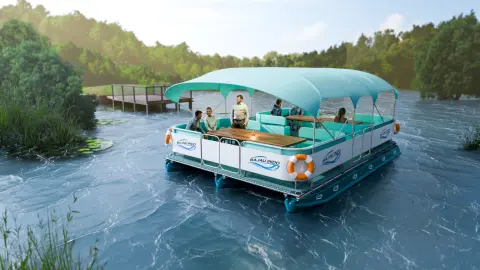
Operators of tourist lakes and river areas often need boats that are spacious, stable for passengers, and easy to maintain. Conventional single-hull boats do not always meet these needs, especially when a wide deck, canopy, or dining area will be built on top. Pontoon boats offer a different approach: the hull is made up of modular pontoon units joined end to end.
At Bajau Indo, this assembly is formed by two elements: the Nose Pod and the Body Pod. This article explains the role of each and how the two form a mobile floating unit.
How Does a Pontoon Boat Work?
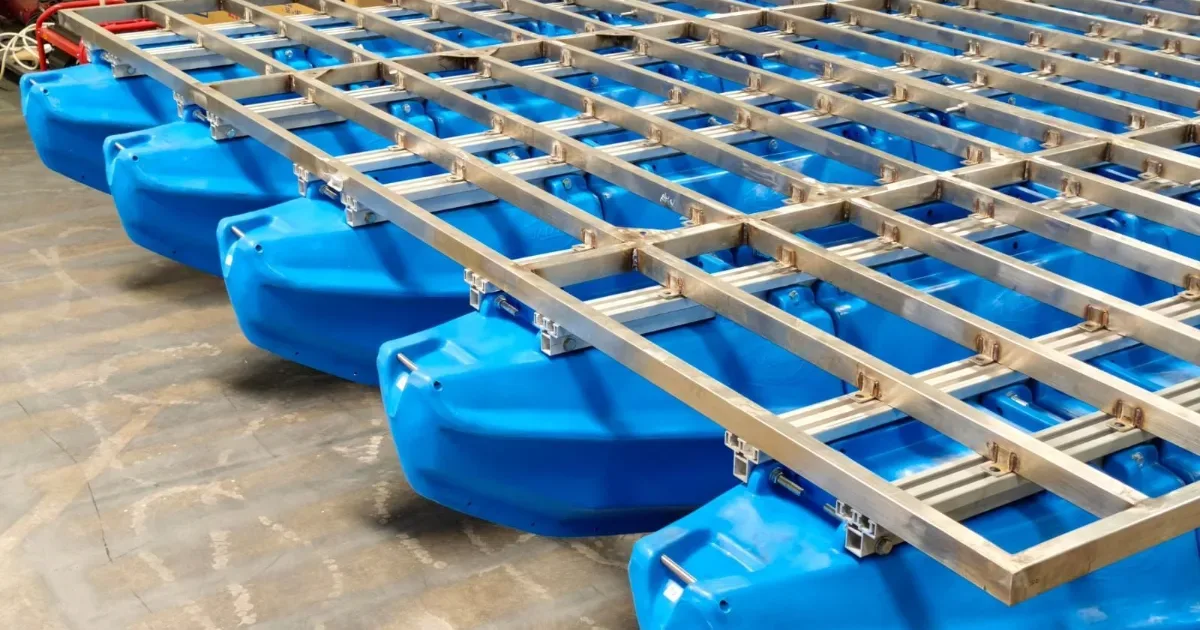
In general, a pontoon boat rests on two or more separate hulls joined by a frame on top. Each hull contributes buoyancy, while the spacing between the hulls provides good transverse stability for a wide deck.
The concept is similar to a catamaran. The difference is that the hull of a modular pontoon boat is not molded as one long body but is assembled from several units. This means the hull length can be adjusted by adding or removing units, and each unit is easier to transport to the site.
On top of the hulls, an aluminum or galvanized frame is installed to support decking, seating, canopies, and even lightweight structures. This combination of pontoon hulls and frame forms the mobile floating unit.
The Role of Nose Pod and Body Pod in the Pontoon Hull
Each pontoon hull starts with one Nose Pod at the front, followed by a number of Body Pods behind it. Both use the same material: a UV-resistant LLDPE shell and a CFC-free polyurethane core.
Nose Pod as the front end
The Nose Pod has a tapered shape, so it serves as the bow of the assembly. This shape helps the hull cut through the water when the unit is moving.
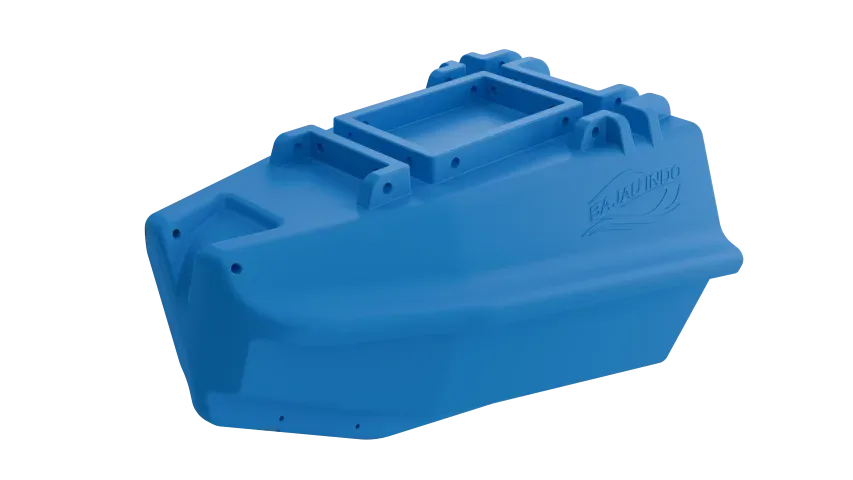
Nose Pod, the front element of the pontoon hull assembly. Source: Bajau Indo 3D product render
Body Pod as the hull body
The Body Pod is straight in shape and connects behind the Nose Pod. The number of Body Pods determines the hull length while also adding to the total buoyancy of the assembly.
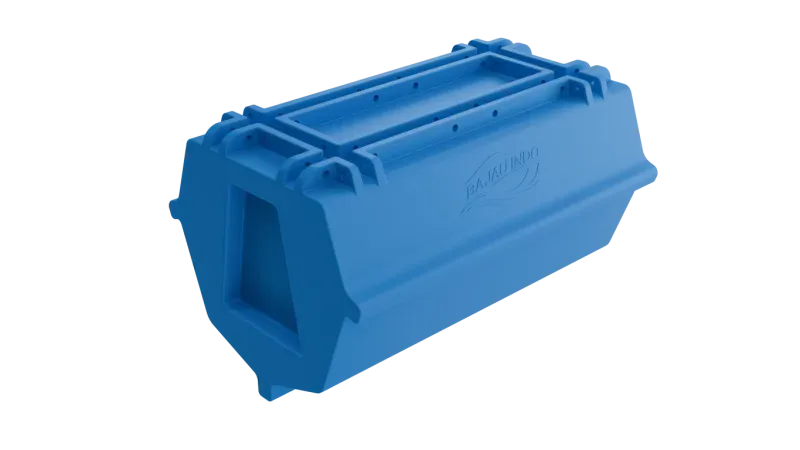
Body Pod, the body element connected behind the Nose Pod. Source: Bajau Indo 3D product render
Here is a comparison of the official per-unit specifications of the two:
Dimensions per unit — Nose Pod: 100 × 82 × 75 cm; Body Pod: 125 × 82 × 75 cm
Weight per unit — Nose Pod: 23 kg; Body Pod: 33 kg
Buoyancy per unit — Nose Pod: 130 kg; Body Pod: 230 kg
Position in the assembly — Nose Pod: At the very front; Body Pod: Behind the Nose Pod
As a simple calculation example, one hull with 1 Nose Pod and 4 Body Pods has a combined per-unit buoyancy of 130 + (4 × 230) = 1,050 kg. This figure is not the boat's load capacity, because the weight of the frame, deck, equipment, and safety margins must still be taken into account.
Applications: Tourist Boats and Floating Restaurants
According to their product pages, the Nose Pod and Body Pod are intended for tourist boats and floating restaurants. Both types of unit require a spacious deck on top of a stable hull.
For tourist boats, Bajau Indo also offers ready-to-use catamarans with PU-insulated LLDPE pontoons and a marine-grade aluminum frame, such as the Kelimutu type catamaran, measuring 4.6 × 3 m for 7–10 people. One example of its use is the catamaran at Kebun Raya Bogor, which operates on Danau Gunting.
On a larger scale, a mobile floating unit can be developed into a floating restaurant. One example is the floating restaurant on the Manggar River, Balikpapan, measuring 13 × 5 m and able to accommodate up to 30 people. This unit also has a 3 × 4 m air-conditioned VIP room, an example of how the deck above a floating hull can be arranged for commercial use.
Pontoon Boat Design Considerations
Before deciding on the number of units, the following points should be discussed with the engineering team:
Passenger and equipment capacity. The number of people, tables, chairs, or kitchen equipment affects the total load.
Number of hulls. Two hulls are commonly used for small boats, while a wider deck may require additional hulls.
Water conditions. Calm lakes, rivers with currents, and open waters call for different stability considerations.
Propulsion and steering system. The type of propulsion should be chosen to suit the route, local regulations, and site characteristics.
Passenger boarding access. The deck height needs to align with the dock where the boat berths.
Periodic maintenance. The connections between units and the frame should be inspected regularly so the hull assembly remains solid during operation.
In general, boats designed to carry people must comply with the safety regulations that apply at their place of operation.
Frequently Asked Questions
What is the difference between Nose Pod and Body Pod?
The Nose Pod is the front element with a tapered shape, measuring 100 × 82 × 75 cm with a buoyancy of 130 kg per unit. The Body Pod is the body element connected behind it, measuring 125 × 82 × 75 cm with a buoyancy of 230 kg per unit.
Are pontoon boats suitable for floating restaurants?
The Nose Pod and Body Pod are indeed intended for mobile units such as tourist boats and floating restaurants. The restaurant's size, number of hulls, and layout need to be calculated per project with the engineering team.
How long can a pontoon boat be?
The hull length is determined by the number of Body Pods connected behind the Nose Pod. The final size of the boat depends on capacity requirements, water conditions, and the technical calculations for each project.
Planning a tourist boat or floating restaurant? Send an outline of your route, passenger capacity, and water location to marketing@bajauindo.com or WhatsApp 0878-5931-4314. The Bajau Indo team will help you put together a pontoon hull configuration that suits your operational needs.
Written by
Tim Redaksi Bajau Indo
Tim Teknis & Redaksi
Tim teknis dan redaksi Bajau Indo — produsen dermaga apung, kubus apung, dan ponton modular LLDPE dari Sentul, Bogor.
Share this article: