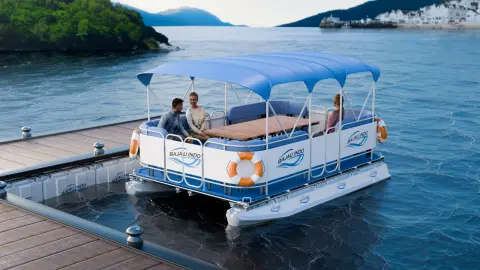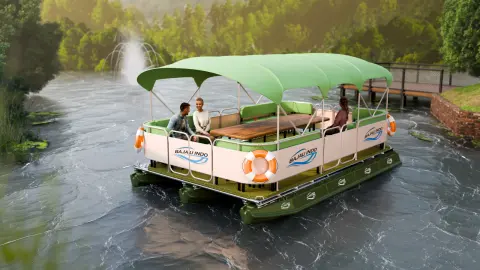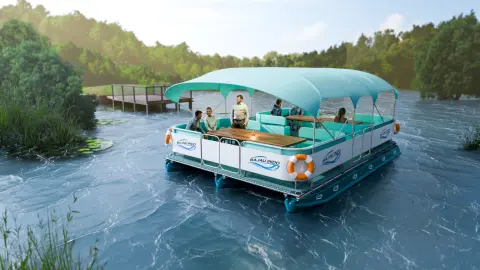
Pontoon Bow Design: Why Moving Floating Units Need a Nose Pod
The shape of the front determines how a floating unit moves. Learn the principles of pontoon bow design, the role of the Nose Pod, row arrangement, and when platforms do not need a bow.
Try pushing a plastic box across the surface of a pond, then push a pointed board with the same force. The box piles up water in front of it and moves haltingly, while the board glides more easily. This simple observation is the essence of pontoon bow design: the shape of the front determines how a floating unit moves through the water.
For owners of tourist boats, operators of floating restaurants that change location, or contractors assembling mobile platforms, understanding this principle helps in choosing the right pontoon arrangement. The discussion below covers general principles, together with the official specifications of the Nose Pod and Body Pod.
Why Moving Floating Units Need a Tapered Bow
When a floating unit moves forward, its front has to push aside the water in its way. A blunt, vertical end hits the water head-on, so water is pushed and piles up in front. A tapered, sloping end parts the water to the sides and downwards gradually.
In general, a tapered bow offers three benefits for a moving unit:
- Lower water resistance: more of the propulsion power is used to move forward rather than to push a mound of water.
- Less spray: water that is parted gradually tends not to splash onto the deck, so passengers are more comfortable.
- Better-maintained heading: a directed front shape helps the unit hold its intended course, especially when meeting small waves.
Water Resistance: The General Principles Behind Pontoon Bow Design
Water resistance on a floating object is influenced by many factors, including the area facing the direction of travel, hull shape, speed, and total weight, which determines how deep the unit sits in the water. At low speeds, such as a tourist boat on a lake, the bow shape still matters because it affects the wave formed in front of the unit.
Note that the bow is not the only factor. Load distribution on the deck, the number of pontoon rows and the position of the propulsion also affect how the unit moves. For that reason, pontoon bow design is always seen as part of the hull as a whole, not as a stand-alone element.
The Role of the Nose Pod at the Front of a Body Pod String
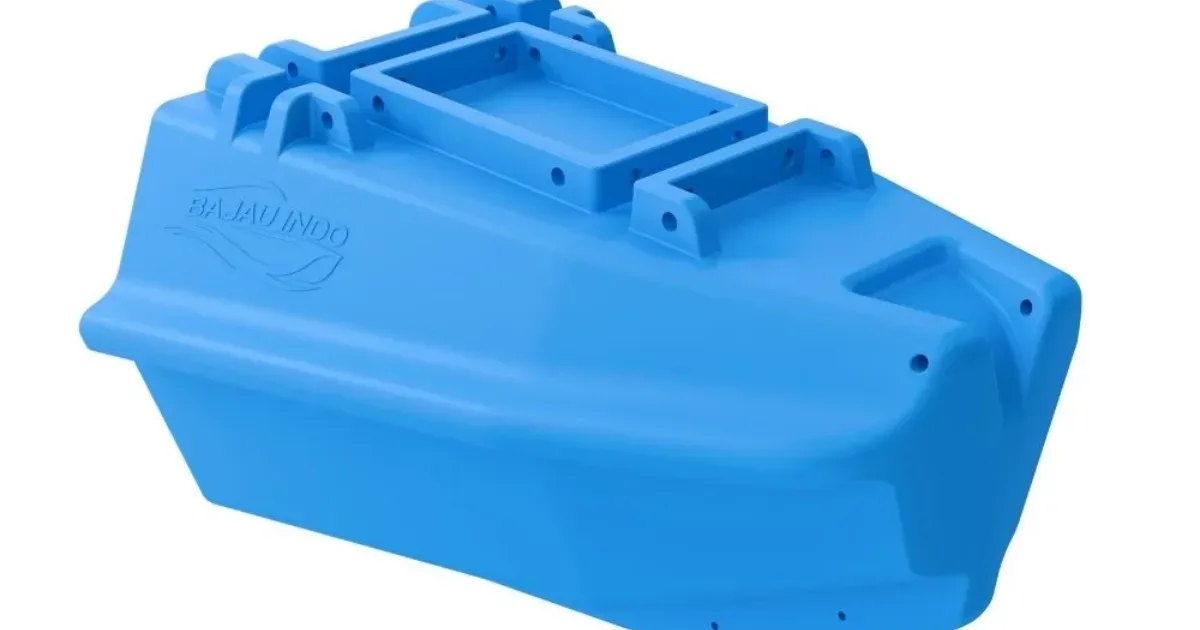
The Nose Pod is the front element of a pontoon string for mobile floating units. Its shape is tapered, so it serves as the bow for the row of Body Pods behind it. Official per-unit specifications:
- Nose Pod: 100 × 82 × 75 cm, weight 23 kg, buoyancy 130 kg.
- Body Pod: 125 × 82 × 75 cm, weight 33 kg, buoyancy 230 kg.
Both share the same width and height, 82 × 75 cm, so the Nose Pod and Body Pod can join into one even row. Because it is shorter and its front is tapered, the Nose Pod has a smaller volume, and therefore lower buoyancy. How this string forms a hull is discussed in more detail in our article on pontoon boats made from Nose Pods and Body Pods.
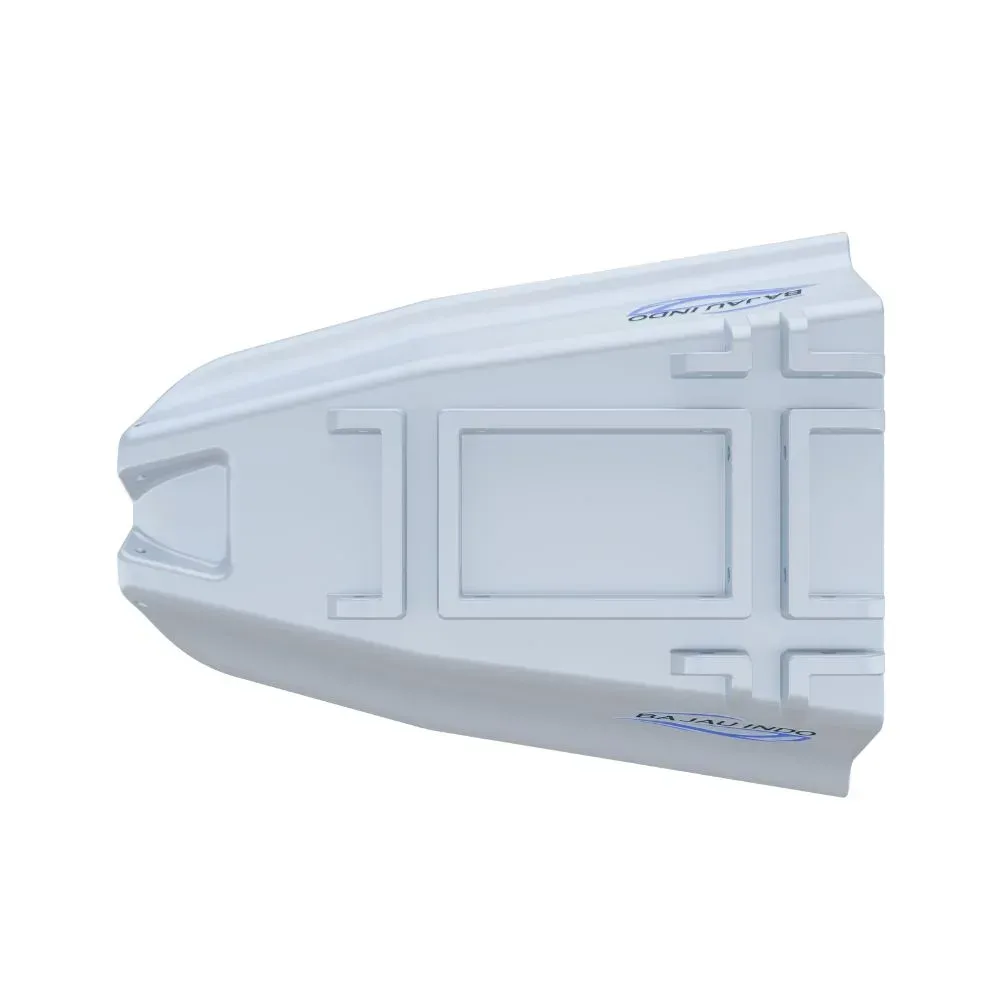
A white Nose Pod seen from below, showing its tapered hull shape. Source: Bajau Indo 3D product render
Row Arrangement: How the Bow Is Formed on a Platform
On a mobile platform, pontoons are arranged in several longitudinal rows. The Bajau Indo platform pontoon configurator uses a simple assumption: each row consists of 1 Nose Pod at the front (counted as 1 m) followed by a number of Body Pods (each counted as 1.2 m). Platforms up to 3.5 m wide are calculated with 2 rows, while wider platforms use 3 rows.
For example, an 8 × 4 m platform in the configurator produces an estimate of 3 rows with a total of 18 units, namely 3 Nose Pods and 15 Body Pods. This means each row has its own bow, and the three Nose Pods together form the front of the platform. In other words, pontoon bow design on a platform is not about a single pointed end, but a series of bows held together by the frame above them. This result is an initial estimate to be verified by the engineering team.
As a consequence, the front direction of the unit needs to be decided early in the design, because the position of the Nose Pods follows the main direction of travel.
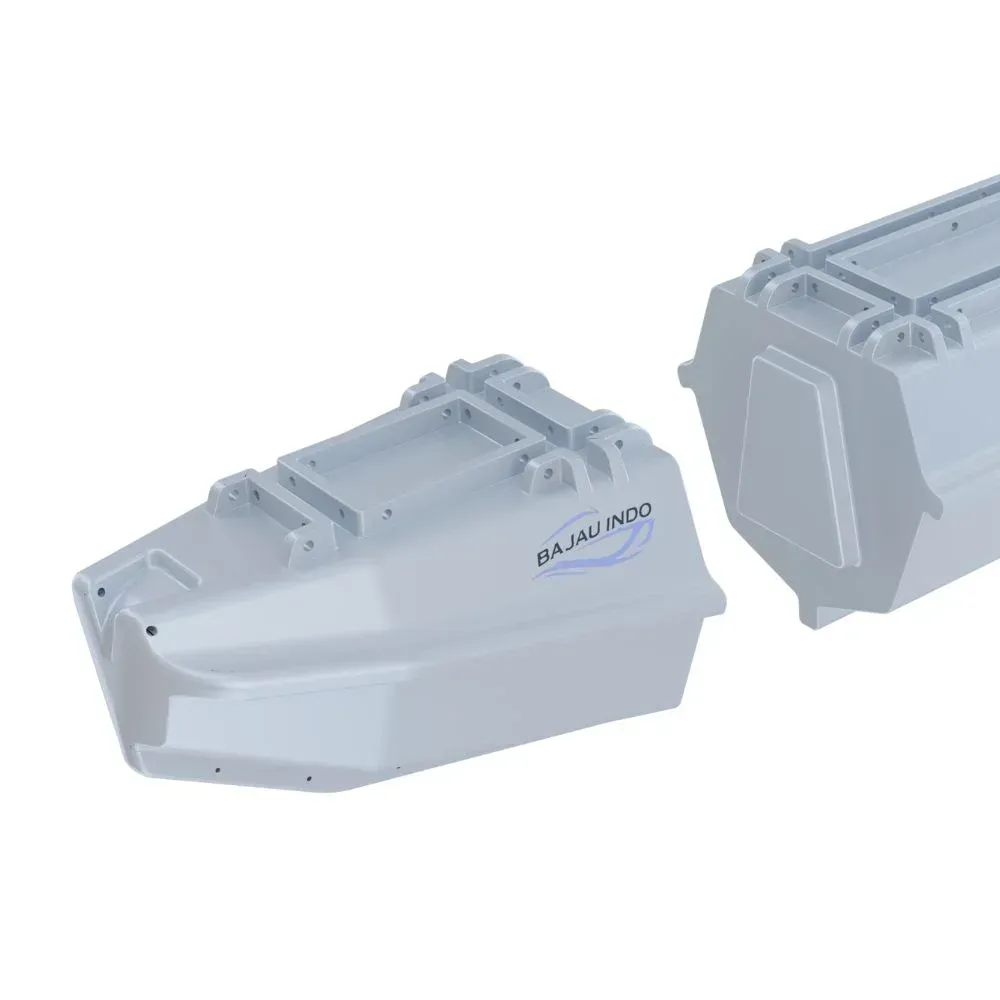
A white Nose Pod and a Body Pod about to be joined into one row. Source: Bajau Indo 3D product render
When Static Platforms Do Not Need a Bow
Not every floating unit needs a designed pontoon bow. Docks, walkways, pump platforms or floating stages moored in one location do not travel through the water, so resistance while moving is not a primary consideration. For needs like these, box-shaped modules such as the Block Pod or Nusa Dock are generally more practical because they form a flat surface that is easy to connect in various directions.
Another consideration arises if a static platform occasionally needs to be relocated, for example towed to another site. In such cases, the need for a bow should be discussed with the technical team according to how often and how far the platform will be moved.
Frequently Asked Questions
Must a Nose Pod be fitted on every row?
In the Bajau Indo configurator's assumptions, each row starts with one Nose Pod. The final arrangement for a specific project is still determined by the engineering team based on the unit's size, load and function.
Can a pontoon boat be made from Body Pods only?
A string of Body Pods will still float, but its front will be blunt. For a moving unit, a blunt end tends to increase water resistance and spray, which is why the Nose Pod is used as the bow element.
Is a tapered shape also needed at the rear?
In the configurator's assumptions, Nose Pods are placed only at the front of each row. Any special shape needed at the rear, for example for a propulsion mount, is discussed per project according to the unit design.
Want to know how many Nose Pods and Body Pods your unit needs? Enter the size and target load in the platform pontoon configurator, then send the summary using the WhatsApp button so the Bajau Indo team can verify it. You can also discuss it directly at 0878-5931-4314.
Written by
Tim Redaksi Bajau Indo
Tim Teknis & Redaksi
Tim teknis dan redaksi Bajau Indo — produsen dermaga apung, kubus apung, dan ponton modular LLDPE dari Sentul, Bogor.
Share this article: