Floating Dock Cost: 8 Factors That Affect Your Project Budget
Floating dock costs are shaped by size, number of pontoons, decking, frame, mooring, and logistics. Learn these factors so you can build a more realistic project budget.
"How much does a floating dock cost per square meter?" This question almost always comes up at the start of a project discussion, and the answer can rarely be given as a single figure. Two docks of the same size can require different budgets because their function, materials, and location differ.
Rather than looking for a benchmark figure, it is more useful to understand the components that make up the cost. That way, you can build a realistic budget for a floating platform and read vendor quotations more critically. This article deliberately does not list prices, because prices depend on specifications, volume, and delivery location.
Why Floating Dock Costs Cannot Be Generalized
A floating structure is made up of many components that affect one another. Choosing heavier decking, for example, can increase the number of pontoons required. Choosing a site on a remote island adds logistics stages. For this reason, a good project estimate starts from requirements, not from a unit price.
Floating dock cost factors are also closely tied to the scope of work. A project that only needs a supply of pontoons is clearly different from one that includes design, frame, decking, mooring, and full installation.
Pontoon and Structure Cost Factors
1. Structure size and function
Deck area, layout shape, and function, such as a pedestrian walkway, boat mooring, or work platform, determine the scale of the work. The function also determines the design load that must be supported.
2. Pontoon type and number of units
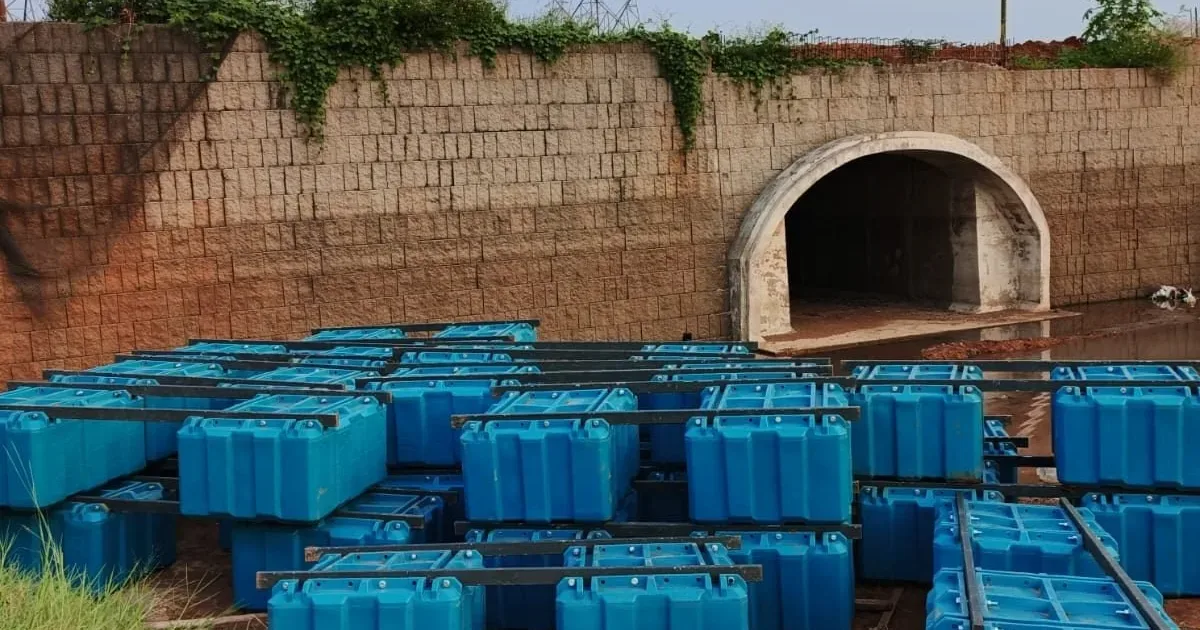
The number of units is calculated from the total load, meaning the structural weight plus the target load, compared with the buoyancy. The module type also matters, because Nusa Dock, Block Pod, and Nose Pod and Body Pod each have different dimensions and buoyancy per unit.
3. Decking
The choice of decking affects weight and appearance. In the Platform Pontoon Configurator's assumptions, WPC decking is calculated at around 25 kg/m², while aluminum checker plate is around 15 kg/m². A no-decking (frame-only) option is also available for specific needs.
4. Frame material
Aluminum and galvanized frames have different characteristics in terms of weight, resistance to the aquatic environment, and maintenance. The configurator assumes a frame weight of around 15 kg/m².
5. Accessories
Railings, pool ladders, steering consoles, outboard motors, storage boxes, and canopy roofs add to the number of components as well as the structural weight.
6. Mooring system
Depth, bed type, currents, and the water level range determine the appropriate type of mooring, such as anchors or guide piles. This component is often overlooked when the initial budget is prepared.
7. Location and logistics
The distance from the production facility, the mode of shipment, land access to the installation point, and the need for inter-island crossings all affect shipping costs. For island locations, cargo ship schedules also need to be taken into account.
8. Installation and site conditions
On-site assembly, the need for supporting equipment, weather conditions, and ease of access to the waterfront all affect the installation stages.
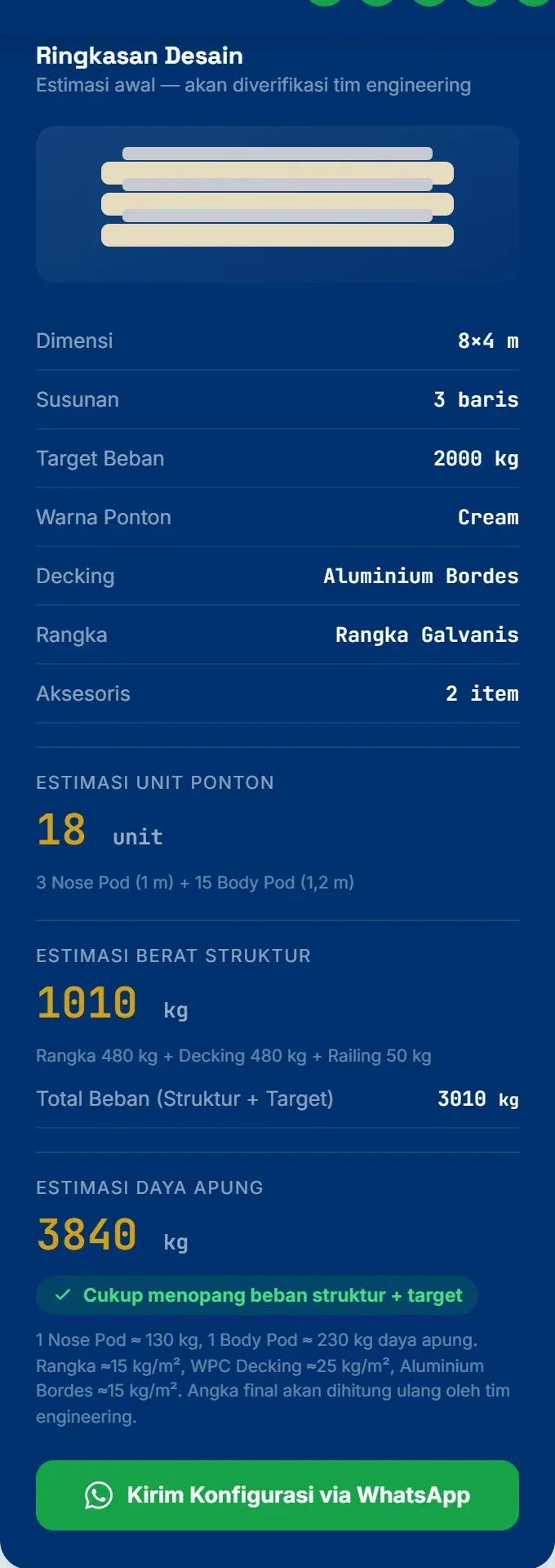
Configurator summary for an 8 × 4 m platform with a target load of 2,000 kg. Source: screenshot from bajauindo.com
Preparing an Initial Estimate with the Configurator
A practical first step is to map out your technical requirements. The Platform Pontoon Configurator helps you see the impact of each choice before requesting a quotation. For example, an 8 × 4 m platform with a target load of 2,000 kg, aluminum checker plate, a galvanized frame, railings, and a ladder produces:
3 rows of pontoons with 18 units (3 Nose Pod + 15 Body Pod)
Estimated structural weight of around 1,010 kg
Total load of around 3,010 kg
Estimated buoyancy of around 3,840 kg, with the note "Sufficient to support structure load + target"
This summary can be sent using the "Send Configuration via WhatsApp" button and is labeled as a preliminary estimate to be verified by the engineering team. For docks based on Nusa Dock, the Nusa Dock Drawing Tool helps you sketch the layout and estimate the number of units.
Reading a Floating Dock Quotation
When you receive a quotation, check the following so that comparisons between vendors are fair:
Are the pontoon type and quantity itemized?
Are the decking, frame, and accessory specifications stated?
Are the mooring system and gangway included?
Are shipping and installation costs listed separately or combined?
Are there assumptions about site conditions that need to be confirmed by a survey?
A realistic floating dock cost also takes into account routine maintenance once the structure is in operation, such as inspecting connections, mooring, and decking. Including this item from the outset helps project owners prepare a long-term budget.
A quotation that looks leaner may not yet include important components. To assess the quality of the pontoons themselves, see the guide to choosing quality floating cubes.
Frequently Asked Questions
How much does a floating dock cost per square meter?
There is no single figure that applies to every project. Prices depend on specifications, volume, and delivery location, including the type of pontoon, decking, frame, accessories, mooring, and installation. The most accurate approach is to request a quotation based on your project data.
What should I prepare before requesting a quotation?
Prepare the dock's function, approximate size, design load, location, and water data such as depth and water level changes. Site photos and information about land access also help. The more complete the data, the more accurate the estimate that can be prepared.
Can the configurator results be used as a basis for a budget?
The configurator results are a preliminary estimate of the number of units, weight, and buoyancy, not a price quotation. Use them as material for initial discussion, then wait for verification by the engineering team. An official quotation is prepared once the requirements and site conditions have been confirmed.
Ready to map out your project budget? Put together an initial configuration in the Bajau Indo Drawing Tool, then send the results along with your site data to our team via WhatsApp at 0878-5931-4314 so we can discuss it together.
Written by
Tim Redaksi Bajau Indo
Tim Teknis & Redaksi
Tim teknis dan redaksi Bajau Indo — produsen dermaga apung, kubus apung, dan ponton modular LLDPE dari Sentul, Bogor.
Tags
Share this article: