Floating Dock Gangways: Principles of Length, Slope and User Safety
A floating dock gangway connects the shore to the dock as the water level changes. Understand the principles of gangway length, slope and user safety.
A floating dock rises and falls with the water surface, while the surrounding land stays still. This height difference is what dock users must bridge every day. That is the role of the floating dock gangway: a connecting bridge that keeps access safe at both high and low tide.
This article explains the general principles of how a gangway works, the relationship between its length and slope, and the safety and comfort aspects that need to be considered.
What Is a Gangway and Why Is It Needed
A gangway is a dock access bridge that connects land, an embankment or a fixed structure to a floating platform. Unlike the deck walkway on the dock itself, a gangway must be able to adjust its angle as the dock's position changes.
Without a well-designed gangway, dock access can become a hazard point. Users may have to step down too far at low tide or face an uneven gap at high tide. For this reason, a floating dock gangway should be treated as part of the dock system, not an add-on accessory. For a general discussion of the benefits of floating docks that follow the water level, see our article on why floating docks are key to port flexibility.
How a Floating Dock Gangway Works
In general, a floating dock gangway works with two ends that serve different functions:
The shore end is hinged to a fixed structure, allowing the gangway to pivot up and down.
The dock end rests on the floating platform and can slide, usually on rollers or a sliding plate, because the horizontal distance changes as the gangway angle changes.
Transition plates at both ends help users step from the gangway onto another surface without tripping.
This design allows the gangway to follow the dock's movement without placing excessive stress on the connections. Construction details are still tailored to the dock type and site conditions.
The Relationship Between Gangway Length and Slope
Gangway slope is determined by two things: the height difference between the hinge point and the dock surface, and the length of the gangway itself. The greater the height difference, the steeper the gangway. Conversely, a longer gangway produces a gentler slope for the same difference.
High water level — Height difference: Small; Effect on gangway: Gangway is relatively flat or slightly downward
Normal water level — Height difference: Medium; Effect on gangway: Moderate slope
Lowest water level — Height difference: Large; Effect on gangway: Steepest slope; this condition is usually the design reference
For floating dock gangways, it is this lowest condition, not the average condition, that is generally used as the basis for calculation.
As a simple illustrative calculation, not a design recommendation: a 1 meter difference over a 6 meter gangway gives a slope ratio of about 1:6. If the gangway is 10 meters long, the ratio becomes 1:10 and feels gentler. That is why data on the range of water level change from a site survey is an important input for planning gangway slope.
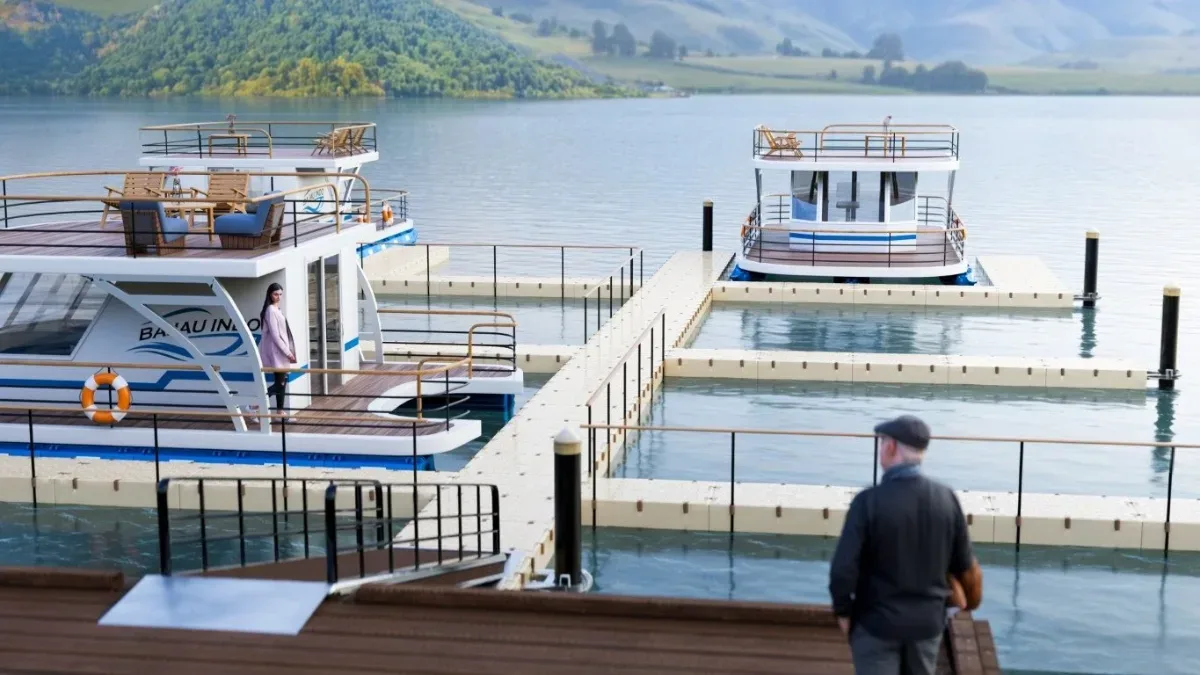
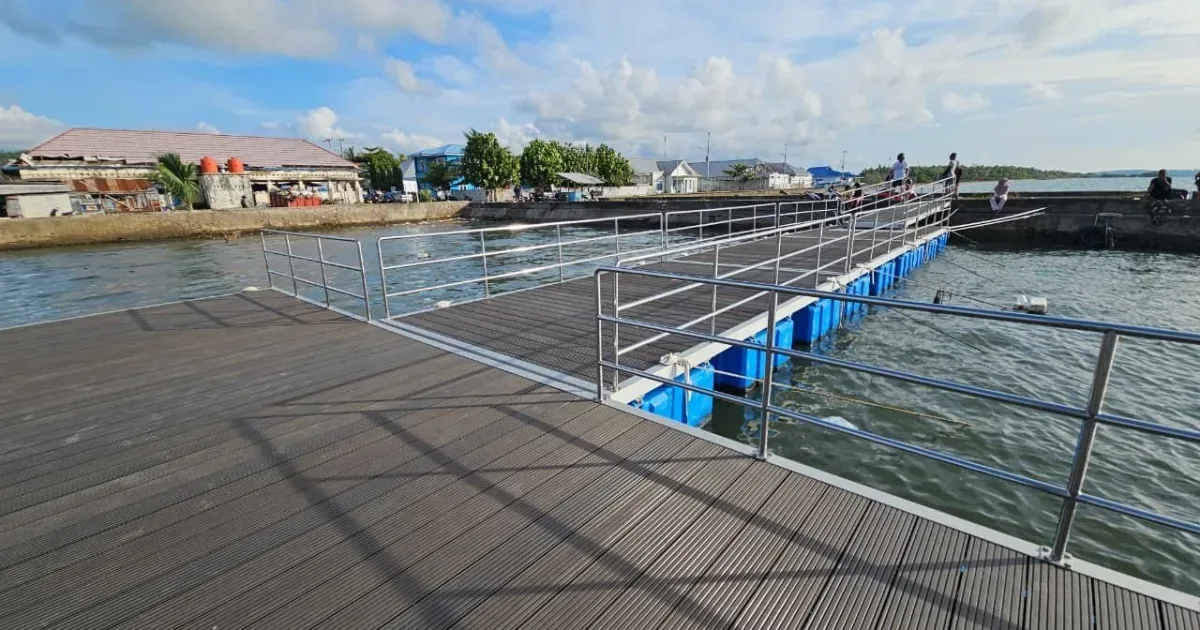
A floating dock walkway at a lake marina providing access to tourist boats. Source: Bajau Indo documentation
User Safety and Comfort
Gangways are used by many people in different conditions, from tourists and boat crews carrying goods to the elderly. Some safety elements that generally need attention:
An anti-slip surface, as gangways are often wet from splashing water or rain.
Handrails on both sides at a height that is comfortable to grip.
Flush transition plates at both ends to reduce the risk of tripping.
Adequate lighting if the dock is used in the evening or at night.
Routine inspection of hinges, rollers and connections so that the gangway continues to move smoothly.
On the dock side, the gangway landing area should be sufficiently large and stable. Docks based on Block Pod or Nusa Dock can be designed with a deck area that meets this need, while structural capacity is still calculated per project. For an example of a railed deck walkway in use, see the Bajau Indo floating dock in the Selayar Islands Regency, which uses Block Pod, a marine-grade aluminum frame and WPC decking.
Dock Accessibility for All Users
Dock accessibility is receiving increasing attention, especially for tourism facilities and public services. Wheelchair users, the elderly and families with strollers need gentler slopes and level surfaces. Building accessibility guidelines generally set limits on ramp slopes, so the standards that apply at the project location should be referenced from the outset.
If accessibility is a priority, the consequence is usually a longer gangway or the addition of rest landings. This needs to be accounted for at the planning stage, not after the dock has been installed. With proper planning, a floating dock gangway can comfortably serve more user groups.
Frequently Asked Questions
Does every floating dock need a gangway?
Not always. A gangway is needed when there is a height difference between the land or a fixed structure and the floating dock, especially if the water level changes frequently. At locations with a gently sloping shoreline, access may be designed in other ways based on survey results.
How is gangway length determined?
In general, gangway length is determined from the greatest height difference between the hinge point on land and the dock surface, particularly at the lowest water level. Based on that difference, the length is chosen so that the slope stays within safe and comfortable limits according to applicable standards.
Can a gangway be used by wheelchairs?
Yes, if it is designed with a slope that meets accessibility guidelines, an anti-slip surface, handrails and flush transition plates. These requirements should be set at the planning stage because they affect the gangway length.
Planning a floating dock complete with access from land? Sketch an initial layout with the Bajau Indo Drawing Tool, then discuss your gangway needs, water level data and dock function with our team via WhatsApp 0878-5931-4314 or marketing@bajauindo.com.
Written by
Tim Redaksi Bajau Indo
Tim Teknis & Redaksi
Tim teknis dan redaksi Bajau Indo — produsen dermaga apung, kubus apung, dan ponton modular LLDPE dari Sentul, Bogor.
Tags
Share this article: