Solar-Powered Trash Boats: A Solar Panel Roof Concept for Floating Units
Bajau Indo's solar-powered trash boat concept: a solar panel roof that provides shade as well as supplementary power, plus the technical considerations to address before anything is built.
Almost every trash cleaning unit on the water needs a roof, because workers can spend hours under the hot sun. That raises a simple question: could a roof that is needed anyway also work to generate electricity? This question led to the solar-powered trash boat concept visualised by Bajau Indo. It should be stated from the outset that the images in this article are concept renders, not a unit that has been built or a product ready for sale.
Bajau Indo's Solar-Powered Trash Boat Concept
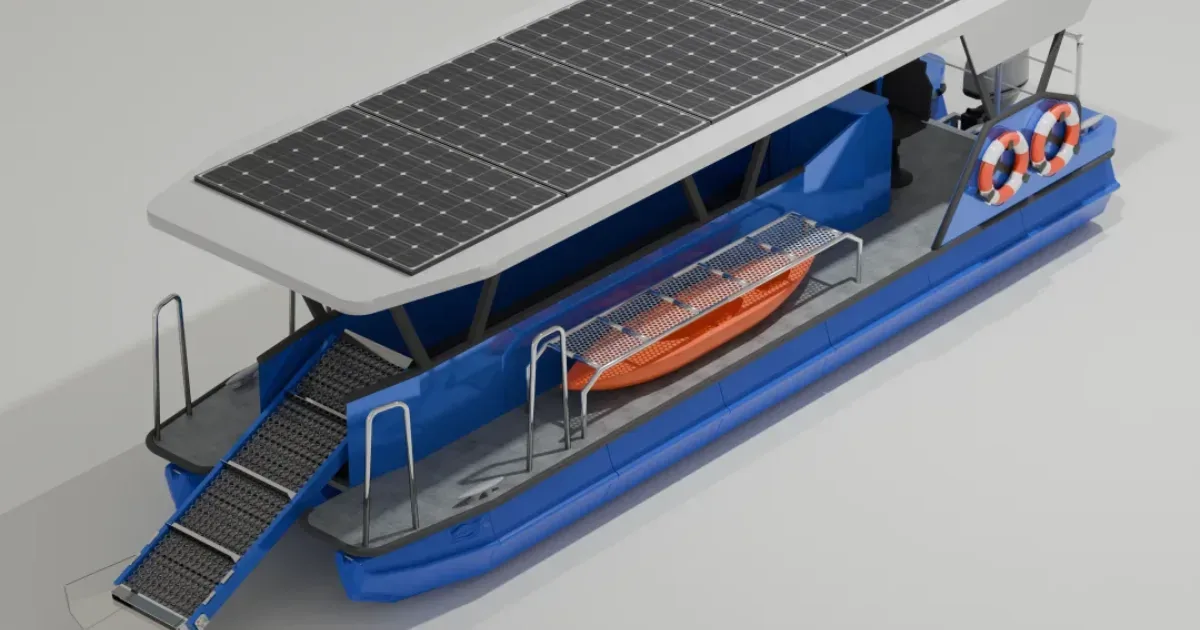
The concept render shows a trash cleaning unit with a solar panel roof, a conveyor at the front to lift waste, and safety rings on the side of the unit. From the side, an outboard engine can be seen at the rear as the propulsion. In other words, in this concept the solar panels are positioned as a supplementary power source, not a replacement for the main propulsion.
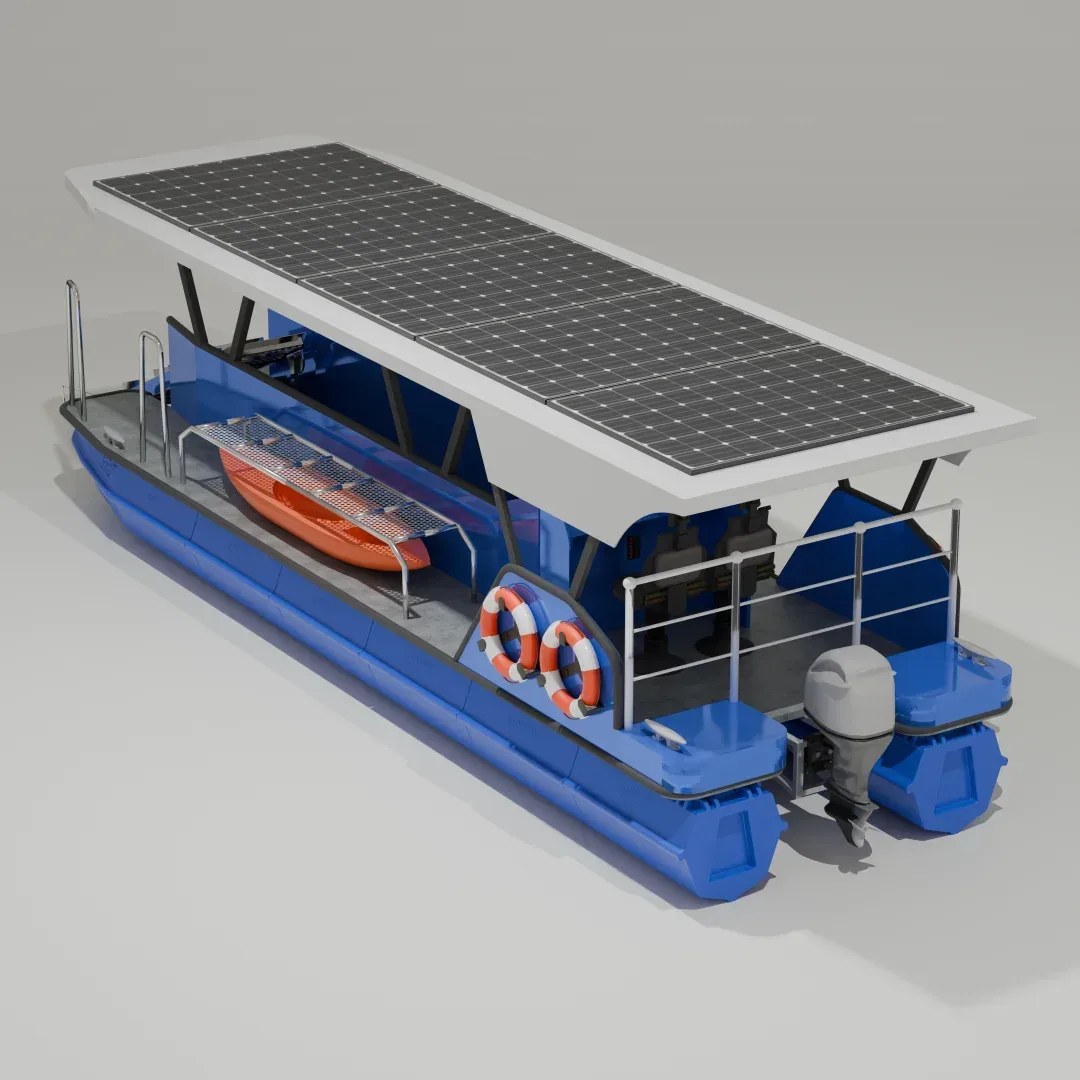
Concept render of a trash cleaning boat with a solar panel roof seen from the side, with an outboard engine at the rear. Source: Bajau Indo 3D concept visualisation — not a built project
Concepts like this are part of a collection of 3D visualisations that you can explore on the floating unit inspiration page. If developed into a project, the electrical system requirements are calculated per project according to the owner's operating pattern.
Benefits of a Solar Panel Roof on a Floating Unit
In general, combining the roof with solar panels offers several benefits:
- Shade for workers: the panels still act as a roof that protects workers from heat and light rain.
- Supplementary power for equipment: the energy can be used for work lighting, charging communication devices or small equipment on the unit.
- Late-afternoon lighting: work lights and navigation lights can be supplied from batteries charged during the day.
- Environmental programme image: for agencies or area managers, a unit that uses renewable energy fits the message of a water-cleaning programme.
How much electricity is produced depends on the roof area, the weather and the unit's orientation. The benefits above should therefore be treated as potential to be calculated, not as a performance promise.
Technical Considerations Before Building
Installing solar panels on a floating unit is not the same as installing them on a building roof. In general, the following need to be taken into account:
- Roof load and centre of gravity: the panels and their frame sit high up, which raises the unit's centre of gravity. The number and arrangement of pontoons need to be recalculated with this load included. The basic principle is covered in the article how to calculate pontoons for a floating platform.
- Wind load: a wide roof acts like a sail. Mount strength, panel angle and operating limits in strong winds need to be defined.
- Batteries: these should be placed low and in the middle of the unit, protected from water, with adequate ventilation.
- Waterproof cables and connectors: cable runs need protection from splashes, standing water and friction with moving parts.
- Panel maintenance: dust, dried mud and bird droppings reduce panel performance, so the panels need regular cleaning.
Calculating Energy Needs Realistically
The first step in designing a solar-powered trash boat is not choosing panels but mapping requirements. The recommended order is:
- List all the electrical equipment to be used on the unit together with its estimated daily operating time.
- Decide which equipment must stay on and which is supporting.
- Take cloudy days and the rainy season into account, when panel output falls.
- Hand this data to the engineering team to determine panel and battery size.
- Prepare a backup, such as shore charging, for times when the panels are not enough.
Similar logic applies to electric boats, as discussed in the article electric tourist boats for nature tourism areas.
From Concept to Project
A solar-powered trash boat concept still starts from a functional floating trash collector: a pontoon hull, lifting equipment, a storage area and propulsion. These basic components are covered in the article floating trash collectors: components, unit scale and the data to prepare. Solar panels become an additional layer designed once the unit's basic requirements are clear.
In the initial discussion, the project owner should share the operating route, daily working hours, number of workers and the equipment they want to install. From this data, the team can assess whether a solar panel roof brings benefits that justify the additional load and maintenance needs. At some sites a solar-powered trash boat can be an attractive option; at others, an ordinary shade roof may be sufficient.
Frequently Asked Questions
Is this solar-powered trash boat already available as a product?
No. The images in this article are 3D concept visualisations, not a unit that has been built or a product ready for sale. The concept can be a starting point for discussion if you want to develop a unit with a solar panel roof, and its requirements are calculated per project.
Can solar panels be the unit's only source of propulsion?
That depends on the roof area, the propulsion power needed and the operating pattern, so it cannot be answered in general terms. In this concept render, the main propulsion remains an outboard engine and the solar panels serve as a supplementary power source.
Is it safe to install solar panels on a unit that is constantly splashed?
In general it can be done if cables, connectors and batteries are selected and installed with protection against water. The panel mounts must also be strong enough to withstand wind and vibration. Routine inspections help find worn cables or loose connectors early.
Interested in developing a trash cleaning unit with a solar panel roof for the waters in your area? Tell the Bajau Indo team about your operating pattern and the equipment you want to use via WhatsApp 0878-5931-4314 or email marketing@bajauindo.com.
Written by
Tim Redaksi Bajau Indo
Tim Teknis & Redaksi
Tim teknis dan redaksi Bajau Indo — produsen dermaga apung, kubus apung, dan ponton modular LLDPE dari Sentul, Bogor.
Tags
Share this article: