Tourist Boat Service Capacity: How to Plan Schedules and Trip Rotation
How to calculate daily tourist boat service capacity from the trip cycle, build a schedule, manage queues, and protect operator rest time.
It is ten in the morning on a public holiday. The queue at the dock is getting longer, while the boat that left half an hour ago has not come back yet. Visitors ask how much longer, and staff have no clear answer. This situation is rarely caused by a shortage of boats alone. More often, tourist boat service capacity has never been calculated in a simple way and then turned into a schedule.
This article explains how managers of lake, river or nature tourism destinations can estimate daily capacity, plan trip rotation, and manage visitor queues without compromising safety or operator rest time.
What Is Tourist Boat Service Capacity?
Tourist boat service capacity is the number of passengers that can be served in one operating day on a realistic schedule. This figure is different from seating capacity. A boat for 15 people will not automatically serve hundreds of visitors per day if boarding and alighting take a long time, the dock has only one berthing point, or the operator needs to rest.
In general, three components determine it:
- Capacity per trip: the number of passengers according to the official specification of the boat type, not the maximum that physically fits.
- Trip cycle: trip duration plus time for boarding, alighting and a short check before departure.
- Effective operating hours: opening hours minus rest breaks, charging or refuelling time, and a time reserve for weather.
The Basic Formula for Daily Trip Rotation
The logic is simple. The trip cycle equals trip duration plus boarding and alighting time. The number of trips per boat is the effective operating time divided by the trip cycle, rounded down. Daily capacity is capacity per trip multiplied by the number of trips, then by the number of boats.
Sample calculation (illustration)
The figures below are illustrative assumptions, not real destination data. Suppose a tourist lake uses one boat with a capacity of 12 passengers, a trip duration of 25 minutes, and 10 minutes for boarding and alighting. The cycle is 35 minutes. With 6 effective operating hours, or 360 minutes, the boat can run 10 trips (360 ÷ 35 = 10.3, rounded down). That tourist boat service capacity is about 120 passengers per day.
The same illustration shows two things. Cutting boarding and alighting time from 10 to 5 minutes shortens the cycle to 30 minutes and adds two trips. Adding a second boat can double capacity, provided the dock can serve two boats without them waiting for each other to berth.
Choosing a Boat Type to Match Visitor Patterns
Capacity per trip is determined by the boat type. In the Bajau Indo catamaran line, the official capacity specifications are Kelimutu 7–10 persons, Sentani 10–15 persons and Toba 15–20 persons. The three are compared in the article on choosing a Kelimutu, Sentani or Toba tourist catamaran.
Visitor patterns influence the choice. A destination that often receives school or company groups may suit a larger-capacity boat. A destination with families arriving in waves often benefits more from several medium boats departing more frequently, because short waiting times are usually valued more than a large boat that has to wait until it is full. A mid-size type such as the Sentani tourist catamaran can be a starting point for comparison.
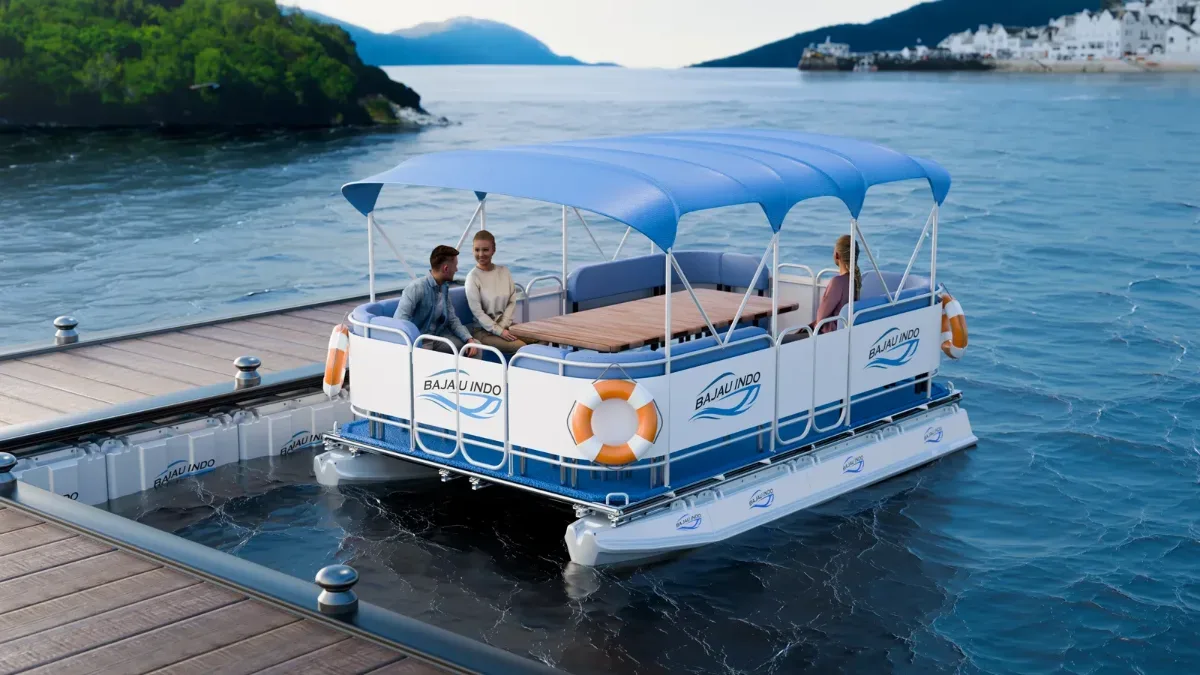
Concept visualisation of a blue-roofed tourist catamaran with passengers, moored at a dock. Source: Bajau Indo 3D concept visualisation — not a built project
Setting Tourist Boat Schedules and Managing Visitor Queues
A tourist boat service capacity calculation is only useful once it is turned into a tourist boat schedule and clear queuing rules. Some general practices that can be applied in lake destination management:
- Fixed departure times: announce departure times based on the cycle so visitors know when to return to the dock.
- Numbered tickets or time slots: visitors do not need to stand in a physical queue and can enjoy other facilities while they wait.
- Shaded waiting area: separate the waiting area from the boarding path so the dock does not get crowded.
- Two lanes at the dock: where the layout allows, passengers alight on one side and new passengers board on the other.
- Ticket sales limit: stop selling tickets once the day's slots are full, instead of adding more load.
For weekends and holiday seasons, prepare a special schedule. Standby operators, extra boats or slightly longer operating hours can be considered, but the number of passengers per trip must still not exceed the limit.
Safety and Operator Rest in the Schedule
A packed schedule with no breaks is a risk. A tired operator is more likely to lose focus when berthing or when helping passengers board. For that reason, rest time should be built into the calculation from the start, not squeezed in when the queue happens to be quiet.
In general, several items should be part of the daily SOP: checking the boat and life jackets before the first trip, counting passengers at every departure, a short safety briefing, and criteria for a temporary stop when the weather worsens. For electric boats, the charging schedule also needs to be taken into account. These considerations are covered in the article on electric tourist boats for nature tourism areas.
Frequently Asked Questions
How can I quickly estimate tourist boat service capacity per day?
Calculate the trip cycle, which is trip duration plus boarding and alighting time. Divide the effective operating time by that cycle, then multiply by the official capacity per trip and the number of boats. The result is an initial estimate that should be tested with on-site observation.
Is one large boat or several medium boats better?
It depends on visitor patterns and dock conditions. One large boat is efficient for groups, while several medium boats can shorten waiting times. Make sure the dock can serve the planned number of boats without a berthing queue.
Can capacity per trip be increased on busy days?
No. Capacity per trip follows the boat's official specification and the applicable safety rules. Visitor surges are better handled with schedules, time slots or additional boats, not by adding more load.
Planning a tourist boat service for your lake or tourism area? Send your estimated visitor numbers, route length and dock conditions via WhatsApp 0878-5931-4314 so the Bajau Indo team can help you discuss the right catamaran type and number of units.
Written by
Tim Redaksi Bajau Indo
Tim Teknis & Redaksi
Tim teknis dan redaksi Bajau Indo — produsen dermaga apung, kubus apung, dan ponton modular LLDPE dari Sentul, Bogor.
Tags
Share this article: