Floating Net Cages Built on Modular Pontoons: Concept and Considerations
Explore the concept of floating net cages built on modular pontoons: site considerations, business scale, and the role of Block Pod as a floating fish-farming frame.
For fish farmers, the cage frame is the daily workplace. On it, workers feed the fish, inspect the nets, and harvest. When the frame starts to wobble or its floats need frequent replacement, working time gets eaten up by repairs. This need gave rise to the idea of building floating net cages with modular pontoons as the floating frame.
This article discusses the concept in general terms, the site and business-scale factors to consider, and the place of Block Pod as a module that, according to Bajau Indo's official website, is suitable for marine aquaculture.
Understanding Modular Floating Net Cages
In general, a floating net cage (KJA) consists of bag-shaped nets suspended from a floating frame. The fish are raised inside the nets, while the frame above serves as both a float and a working walkway.
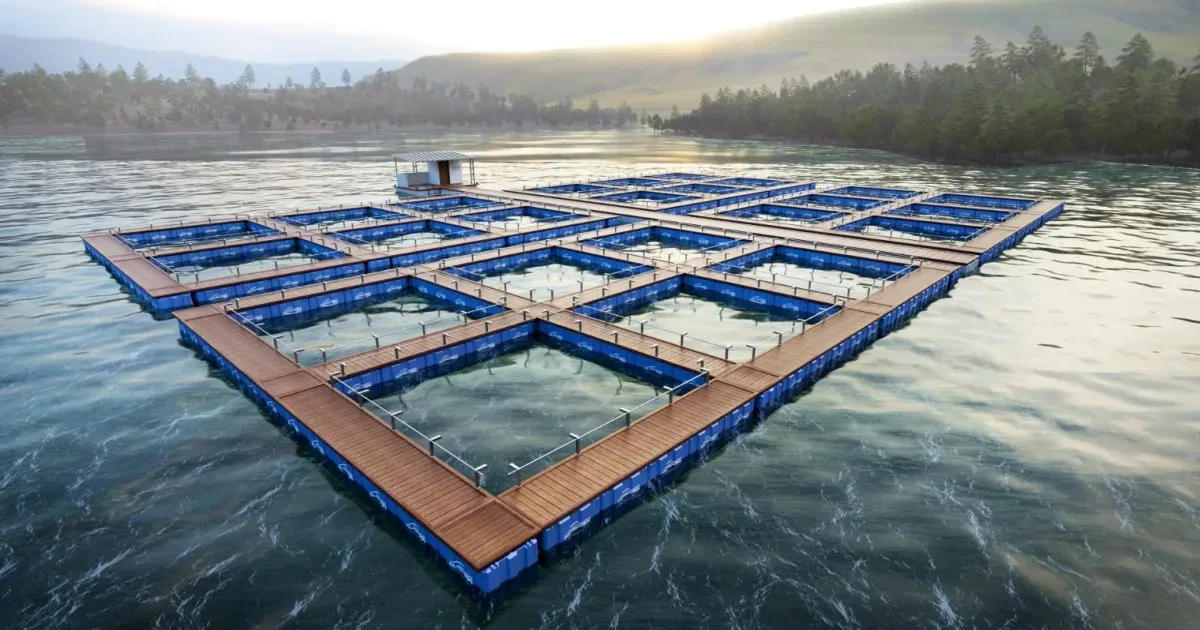
In a modular floating net cage, the floating frame is assembled from interlocking pontoon units. This arrangement forms the net bays and the walkways between them. The main image of this article is a 3D concept illustration, not a built project, and is intended to show possible layouts. If you are new to floating module systems, the article what is a floating cube explains the basics.
Why Block Pod Is Relevant for Cage Pontoons
The Block Pod product page lists marine aquaculture, including fish cages, as one of its uses. Here are its official specifications:
Dimensions — Block Pod (per unit): 123 × 97 × 65 cm
Weight — Block Pod (per unit): 40 kg
Buoyancy — Block Pod (per unit): 375 kg
Material — Block Pod (per unit): UV-resistant LLDPE shell, CFC-free polyurethane core
The wider top surface gives workers a spacious footing area. The LLDPE shell is flexible, crack-resistant, and UV-resistant, making it suitable for all-day sun exposure. The polyurethane core helps maintain buoyancy if the outer shell is scratched or damaged, for example from rubbing against work boats.
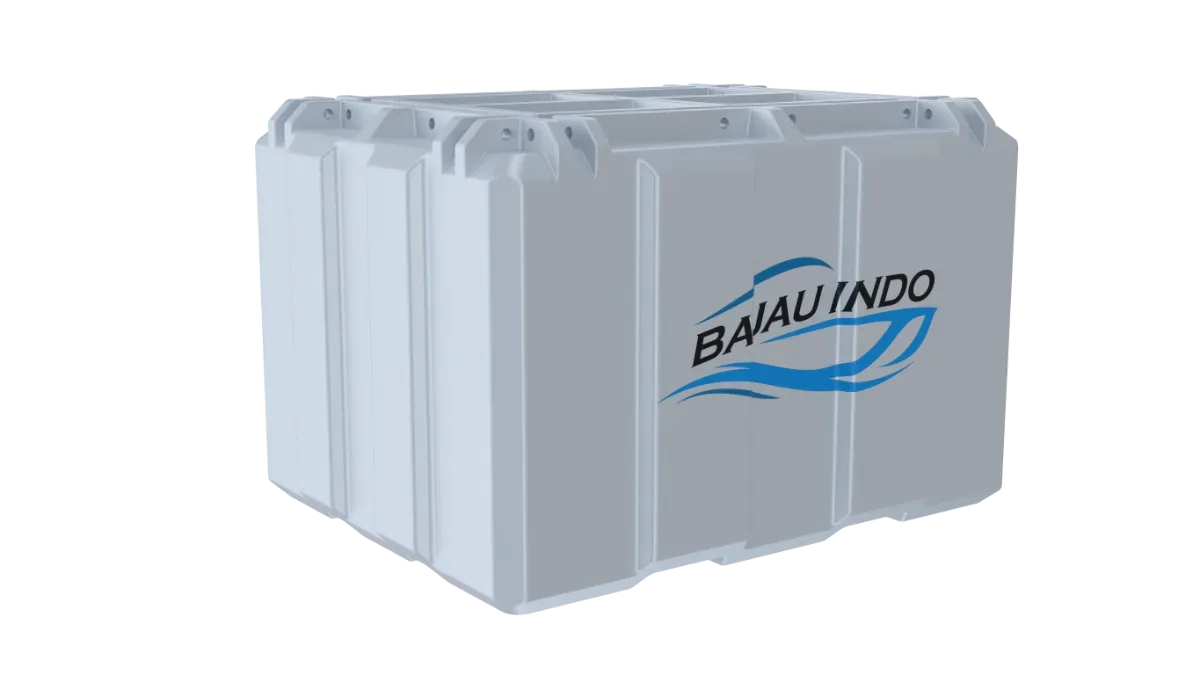
Block Pod, one of the modules suitable for cage frames. Source: Bajau Indo 3D product render
To understand how to assess floating modules more broadly, you can read the guide on choosing quality floating cubes.
Site Considerations for Aquaculture
The site determines both the success of cage fish farming and the working life of the structure. In general, the points to review include:
Water depth, so the bottom of the net stays clear of the seabed or lakebed when the water level is low.
Currents and water exchange, which affect oxygen levels as well as the forces acting on the nets and frame.
Shelter from waves, especially in open sea or large lakes.
Water quality and distance from pollution sources, such as wastewater outfalls.
Land access, for delivering feed and fry and transporting the harvest.
Zoning and permits, which are regulated by the relevant authorities in each region.
Carrying capacity of the waters, so that cage density does not degrade water quality.
The same data is also needed to design the mooring system that holds the floating net cages in position. For this reason, collect field observations across several seasons if possible, as currents, waves, and water levels can differ considerably between the rainy and dry seasons.
Matching the Business Scale
Modular floating net cages can be planned in phases according to your capacity and business targets. The following outline is general:
Pilot scale: a few bays with a single working walkway, suitable for testing the site and fish species.
Growth scale: additional bays alongside the existing ones, plus a deck area for storing feed and equipment.
Full commercial scale: a grid layout with several working walkways, a boat berthing point, and a larger work area.
At every stage, the loads from workers, feed, equipment, and the forces from nets pulled by the current need to be taken into account. The capacity of the overall structure is calculated per project by the engineering team, not simply by adding up the buoyancy of each unit.
Flexibility of the Modular System
One of the strengths of the modular approach is how easily it can be adapted. Bays can be added as the business grows, the arrangement can be changed if work patterns shift, and units can be dismantled and moved if the site needs to be relocated. The same pontoons can also be combined with a work deck or a small dock for boats carrying the harvest. In this way, floating net cages are not a standalone structure but part of a single, well-organized work area.
Other concepts that use a similar system, such as docks and work platforms, can be seen in the Floating Unit Inspiration gallery. All visuals in that gallery are 3D models for inspiration, including the floating net cage concept in this article's main image.
Frequently Asked Questions
What is the difference between modular floating net cages and traditional cages?
In modular floating net cages, the floating frame is assembled from interlocking factory-made pontoon units, so the layout is easy to expand or change. Traditional cages are generally assembled from materials such as wood, bamboo, and drums. The right choice depends on your site, business scale, and long-term plans.
Can Block Pod be used for cages at sea?
According to Bajau Indo's official website, Block Pod is suitable for marine aquaculture, including fish cages. Even so, wave, current, and depth conditions at the site need to be reviewed so that the module arrangement and mooring system are designed correctly.
How many fish can be raised in one cage bay?
Stocking density depends on the fish species, net size, water quality, and the farming practices applied. This figure should follow the recommendations of fisheries extension officers or the relevant authorities. Discussions with Bajau Indo will focus on the floating frame and its structure.
Want to test the idea of modular cages at your site? Start by sketching a module layout with the Bajau Indo Drawing Tool, then discuss the result with our team via WhatsApp 0878-5931-4314.
Written by
Tim Redaksi Bajau Indo
Tim Teknis & Redaksi
Tim teknis dan redaksi Bajau Indo — produsen dermaga apung, kubus apung, dan ponton modular LLDPE dari Sentul, Bogor.
Share this article: