Tides and Docks: How Water Level Affects Dock Design, Gangways, and Boat Berthing
Tides affect dock elevation, gangways, and boat berthing. Understand the general principles and the data you need to collect before designing a floating dock.
In the morning a boat can berth easily, but by the afternoon passengers have to climb because the dock deck now sits far above the boat's hull. This is common at fixed docks in waters with a fairly large tidal range. Understanding how tides affect a dock from the planning stage helps you avoid problems with access, safety, and damage to vessels.
This article explains the general principles linking water level and dock design, the impact on gangways and boat berthing, and the data you need to collect before design begins.
What Happens When the Tidal Water Level Changes
In general, tides are the periodic rise and fall of sea level caused by the gravitational pull of the moon and the sun. The range differs from one location to another; some waters have a small difference, while others have a fairly large one. In lakes and reservoirs, changes in water level are driven more by the rainy and dry seasons and by sluice gate operation.
For a dock, these changes determine the dock's elevation relative to the boat. If the difference is too large, passengers struggle to embark and disembark, cargo is hard to transfer, and the boat's hull risks rubbing against the structure.
That is why tides are one of the first parameters a dock planner checks. Deck elevation, gangway length, and the mooring system all depend on how far the water rises and falls at the site.
Fixed Docks vs Floating Docks in Tidal Waters
A fixed dock stands on piles, so its elevation is constant. A floating dock sits on pontoons and rises and falls with the water. The general differences are:
Deck elevation — Fixed dock: Constant, the height difference with the boat changes; Floating dock: Follows the water level, the height difference with the boat stays relatively consistent
Access from land — Fixed dock: Direct, with no moving parts; Floating dock: Usually via a gangway whose angle changes
Boat berthing — Fixed dock: Often requires ladders or tiered fenders; Floating dock: More uniform berthing height throughout the day
Layout adjustment — Fixed dock: Limited once built; Floating dock: Modules can be added or rearranged
The final choice still depends on a site survey and technical analysis. The role of pontoons in structures like this is discussed further in the article the function of pontoons and floating cubes for floating docks.
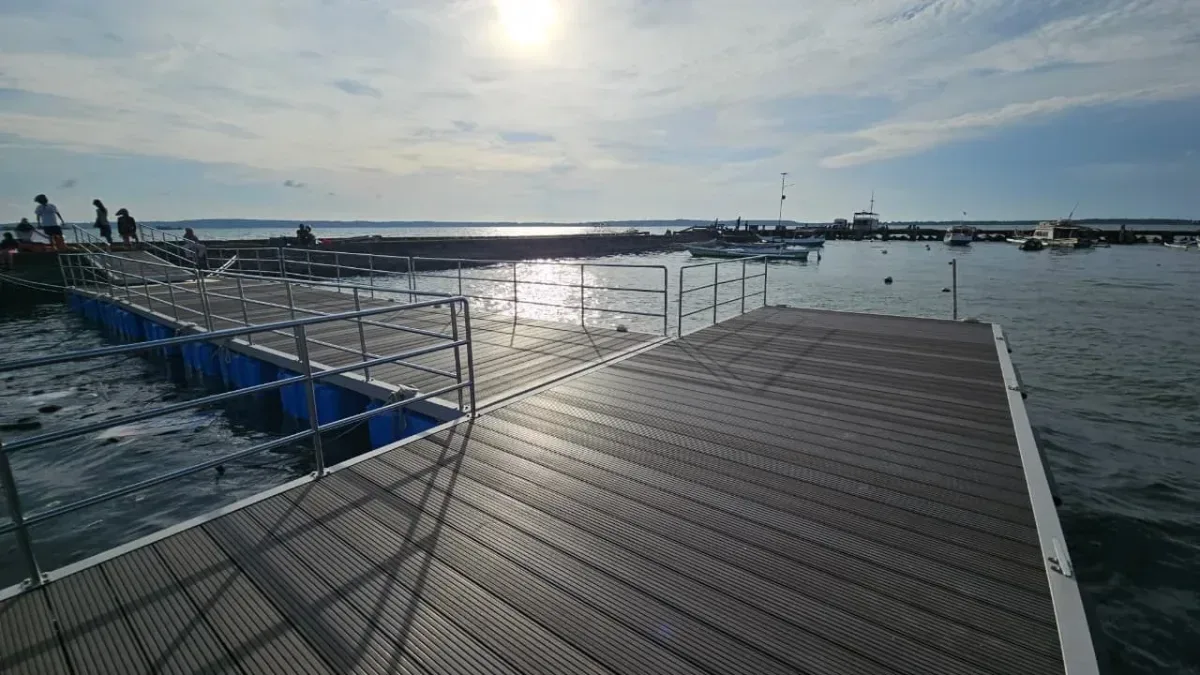
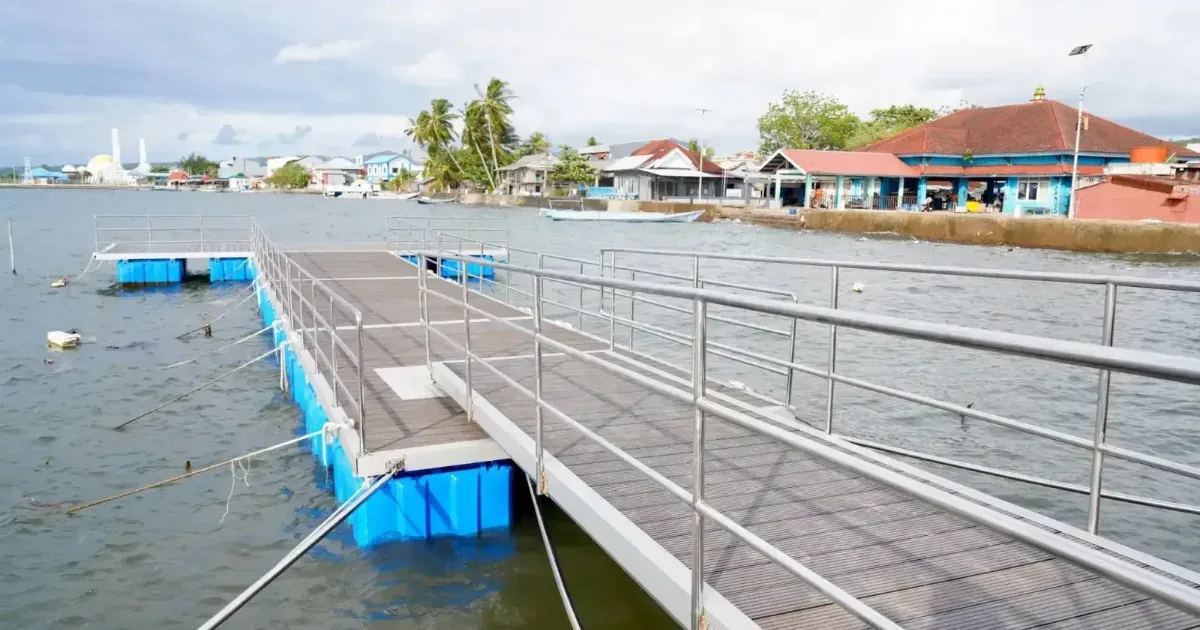
Floating dock deck with railings in Selayar Islands Regency, South Sulawesi. Source: Bajau Indo documentation
Impact on the Gangway
The impact of tides on a dock is felt most at the point where the floating structure meets the land. When the dock follows the water, the fixed part is the land or embankment at the shore. The two are connected by a gangway, a bridge that is hinged on land at one end while the other end can slide across the floating deck.
The general principle is simple: the greater the range of water level change, the greater the change in gangway angle. To keep the slope comfortable, the gangway is usually made longer. General points to consider:
The slope at the lowest water level, when the gangway is at its steepest.
Anti-slip surfaces and handrails on both sides.
A sliding end that does not snag as the dock moves.
The needs of specific users, such as the elderly or wheelchair users.
Impact on Boat Berthing and the Mooring System
With a floating dock, the boat and the deck move together with the water level, so the boat's mooring lines do not need constant adjustment as they would at a fixed dock. Even so, the dock itself must be moored so it does not drift away. The mooring system, such as guide piles or anchors with chains, needs to accommodate the dock's range of vertical movement without locking it in place.
For modular docks based on Nusa Dock or Block Pod, the pontoon layout also affects stability when boats come alongside. Berthing areas are generally designed with a wider edge and fitted with suitable fenders.
Data You Need to Collect
Before design begins, prepare the following data or ask a consultant to carry out a survey:
The tidal range or seasonal water level fluctuation at the site.
Water depth at the lowest water level.
The type of bed, such as mud, sand, or coral, for choosing the mooring.
Currents, prevailing winds, and wave exposure.
The elevation of the land or embankment at the gangway installation point.
The types of boats that will berth and their freeboard height.
Tidal data for docks at sea can generally be taken from official tide predictions and then supported by direct observation at the site. For lakes or reservoirs, water level records from the local operator can serve as an initial reference.
Once the data has been collected, you can sketch an initial layout with the Nusa Dock Drawing Tool before discussing it with the technical team.
Frequently Asked Questions
Why are floating docks suitable for tidal locations?
Because a floating dock rises and falls with the water level, the height difference between the deck and the boat stays relatively consistent. This makes it easier for passengers to embark and disembark and for cargo to be loaded and unloaded. Suitability still needs to be confirmed through a site survey.
How long does the gangway need to be?
Gangway length depends on the range of water level change and the slope limit you want to achieve. In general, a larger range requires a longer gangway so that it is not too steep at low water. The exact figure is determined in the design calculations for each project.
What data matters most before designing a dock?
Water level data, meaning the tidal range or seasonal fluctuation, is the starting point. It is complemented by depth, bed type, currents, and land elevation. Without this data, the dock and gangway elevations are difficult to plan accurately.
Do you have tide records or water level data for your site? Send them to the Bajau Indo team via WhatsApp at 0878-5931-4314 so your floating dock and gangway requirements can be discussed from the earliest planning stage.
Written by
Tim Redaksi Bajau Indo
Tim Teknis & Redaksi
Tim teknis dan redaksi Bajau Indo — produsen dermaga apung, kubus apung, dan ponton modular LLDPE dari Sentul, Bogor.
Tags
Share this article: