Inspecting Pontoons on Delivery: A Handover Checklist for the Project Site
A checklist for contractors and project owners when a pontoon delivery arrives: match the documents, check the shell and shape, count components, store correctly and document everything.
The handover of goods at the project site is often treated as a formality: the delivery note is signed, the truck leaves, and the stack of pontoons waits to be assembled. Yet inspecting pontoons on delivery is the last chance to record the condition of the goods before handling passes to the field team. Issues discovered only during assembly are much harder to trace back to their origin.
The following checklist for inspecting pontoons on delivery is intended for project owners, contractors and site supervisors receiving a delivery of modular pontoons, whether for a floating dock, a platform or another floating unit.
Why Inspecting Pontoons on Delivery Matters
Pontoons travel from the production site to the project location, often going through loading and unloading more than once. Along the way, units can be mixed up by type, arrive short in number, or be scratched by hard objects. An early inspection helps in three ways:
- It confirms that the number and type of units match the assembly plan.
- It records the physical condition with clear, dated evidence.
- It gives the supplier and project team time to follow up on findings before the installation schedule.
Match the Delivery Documents to the Units
Have copies of the working drawings and packing list ready before the truck arrives, so that inspecting pontoons on delivery goes quickly without holding up the vehicle for too long. Start with the delivery note or packing list. Count the units by type, then compare them with the documents and working drawings. If the project uses several pontoon types, types with similar shapes need to be distinguished carefully. The following official per-unit specifications can serve as a reference when matching:
- Nose Pod: 100 × 82 × 75 cm, weight 23 kg.
- Body Pod: 125 × 82 × 75 cm, weight 33 kg.
- Block Pod: 123 × 97 × 65 cm, weight 40 kg.
- Nusa Dock: 150 × 100 × 40 cm, weight 32 kg.
- Belida Trash Barrier: 100 × 53 × 53 cm, weight 17 kg.
Measuring a few samples with a tape measure is usually enough to confirm the type. The different functions of each module are explained in our article on choosing floating pontoon modules: Nusa Dock, Block Pod, or Nose Pod and Body Pod.
Visual Pontoon Check: Shell, Corners, and Shape
Inspect every unit in a well-lit place. Focus your attention on the following:
- Scratches: distinguish shallow surface scratches from deep scratches that can be felt by touch.
- Cracks or tears: pay particular attention to corners, edges and the area around connection points.
- Deformation: check whether any part is dented, bent or asymmetrical compared with other units.
- Connection points: make sure the parts where locks are fitted are not damaged or deformed, as they determine how neatly the units assemble.
The shell of Bajau Indo pontoons is made of LLDPE with 8 mm walls for the Nose Pod, Body Pod, Block Pod and Nusa Dock, and 4 mm for the Belida Trash Barrier. If you are unsure whether a scratch is merely cosmetic, simply record and report it, and leave the final assessment to the supplier. For broader quality criteria, also read our guide on how to choose quality floating cubes.
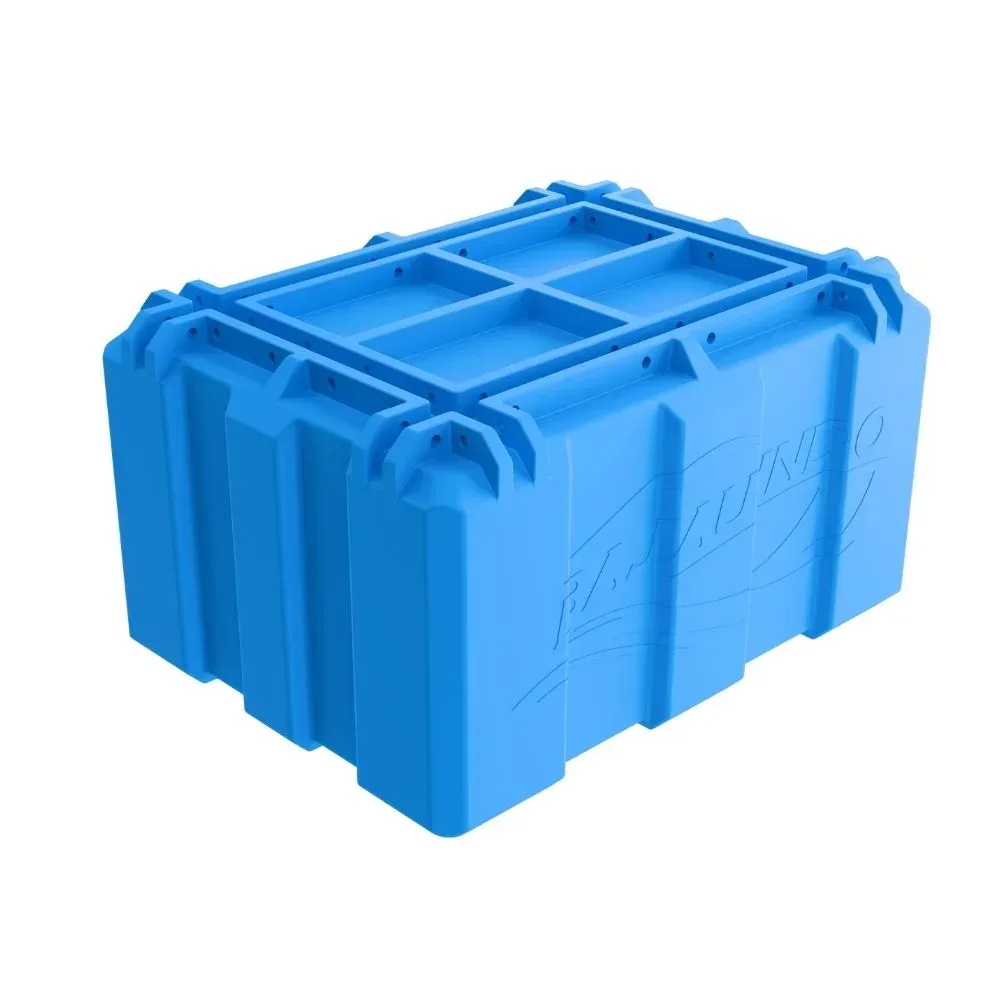
A single blue Block Pod with reinforcing grooves on its side. Source: Bajau Indo 3D product render
Locks, Accessories, and Frame Completeness
Besides the pontoons, a delivery usually includes supporting components. Match their quantities against the packing list: locks or connectors between units, bolts and nuts, frame components, decking, and accessories such as railings or ladders if ordered. Small components are easily lost, so store them in labelled containers as soon as they have been counted.
For the frame, check the straightness of members, the condition of the protective coating and the bolt holes. A frame bent during shipping can make assembly difficult and should be recorded from the start.
Temporary Storage, Documentation, and Reporting
If the pontoons are not assembled straight away, store them on a flat, clean area. Avoid placing pontoons on sharp stones, metal or debris, and keep them away from heavy-equipment traffic. If storage lasts a while, tie down or shelter the stack from strong winds so units are not shifted or overturned.
Documentation is the key to effective reporting. Take the following steps:
- Photograph the whole stack of pontoons when the truck bed is opened.
- Photograph each finding from close up and from mid-range, with a unit marker.
- Record findings on the handover report or delivery note before signing.
- Send a written report with photos to the supplier as soon as possible.
Keep the results of the delivery inspection with the project documents, as these records are useful again when the completed work is handed over to the owner.
The follow-up procedure depends on what was agreed in the purchase contract, so understand its terms before the goods arrive. Details of a module widely used for docks can be found on the Block Pod page. Once installed, inspection continues as routine maintenance, as in our floating dock inspection checklist.
Frequently Asked Questions
Who should carry out the pontoon inspection on delivery?
Ideally a site supervisor or a representative of the project owner who understands the working drawings and the packing list. If possible, do it together with the driver or the shipper's representative so that findings are witnessed by both parties.
Are small scratches on the pontoon shell dangerous?
Shallow surface scratches are generally cosmetic, but they should still be recorded. Deep scratches, cracks or tears should be photographed and reported so the supplier can assess them before the unit is installed.
What if the number of units received does not match?
Record the difference on the delivery note or handover report before signing, then contact the supplier with photos and the document number. Do not start assembling with a shortfall without confirmation, because the pontoon arrangement is calculated for a specific configuration.
Waiting for a pontoon delivery or preparing your next project? The Bajau Indo team can help explain the component list and the unit types you will receive. Contact us via WhatsApp 0878-5931-4314 or at marketing@bajauindo.com.
Written by
Tim Redaksi Bajau Indo
Tim Teknis & Redaksi
Tim teknis dan redaksi Bajau Indo — produsen dermaga apung, kubus apung, dan ponton modular LLDPE dari Sentul, Bogor.
Tags
Share this article: