Water Hyacinth Control: A Mechanical Strategy Using Floating Collector Units
Water hyacinth control needs a system, not just a machine. Learn the role of floating conveyor units, barriers, transport to land and worker safety.
Seen from a bridge, a green mat across a lake can sometimes look like a garden. For sluice-gate operators or tourism managers, however, that view signals a big job ahead. Water hyacinth grows quickly, interlocks, and drifts with the wind and current until it piles up at narrow points. This article discusses mechanical water hyacinth control, with floating collector units as part of a more complete system.
Why Water Hyacinth Is a Problem for Water Managers
Water hyacinth is a free-floating aquatic weed. In small amounts, the plant causes little disruption. Problems arise when its growth gets out of control and covers much of the surface. In general, the impacts managers often face are:
- Covered surface: less sunlight reaches the water and water quality can be affected.
- Restricted flow: thick mats slow the flow in rivers, drains and canals.
- Clogged sluice gates and pumps: piles of plants press against sluice gates and block screens.
- Disrupted tourism: boats struggle to move, docks are blocked and the view deteriorates.
- Trapped waste: plastic and other litter get caught between the plants and become harder to remove.
Mechanical Water Hyacinth Control
There are several approaches to water hyacinth control, and some require specific environmental assessment. The mechanical approach, which physically lifts the plants out of the water, is widely chosen because results are immediately visible and nothing is added to the water.
Manual removal by hand or net is still relevant for small areas. For large mats, floating collector units help speed up the work. The choice between manual methods and a floating unit usually depends on the size of the mat, access to the bank and how often cleaning is needed. Such units usually have an inclined ramp conveyor at the front that lifts plants from the surface onto a storage deck, after which the unit moves to an unloading point on the bank. Unit components and scale are explained in more detail in the article floating trash collectors: components, unit scale and the data to prepare.
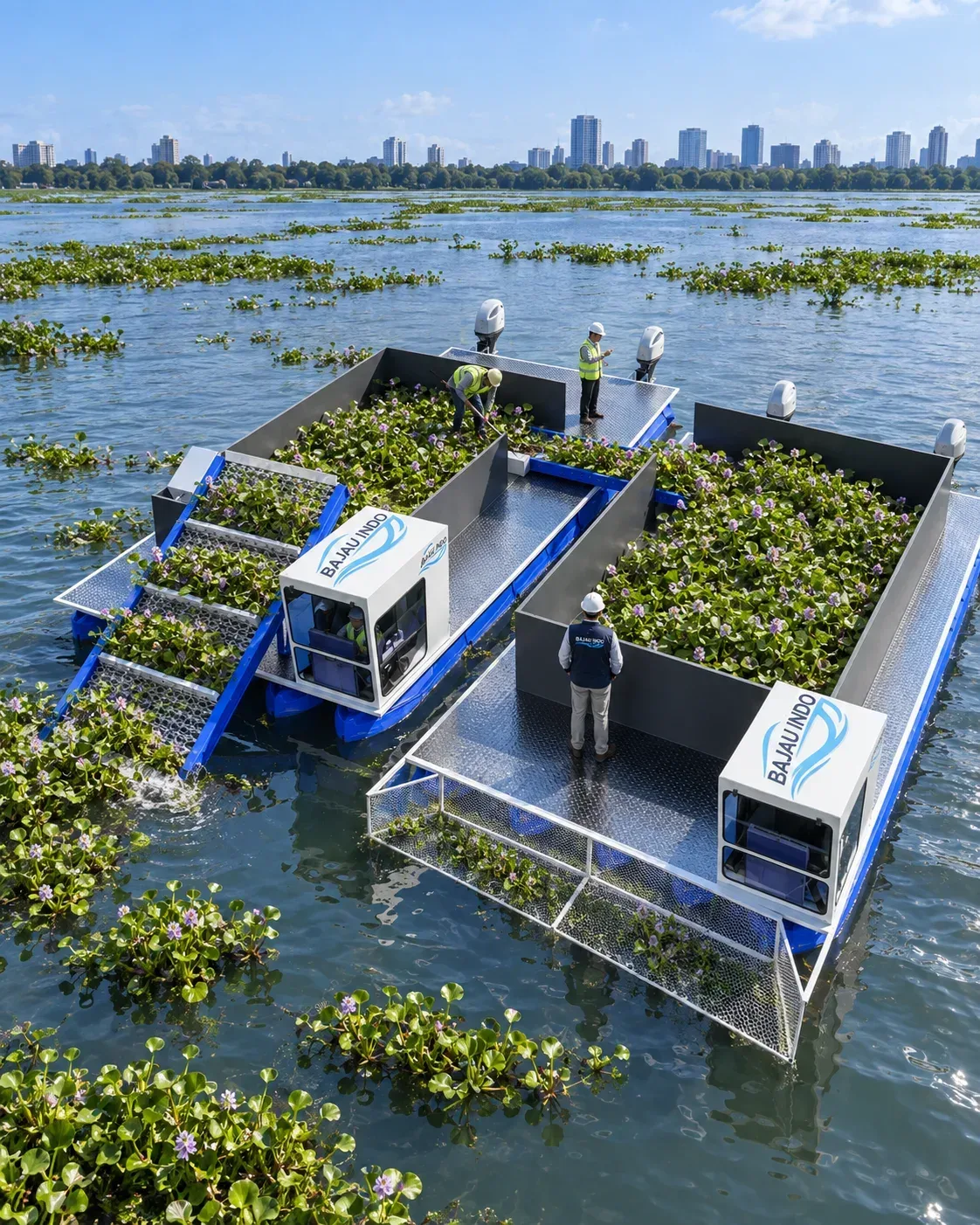
Illustration of two trash collector units side by side, one fitted with a conveyor, with decks full of water hyacinth. Source: Bajau Indo visual illustration (AI-generated) — not a project photo
Under the Bajauindo Trash Collector brand, Bajau Indo has delivered trash collector units in Palembang, Makassar (with a ramp conveyor) and Bandung, as well as a manual trash collector unit at Kebun Raya Bogor. You can see the list on the Bajau Indo projects page.
A Complete System: Barriers, Collectors and Transport
A collector unit works more effectively when supported by other components. Sustainable water hyacinth control is usually organised as the following chain of work:
- A floating barrier to hold or guide the plants towards a defined work area. The principle is discussed in the article river trash barriers: how they work and where to install them. One of Bajau Indo's barrier products is the Belida Trash Barrier; its suitability for thick mats needs to be assessed site by site.
- A floating collector unit that lifts the plants from the water onto the deck.
- An unloading point on the bank with vehicle access and a temporary draining area.
- Transport on land to an agreed processing site.
- Routine monitoring so that new mats are dealt with before they spread.
Without a clear unloading point and transport, the plants that have been lifted simply move elsewhere and risk returning to the water when it rains.
Worker Safety in the Field
A mat of water hyacinth can look solid, but it cannot be walked on. Worker safety must therefore be part of the work plan from the start. In general, the following practices are worth applying: life jackets are always worn when working on or near the water, workers operate at least in pairs, and communication equipment is available. Work should also be postponed during strong currents, high winds or lightning.
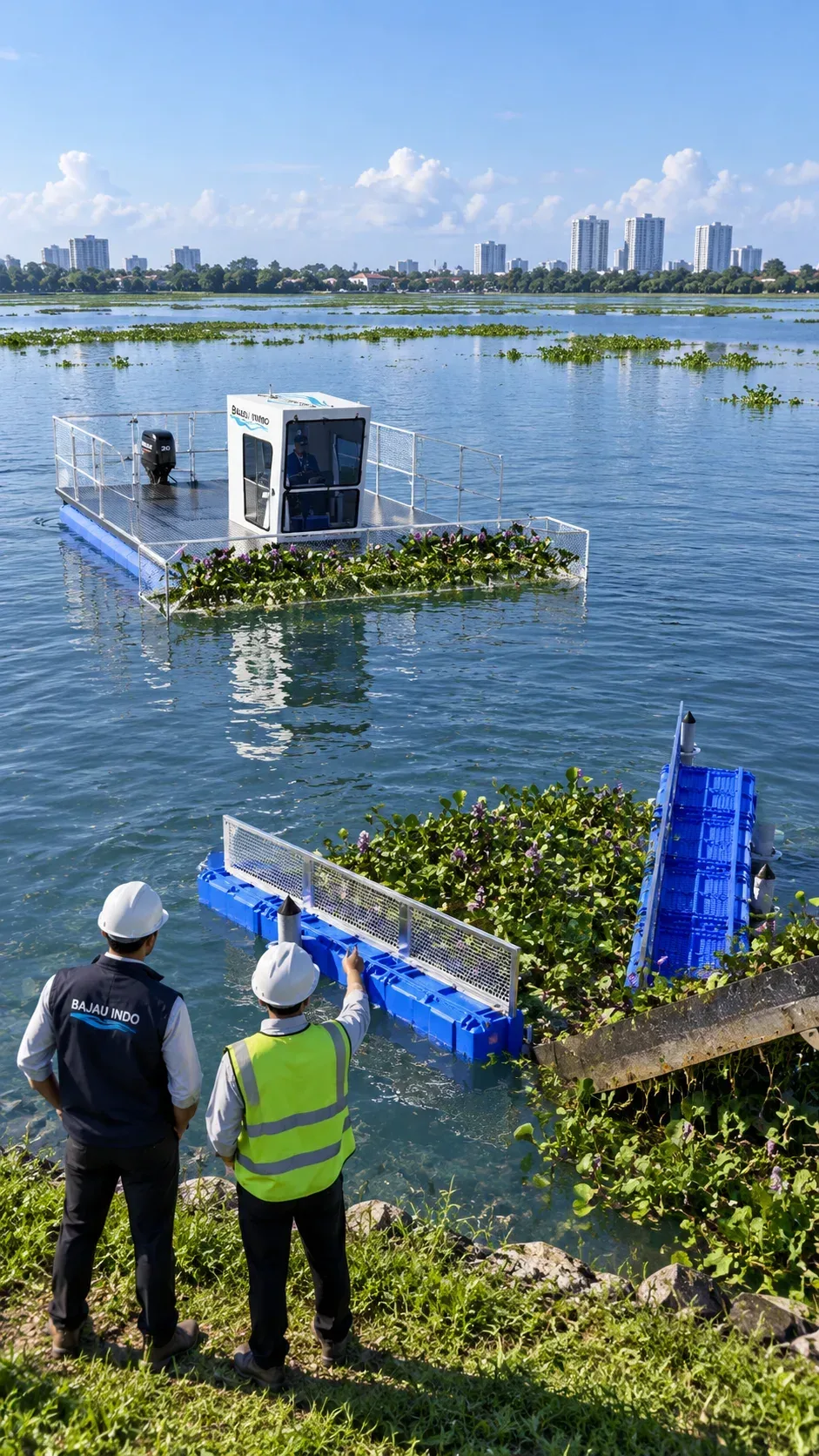
Illustration of two helmeted workers on the bank observing a trash collector unit and a pile of water hyacinth. Source: Bajau Indo visual illustration (AI-generated) — not a project photo
Gloves and work boots protect against sharp objects caught among the roots. Moving parts such as the conveyor also need a safety boundary so that workers do not approach while the machine is running.
Making Use of the Harvested Biomass
Plants that have been lifted out should not be left piled up on the bank. In general, water hyacinth can be turned into compost after draining and shredding, or dried as material for woven crafts. This can involve community groups or small businesses around the water body, so lake cleaning also brings added value to local residents.
Before choosing how to use the biomass, make sure the draining and processing area is far enough from the water's edge so that plant remnants are not carried back. Agree from the outset who is responsible for transport and processing, for example the relevant agency, the area manager or a community partner. Clear roles are often what separates sustainable water hyacinth control from a one-off clean-up.
Frequently Asked Questions
Can water hyacinth be eliminated completely?
In general, water hyacinth is difficult to eliminate completely because it regrows easily from plant remnants. Water hyacinth control is therefore more realistically designed as a routine programme. Regular monitoring helps the team act before mats spread.
Can a trash collector unit also lift plastic waste?
Floating collector units are basically designed to lift floating material, including litter. However, a mix of plants and waste requires sorting at the unloading point. The unit configuration should be matched to the type of material most often found at the site.
What data should be prepared before a consultation?
Prepare photos and an estimate of the mat area, the width and depth of the water, current conditions, and possible locations for an unloading point. Information on vehicle access to the bank is also important. This data helps the team determine the unit scale and system layout.
Want to set up a water hyacinth control programme for the lake, reservoir or river you manage? Discuss your site's needs with the Bajau Indo team via WhatsApp 0878-5931-4314 or send your initial data to marketing@bajauindo.com.
Written by
Tim Redaksi Bajau Indo
Tim Teknis & Redaksi
Tim teknis dan redaksi Bajau Indo — produsen dermaga apung, kubus apung, dan ponton modular LLDPE dari Sentul, Bogor.
Share this article: