Reservoir Sediment Management: The Role of Dredging and Dewatering in Reservoirs and Small Reservoirs
Understand reservoir sediment management: the role of dredging and dewatering, when modular platforms make sense, and the 3 × 5 m Modular Dredger.
A small reservoir whose capacity was once enough to get through the dry season is slowly shrinking. The water surface looks just as wide, but the depth is decreasing because silt keeps settling year after year. Managers of reservoirs, small reservoirs, and holding ponds in many regions face a similar challenge, which makes reservoir sediment management an important part of water infrastructure maintenance.
This article gives a general explanation of the role of dredging and dewatering, when modular platforms are relevant, and introduces the Modular Dredger / Dewatering Boat from Bajau Indo.
Why Sediment Builds Up
In general, sediment comes from soil eroded in the catchment area, which is then carried by inflows into the reservoir or small reservoir. When the flow slows down in the water body, soil particles settle on the bottom. Plant debris and organic matter add to the layer of deposits. This process is continuous, so reservoir sediment management is best seen as periodic maintenance work, not a one-off action.
Common impacts of sedimentation in small reservoirs and reservoirs include:
Reduced water storage volume.
Inlets and water gates become clogged more easily.
Water quality can decline, especially in shallow areas.
Supporting functions, such as flood control or tourism, are also disrupted.
Trash carried by the flow can also worsen clogging. Upstream, the Belida Trash Barrier can be considered to hold back floating trash before it enters the water body.
Dredging and Dewatering: Two Complementary Stages
Reservoir dredging aims to remove deposits from the bottom of the water body. However, dredged material is usually still mixed with a lot of water, making it heavy, difficult to transport, and in need of a large holding area. This is where dewatering comes in: reducing the water content of that material.
Dredging — Purpose: Removing sediment from the bottom; General considerations: Depth, sediment type, pumping or dredging method
Dewatering — Purpose: Reducing the material's water content; General considerations: Processing area, handling of separated water
Final handling — Purpose: Transporting or reusing the material; General considerations: Disposal site, permits, reuse opportunities
When both stages are planned together, the workflow becomes more streamlined and the risk of recontamination around the site can be reduced. Conversely, dredging without a clear dewatering plan can leave piles of wet silt on the water's edge, which risk being washed back in by the next rain.
When Modular Platforms Are Relevant
Not every sediment job requires a large dredging vessel. In general, a modular floating platform can be an option in the following situations:
The water body is relatively enclosed and difficult for large vessels to enter, such as small reservoirs, retention ponds, or water treatment plant ponds.
The deposit area is out of reach of heavy equipment operating from the bank.
The reservoir or small reservoir must remain in operation and cannot be drained.
Maintenance is carried out in stages or periodically, not once on a large scale.
The unit needs to be moved between sites managed by a single party.
The principle of pontoons as supports for equipment on the water is discussed further in the article on the functions of pontoons and floating cubes. For very large volumes or certain conditions, other methods may be more suitable. The final choice depends on a site survey and technical analysis.
Introducing the Modular Dredger / Dewatering Boat
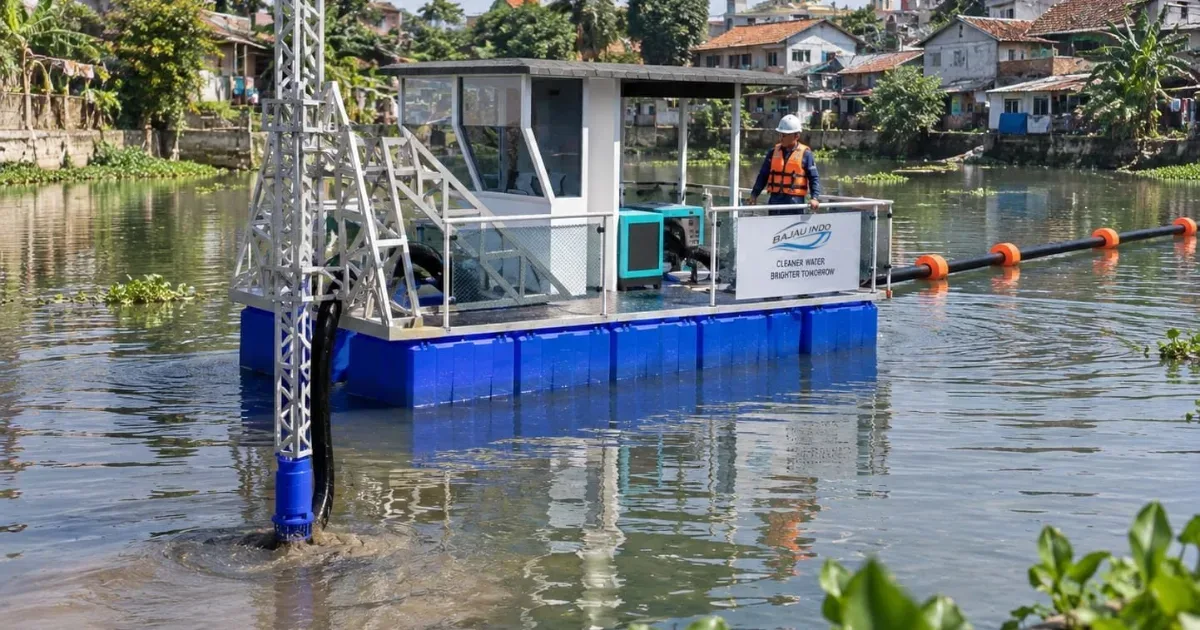
The Modular Dredger / Dewatering Boat is a 3 × 5 m modular platform that integrates pumping, dredging, and dewatering in a single floating work unit. According to its product page, this unit is intended for:
lakes and reservoirs,
rivers and canals,
mangroves and swamps,
reclamation and construction areas,
ponds, small reservoirs, and water treatment plants.
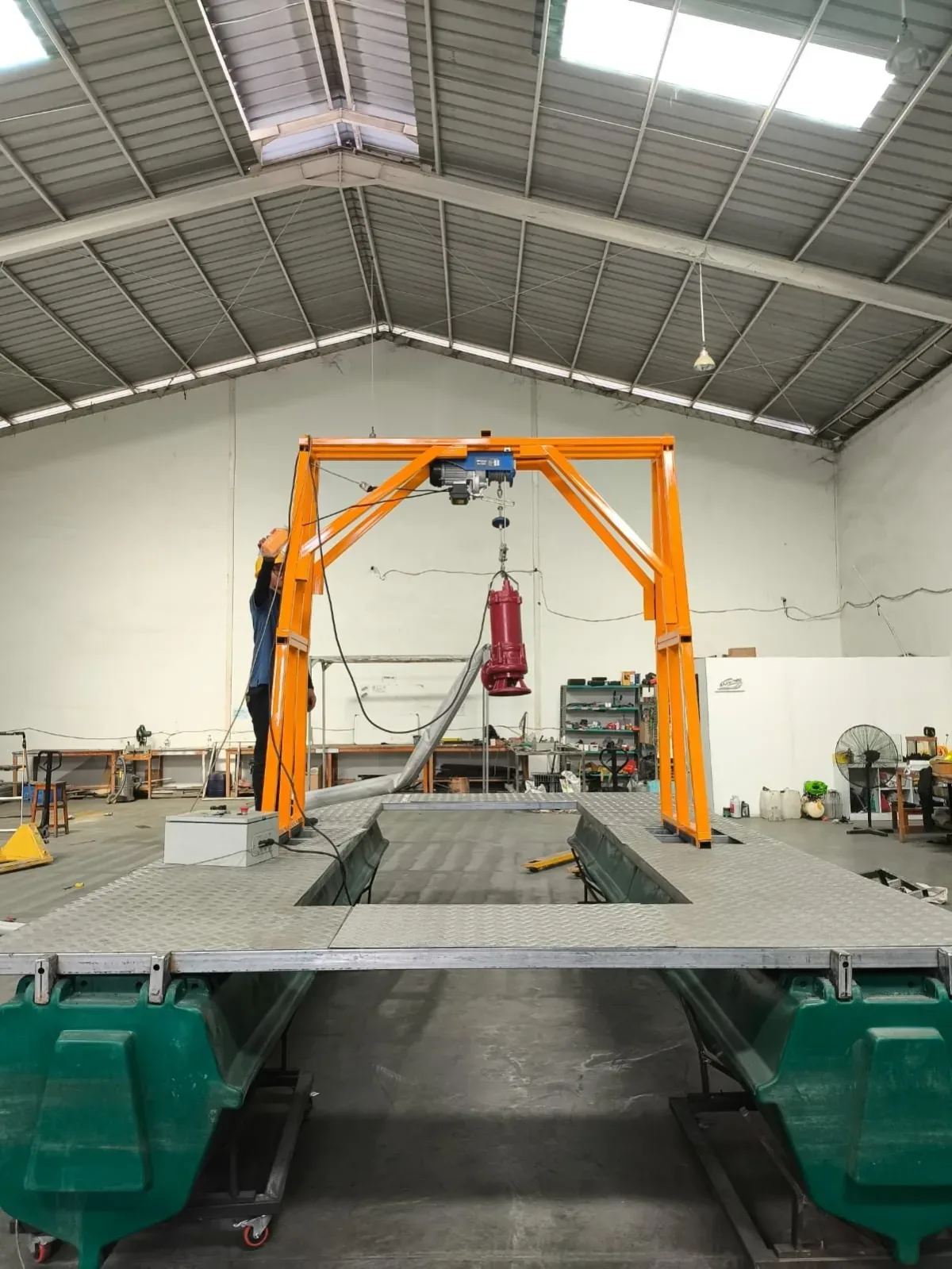
Floating work platform with a gantry and suspended pump during assembly in the workshop. Source: Bajau Indo documentation
Bajau Indo's experience with work platforms on the water is also recorded in its project portfolio, including a floating dredger in Bogor. The equipment configuration for each site is still determined after the requirements and field data have been assessed. Because it is modular, the unit can be assembled on the edge of a water body with limited access, then moved once work at one site is complete.
Data to Prepare
Before discussing with a supplier, prepare the following data so that the initial assessment of your reservoir or small reservoir sediment management is more focused:
The area of the water body and estimated depth at several points.
Sediment type, for example fine silt, sand, or a mix.
Estimated volume to be removed and the target timeframe for the work.
Location for holding or disposing of the material.
Vehicle access and an assembly area at the water's edge.
Permit status and the parties that need to be involved.
This data does not have to be complete from the start. Basic information is enough to begin the discussion, which can then be supplemented gradually through a field survey.
Frequently Asked Questions
What is reservoir sediment management?
Reservoir sediment management is a series of efforts to control, remove, and handle deposits that accumulate at the bottom of a reservoir or small reservoir. These efforts include upstream erosion control, dredging, dewatering, and handling of dredged material. The goal is to keep the water storage function working.
What is the difference between dredging and dewatering?
Dredging is the process of removing sediment from the bottom of a water body, while dewatering is the process of reducing the water content of the dredged material. The two complement each other because drier material is generally easier to transport and handle.
Is the Modular Dredger suitable for a small reservoir?
The Modular Dredger / Dewatering Boat measures 3 × 5 m and, according to its product page, is intended for, among others, ponds, small reservoirs, and water treatment plants. Its suitability for your small reservoir still needs to be assessed based on depth, sediment type, and site access.
If sediment is starting to erode the capacity of the reservoir or small reservoir you manage, the first step is to map the site conditions. Share data and photos of the water body with the Bajau Indo team via WhatsApp 0878-5931-4314 or marketing@bajauindo.com to discuss a suitable approach.
Written by
Tim Redaksi Bajau Indo
Tim Teknis & Redaksi
Tim teknis dan redaksi Bajau Indo — produsen dermaga apung, kubus apung, dan ponton modular LLDPE dari Sentul, Bogor.
Share this article: