Modular Pontoon Delivery: Site Data, Unloading, and Storage
Plan the delivery of modular pontoons to your project site: address data, truck access, unloading hours, stacking area, temporary storage, and the assembly team's schedule.
The truck has reached the estate gate, but the road to the lakeshore turns out to be narrow and blocked by a vehicle height barrier. This happens more often than people expect, and it can almost always be prevented. Smooth modular pontoon delivery does not start when the goods are loaded; it starts when the project owner and the supplier agree on the site data at the outset.
This article covers floating-project logistics from the receiving side: what information to prepare, how receiving goods on site works, and how to store pontoons and frames before the assembly team starts work.
Why Modular Pontoon Delivery Needs Planning
Modular pontoons are shipped as separate units, not as one large structure. The advantage is that the goods can travel by ordinary road and, at many sites, be unloaded without heavy equipment. However, there can be many units, plus frames, decking, bolts and accessories. Without a plan, the load can pile up in the wrong place, block residents' access, or have to be moved twice.
Delivery costs and schedules depend on the location, volume and access conditions, so they are always calculated per project. These factors are also discussed in the article on factors that affect the cost of a floating dock.
Site Data to Prepare Before the Goods Leave
Most of this data is already collected during the floating dock site survey. For modular pontoon delivery, make sure the following information is available and sent to the supplier in writing:
- Full address and map pin: including the actual unloading point, not just the address of the estate management office.
- Truck access: road width, sharp bends, bridges, height barriers, and the largest type of vehicle allowed in.
- Unloading hours: the estate's operating hours, truck bans at certain times, and entry permits from the management or security staff.
- Stacking area: flat ground large enough, as close as possible to the launch point, and not in the way of residents' or guests' traffic.
- Receiving contact: the name and number of the person authorised to receive and check the goods on site.
If large vehicles cannot get in, the delivery can be planned in stages or the load transferred to smaller vehicles at a transit point. This decision should be made before delivery day, not while the truck is already waiting at the gate.
Manual Unloading: Making Use of Relatively Light Units
One advantage in modular pontoon delivery is the weight per unit. According to the official specifications, the weight per unit is 23 kg for the Nose Pod, 33 kg for the Body Pod, 40 kg for the Block Pod and 32 kg for the Nusa Dock. At these weights, units can generally be unloaded and moved by hand, so a crane is not always needed.
Although relatively light, each unit still needs to be handled properly. In general, recommended practice is to:
- Lift units rather than drag them over asphalt, rough concrete or stones.
- Prepare a carrying route free of sharp objects such as steel offcuts, nails or broken concrete.
- Separate frames, decking and bolts into groups so they are easy to count.
- Make sure workers wear suitable gloves and footwear.
Metal frames and decking materials are usually longer than the pontoons and need a different lifting method. Make sure there are enough hands when these parts are unloaded.
Receiving Goods on Site and Temporary Storage
Receiving goods on site should include checking quantities against the packing list. Record any shortfall or damage on the spot, with photos, before the handover document is signed. This simple habit makes it easier to resolve any issue later on.
For temporary storage, place the pontoons on a flat, clean surface. The LLDPE pontoon shell is designed to be UV resistant, but the stacking area still needs to be safe from vehicle traffic, muddy puddles, and sparks from nearby welding or metal cutting. Stack the units stably so the wind cannot shift them, and fence off the area if the public passes through it.
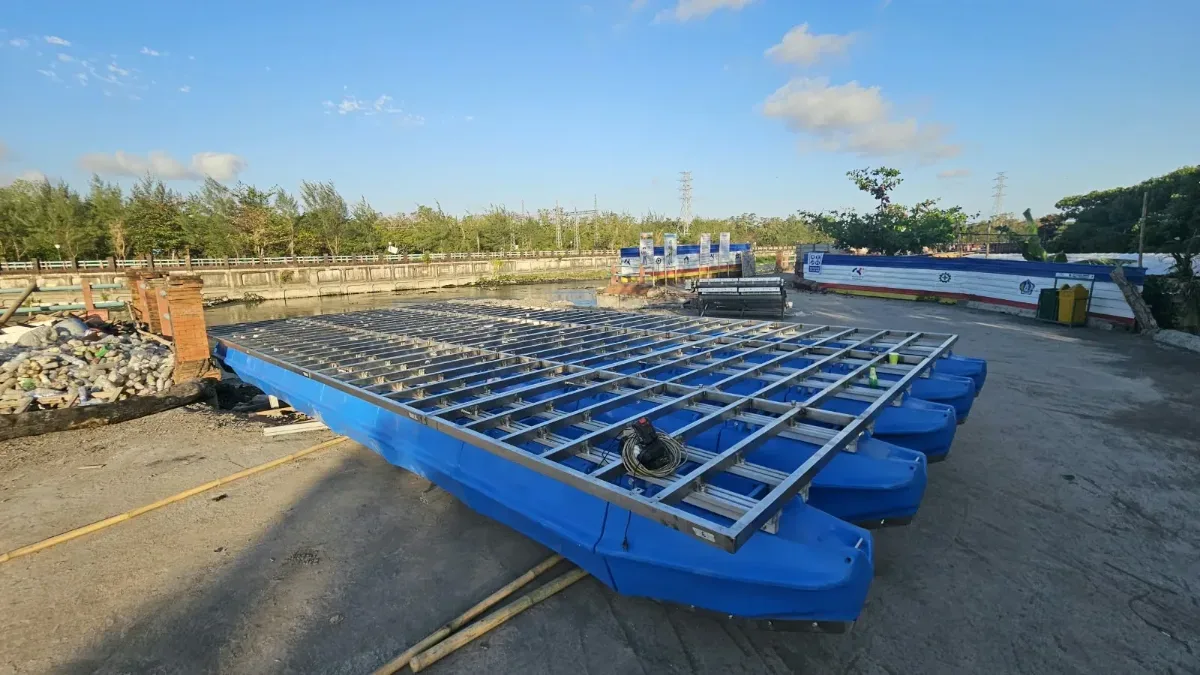
Blue pontoon platform with a grid frame in an open area near the water, ready for decking. Source: Bajau Indo documentation
Frames and small components are best stored indoors or under a tarpaulin, especially bolts, nuts and accessories that are easily lost.
Coordinating the Schedule with the Assembly Team
Ideally, the goods arrive not too long before the assembly team starts work. Pontoons left waiting in the open for too long face a higher risk of being scratched, scattered or moved by others. Conversely, a team that arrives before the goods are complete loses working time.
Appoint one person on the project owner's side to coordinate with the supplier, the estate management and the assembly team. Reconfirm the unloading schedule shortly before delivery day, especially if the site is in a housing estate, a tourist attraction or a government area with access rules. You can see examples of installation sites on the Bajau Indo project portfolio page.
Frequently Asked Questions
Does modular pontoon delivery always require a crane?
Not always. According to the official specifications, the weight per unit ranges from 23 to 40 kg, so many units can be unloaded by hand. The need for lifting aids still depends on site conditions, the distance to the launch point, and other components such as frames.
Who should receive the goods on site?
Ideally, one person appointed by the project owner who understands the packing list. They check the quantity and condition of the goods, document their findings, then sign the handover. With a single person in charge, information does not get lost between many parties.
What if the truck cannot reach the water's edge?
Units can be unloaded at the nearest reachable point, then moved by hand or by small vehicle. This needs to be discussed early because it affects manpower, scheduling and cost. Send photos of the access route to the supplier so the plan is realistic.
Preparing a floating project and want your goods to arrive without a hitch? Send the address, photos of the access road and your planned stacking area to the Bajau Indo team via WhatsApp 0878-5931-4314 or email marketing@bajauindo.com. We will help you put together a modular pontoon delivery plan that suits your site conditions.
Written by
Tim Redaksi Bajau Indo
Tim Teknis & Redaksi
Tim teknis dan redaksi Bajau Indo — produsen dermaga apung, kubus apung, dan ponton modular LLDPE dari Sentul, Bogor.
Tags
Share this article: