Floating Dredging Platforms: Stability, Equipment Mounting, and Mobilization
What does a floating dredging platform need? Learn about stability, pump and gantry mounting, and mobilization, with an example of a floating dredger in Bogor.
Sediment that settles in rivers, channels, or small lakes is often in spots that are hard to reach. An excavator on the bank can only reach part of it, while a large dredging vessel may not be able to enter narrow, shallow waters. In situations like this, a floating dredging platform is worth considering: a floating work base where the pump, gantry, and operator work directly above the sediment.
This article covers the three core requirements of such a platform—stability, equipment mounting, and mobilization—along with an example of a floating dredger built by Bajau Indo in Bogor.
The Role of Work Pontoons in Dredging
In general, small- to medium-scale dredging requires three components: a means of lifting material from the bed, a line to convey it, and a place to hold or process it. A work pontoon provides a stable base for the first component. On top of it you can mount the pump, a gantry to raise and lower the pump, a generator set, and working space for the operator.
With a floating work base, river or lake dredging can be carried out from the middle of the water without building temporary land access. The basic role of pontoons as supports for structures on water is also covered in our article on the functions of pontoons and floating cubes.
Stability Requirements: Static and Dynamic Loads
A work platform on water carries two types of load. Static loads come from the frame, deck, generator set, pump, and other equipment in fixed positions. Dynamic loads come from work activity. In general, the factors that affect stability include:
The position of the center of gravity, which shifts when the gantry raises or lowers the pump.
Vibration from the pump and generator set during operation.
Pull from the hose carrying the slurry of mud and water to the discharge point.
Operator movement on the deck.
Currents and wind pushing the platform out of its working position.
For this reason, heavy equipment on a floating dredging platform should be arranged in balance about the platform's axis, and total buoyancy needs to leave a reserve above the total load. For an initial picture of the relationship between load and the number of pontoons, you can try the Platform Pontoon configurator. Its results are initial estimates; the overall structural capacity is still calculated per project by the engineering team.
Pump and Gantry Mounting, and Equipment Layout
The gantry suspends the pump and sets its depth. The gantry frame needs to be firmly connected to the platform's main frame so the pump load is distributed evenly across the pontoon assembly. The choice of frame material, such as aluminum or galvanized steel, depends on the water environment and strength requirements. Mounts for the generator set and electrical panel should also be raised above the deck surface to protect them from splashing water.
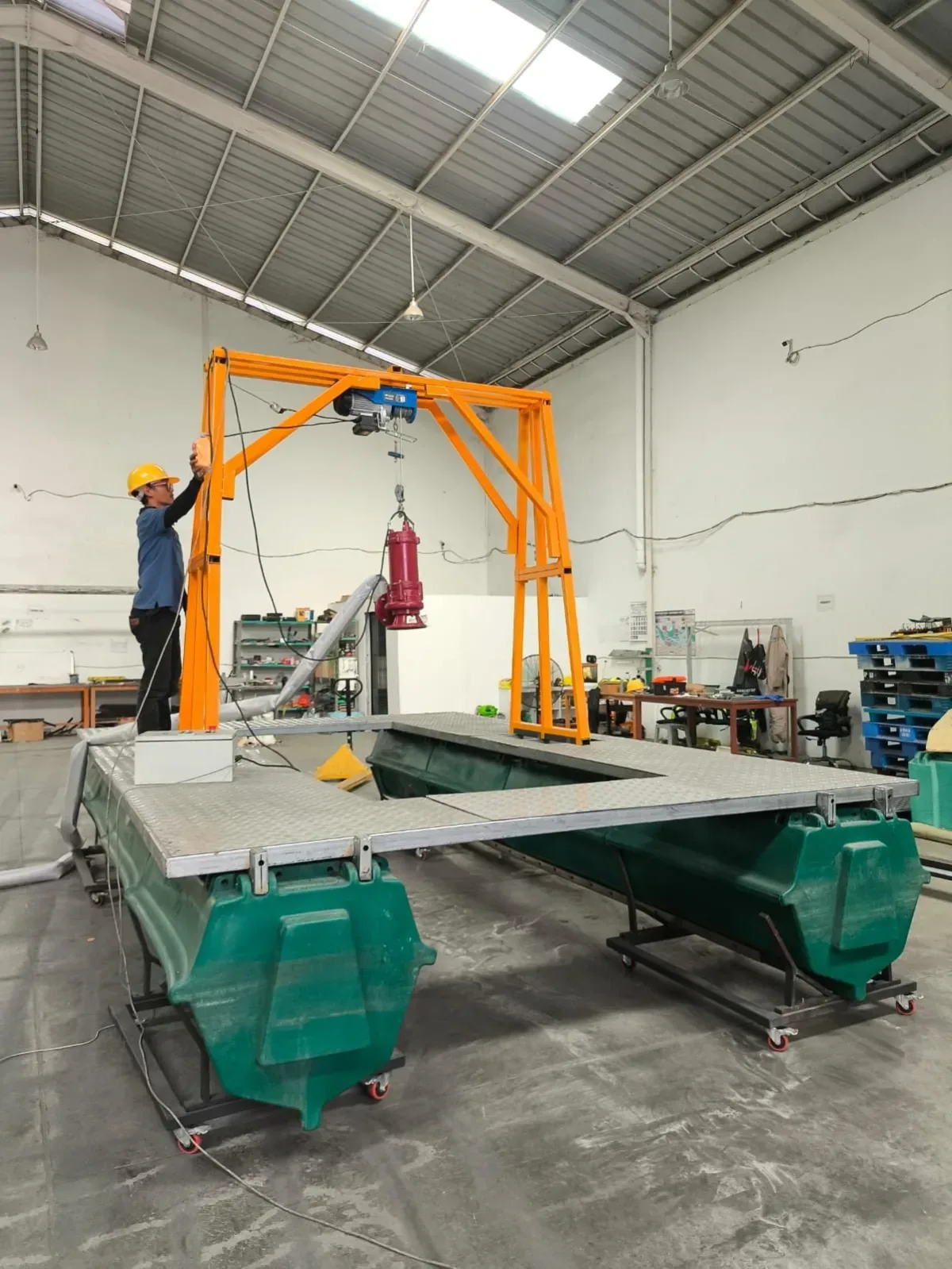
Assembly of a gantry frame on a work pontoon platform in the workshop. Source: Bajau Indo documentation
Commonly considered layouts include:
The pump and gantry placed on one side or in the center with an opening, depending on the working method.
The generator set positioned to counterbalance the pump load.
An unobstructed operator walkway fitted with safety railings.
Hose connection points that are easy to reach for routine inspection.
Mobilization and On-Site Assembly
Dredging sites are often far from ports or main roads. This is where a modular pontoon system offers flexibility: units are shipped separately and then assembled at the water's edge. As an indication of module weights in the Bajau Indo pontoon system, the official specifications list the Body Pod at 33 kg per unit and the Block Pod at 40 kg per unit.
Before mobilization, a few general points should be confirmed: vehicle access to the site, a level area for assembly, a launch point into the water, and how the platform will be held in position while working, whether with anchors or lines to the shore. Once the work is complete, the platform can be disassembled and moved to the next site. For contractors handling several dredging sites in turn, this assemble-and-disassemble capability means one floating dredging platform can be reused on other projects. A disassembly plan should be prepared from the outset so that equipment, frame, and pontoons are removed in an orderly sequence.
Example: Floating Dredger in Bogor
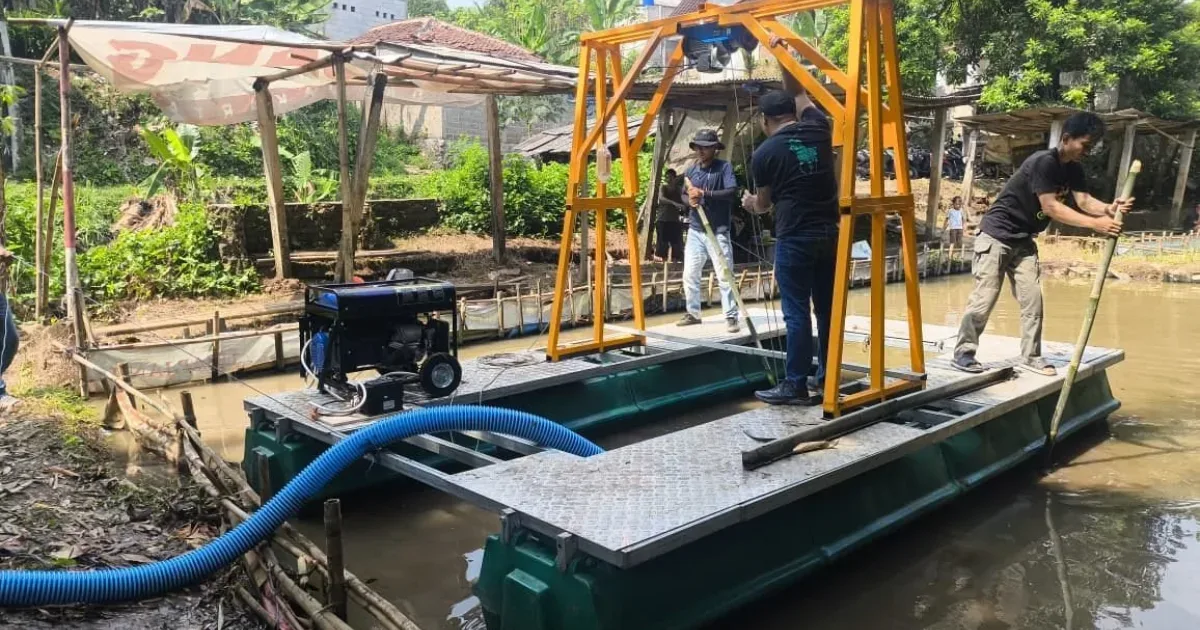
The Bajau Indo project portfolio includes a floating dredger in Bogor. Its documentation shows a floating platform on a river with an orange gantry, a generator set, blue hoses, and workers operating the equipment. The workshop photo above shows the assembly stage of a platform with a similar gantry before it was lowered into the water.
For more standardized needs, Bajau Indo also offers the Modular Dredger / Dewatering Boat, a 3 × 5 m modular platform that integrates pumping, dredging, and dewatering in a single floating work unit.
Frequently Asked Questions
What is a floating dredging platform?
A floating dredging platform is a floating work base where the pump, gantry, generator set, and operator work directly above the sediment area. It enables dredging in waters that are hard to reach with land-based equipment. Its size is tailored to the equipment and site conditions.
Can a dredging platform be moved to another site?
With a modular system, the platform can be disassembled into pontoon units and frames, then shipped and reassembled at the next site. How easily it can be moved still depends on road access, the assembly area, and the size of the installed equipment.
What data should be prepared to design a dredging work pontoon?
Prepare the type and weight of the pump, generator set, and other equipment to be installed, plus the water depth, current conditions, and access to the site. Site photos and an estimate of the working area also help the team develop an initial concept.
Planning dredging work in a river, channel, or lake? Send your equipment list and site photos to marketing@bajauindo.com, or discuss it directly with the Bajau Indo team via WhatsApp 0878-5931-4314 so your work platform concept can be reviewed promptly.
Written by
Tim Redaksi Bajau Indo
Tim Teknis & Redaksi
Tim teknis dan redaksi Bajau Indo — produsen dermaga apung, kubus apung, dan ponton modular LLDPE dari Sentul, Bogor.
Tags
Share this article: