SOP for Trash Cleaning Boats: A Daily Operating Guide for Managers
A guide to drafting an SOP for trash cleaning boats for agencies and managers: pre-departure checks, PPE, communication, routes, record-keeping, weather limits and daily maintenance.
The unit has arrived, the workers have been trained and the schedule has been handed out. Then one morning heavy rain falls from dawn and the river level rises. Who decides whether the unit goes out or stays put? Questions like this should be answered before that day comes, and the place to answer them is a written SOP for trash cleaning boats. This guide helps agencies and water managers draft a daily operating SOP, from the morning check to maintenance after the unit returns.
A written SOP keeps working methods consistent between workers and shifts, makes it easier to train new staff, and provides a basis for evaluation and budget planning. The principles below are general and need to be adapted to the type of unit, the water conditions and your agency's rules.
Pre-Departure Checks in an SOP for Trash Cleaning Boats
The first part of the SOP is a checklist completed every day before the unit leaves its mooring. Examples of items to include:
- Hull and pontoons: check for deep scratches, cracks or loose joints.
- Outboard engine: fuel, propeller condition and other checks according to the engine manufacturer's manual.
- Work equipment: conveyor or net, the deck storage area, and cleanliness from the previous operation.
- Safety equipment: a life jacket for every person, a lifebuoy with a throw line, and a first-aid kit.
- Communication equipment: a radio or phone in a waterproof case, with charged batteries.
- Weather and water-level information: checked and recorded before the decision to depart is made.
If a single safety item is not met, the SOP should state clearly that the unit does not depart until the shortfall is fixed.
PPE, Communication and Roles
Every worker wears a life jacket while on the unit or at the water's edge, plus gloves, non-slip work boots and head protection where needed. Also set clear roles within each crew:
- Operator: steers the unit and decides on manoeuvres on the water.
- Deck worker: operates the lifting equipment and watches the storage area.
- Shore supervisor: monitors the unit's movement, prepares the unloading point and serves as the emergency contact.
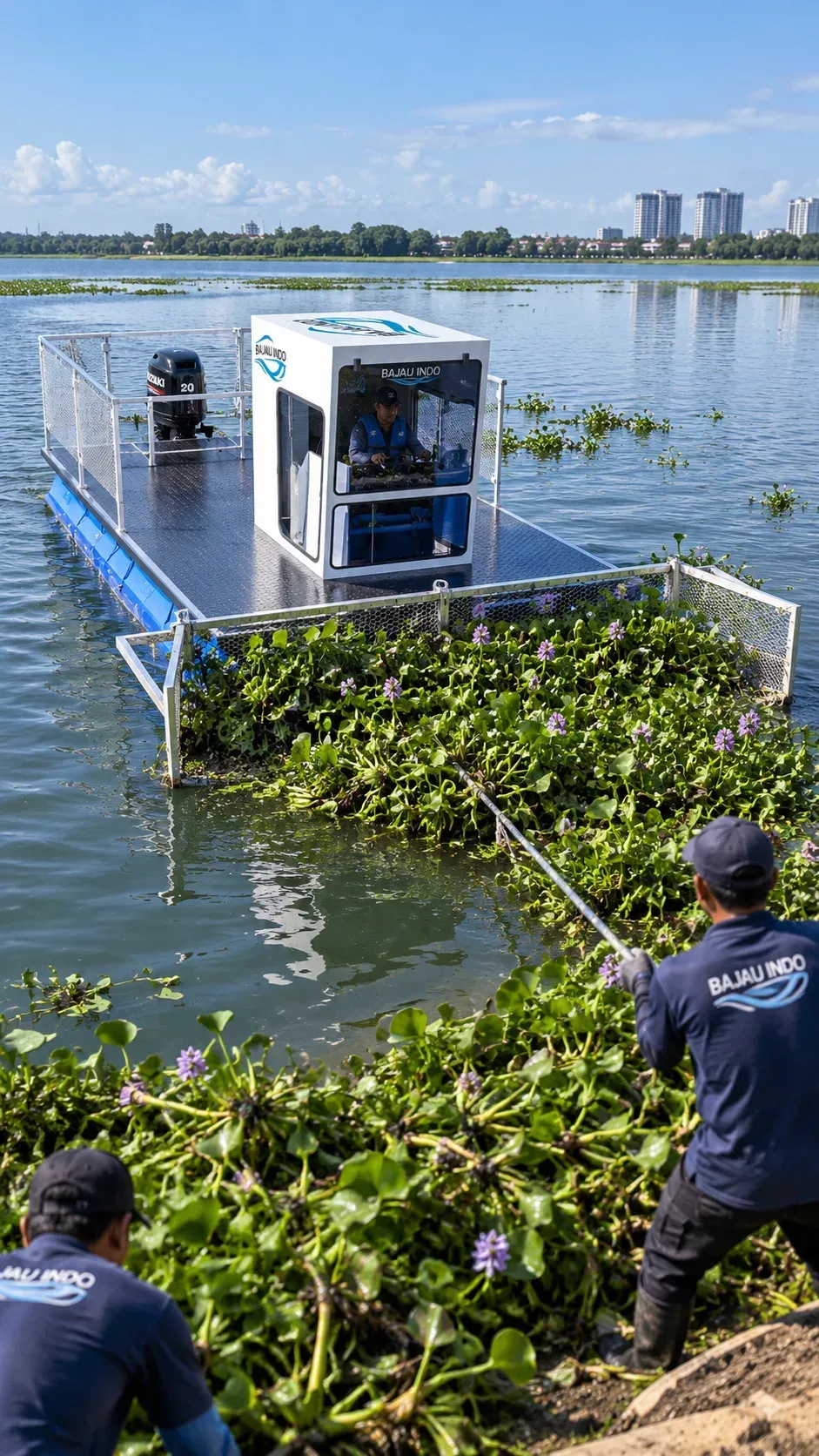
Illustration of a uniformed worker pulling water hyacinth towards a trash collector unit from the bank. Source: Bajau Indo visual illustration (AI-generated) — not a project photo
Set a regular check-in schedule between the unit and the shore supervisor, and agree on simple hand signals for noisy conditions. Safety principles around floating structures are also covered in the floating dock safety guide.
Routes, Unloading Points and Record-Keeping
Divide the water body into several segments and set priority points, such as the area in front of sluice gates, under bridges, or the location of a river trash barrier where waste is held back. The cleaning schedule usually needs to be more frequent in the rainy season, when waste carried down from upstream tends to increase.
Unloading points must have vehicle access and be coordinated with the schedule for transporting waste on land, so waste does not pile up on the bank for too long. After each operation, record the following: date, worker names, segments cleaned, estimated volume in an agreed unit (for example number of sacks or bins), dominant type of waste, and any incidents. These records form the basis for evaluating routes and unit requirements. With routes and unloading points written down, an SOP for trash cleaning boats also helps relief workers follow the same pattern. The data relevant for unit planning is explained in the article floating trash collectors: components and unit scale.
Weather, Floods and When the Unit Stays Put
Write down the criteria for postponement clearly, for example heavy rain, lightning, strong winds, fast currents, rapidly rising water or poor visibility. Also state who has the authority to decide, usually the field coordinator, so workers do not hesitate when conditions worsen. Post these criteria from the SOP for trash cleaning boats as a short list that is easy to read at the guard post.
In general, floods carry logs and heavy objects that are dangerous for both the unit and the workers. After a flood recedes, carry out a thorough inspection of the unit and its mooring before operations resume.
Maintenance After Operation
An SOP for trash cleaning boats does not end when the unit returns to its mooring. Recommended daily closing steps:
- Empty the storage area and rinse the deck, lifting equipment and hull.
- Recheck the pontoons, frame and propeller for wrapped plastic or rope.
- Maintain the engine according to the manufacturer's manual, then secure the fuel.
- Moor the unit correctly and store PPE dry.
- Report any damage or missing equipment to the coordinator.
Bajau Indo trash collector units have been delivered for Palembang, Makassar and Bandung, as listed on the Bajau Indo projects page. Each location has its own character, so the SOP needs to be adapted too.
Frequently Asked Questions
Who should draft the SOP for trash cleaning boats?
Ideally, the SOP is drafted jointly by the field coordinator, the workers who operate the unit day to day, and the official responsible for occupational safety. Input from field workers makes the SOP more realistic. The manufacturer's equipment manuals should also be used as references.
How often should the SOP be updated?
The SOP should be reviewed periodically, for example ahead of the rainy season, and whenever an incident occurs or equipment changes. Daily operating records help identify parts of the procedure that need improving. Each revision should be dated and communicated to all workers.
Is the SOP different for manual and motorised units?
The safety principles are the same, but motorised units need additional items for the engine, fuel and moving parts such as the conveyor. Manual units place more emphasis on work-area limits and the physical condition of workers. Adapt the checklist to the type of unit you operate.
Preparing to operate a trash cleaning unit on the waters you manage? The Bajau Indo team is ready to discuss a unit configuration that suits your routes and working pattern via WhatsApp 0878-5931-4314 or marketing@bajauindo.com.
Written by
Tim Redaksi Bajau Indo
Tim Teknis & Redaksi
Tim teknis dan redaksi Bajau Indo — produsen dermaga apung, kubus apung, dan ponton modular LLDPE dari Sentul, Bogor.
Tags
Share this article: