Floating Walkways: A Guide to Designing Safe and Comfortable Routes on the Water
A good floating walkway feels safe and comfortable to walk on. Learn about path width, railings, non-slip surfaces, lighting, joints and the choice of route shape.
People rarely remember the route they took to reach a dock or cottage on the water, unless it swayed too much, was slippery or was dark. A good floating walkway actually feels unremarkable: visitors walk without hesitation, staff can carry goods freely, and the operator is not busy handling complaints. Achieving that "unremarkable" feeling requires a number of design decisions to be made from the start.
This guide is intended for tourism operators, contractors and technical agencies planning a floating walkway to link tourism units or to lead to a dock.
The Role of Floating Walkways on the Water
A floating walkway is a pedestrian path on the water that floats on the surface rather than resting on piles. Its functions vary: connecting the shore to a dock, linking cottages and gazebos, serving as a tourist trail through mangroves, or acting as a floating bridge on calm water. In tourism areas, the walkway also shapes the visitor flow: where visitors are directed and what they see along the way.
Because it floats, the walkway rises and falls with the water level. This is an advantage on waters where the level changes, and at the same time a source of design challenges that need to be anticipated.
Path Width and Walkway Railings
Path width is determined by who passes and how they pass. A one-way path for visitors strolling at leisure has different needs from a two-way path also used by staff carrying goods or by wheelchair users. In a modular system, the path width also follows the module dimensions. The Nusa Dock pontoon, for example, has an official specification of 150 × 100 × 40 cm, 32 kg in weight and 275 kg of buoyancy per unit, so the path width can be built up from the 100 cm or 150 cm side or multiples of them. On long walkways, consider widening the path at several points as places to stop, take photos or make way for users coming from the opposite direction.
Walkway railings are installed on sides facing the water, especially on paths used by children and tour groups, or over deep water. In general, railings need to be sturdy against people leaning on them, have no sharp ends, and open only at boat boarding points.
Non-Slip Surfaces and Lighting
The path surface determines how safe users feel, especially in the rain or at night. Some points to consider:
- Decking surface: choose a textured or grooved surface that remains safe when wet from rain or splashes.
- Joint gaps: keep the gaps between boards and between segments level so people do not trip.
- Cleanliness: moss and bird droppings make surfaces slippery, so a cleaning schedule should be part of the operator's SOP.
- Lighting: low lights along the path edge or on the railings help users see the walkway edges without glare. Place light points evenly, especially at bends and at the ends of the path.
Segment Joints, Water Level, and Mooring Points
A long floating walkway consists of several segments. The joints between segments need to allow a little movement so the structure can follow the waves without excessive stress, while remaining tight enough to be safe to step on. These joint details directly affect walking comfort.
On the shore side, the walkway is usually connected by a gangway whose slope changes with the water level. The principles are discussed in our article on the length and slope of floating dock gangways. Meanwhile, mooring points hold the walkway so that it does not shift with wind and current. In general, mooring points are placed at the ends of the path, at bends and at intervals along long paths, with their number and type determined by the site survey. The choice of anchors, guide piles and chains is reviewed in our article on floating dock mooring systems.
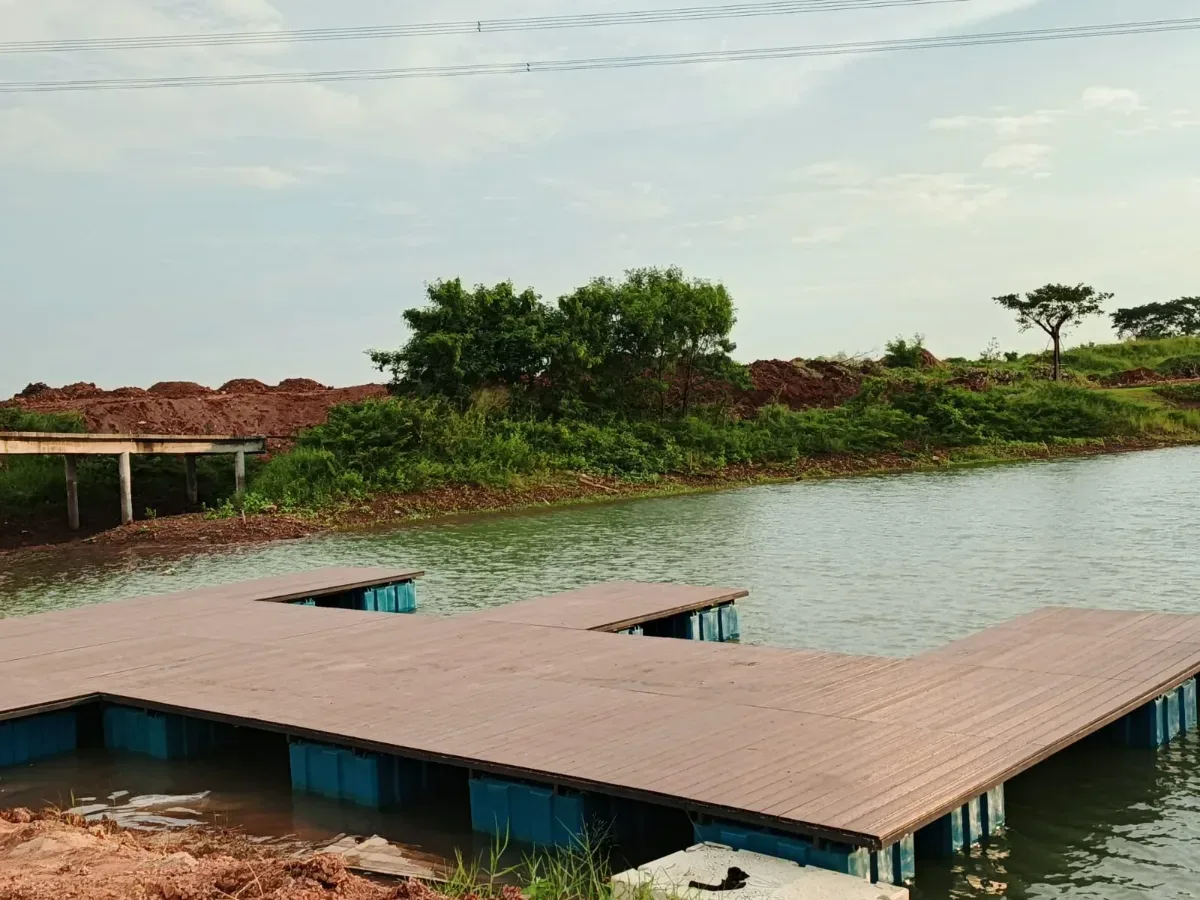
An L-shaped floating dock with brown decking on pontoons, a floating dock project in Serpong, Banten. Source: Bajau Indo documentation
Straight or Zigzag: Choosing the Shape of a Floating Walkway
A straight path is the most compact option: a short walking distance, less material and easier maintenance. It suits dock access where function comes first. L or T shapes are useful when the walkway has to turn towards a berthing area or branch to two destinations, as seen in the floating dock project in Serpong, Banten.
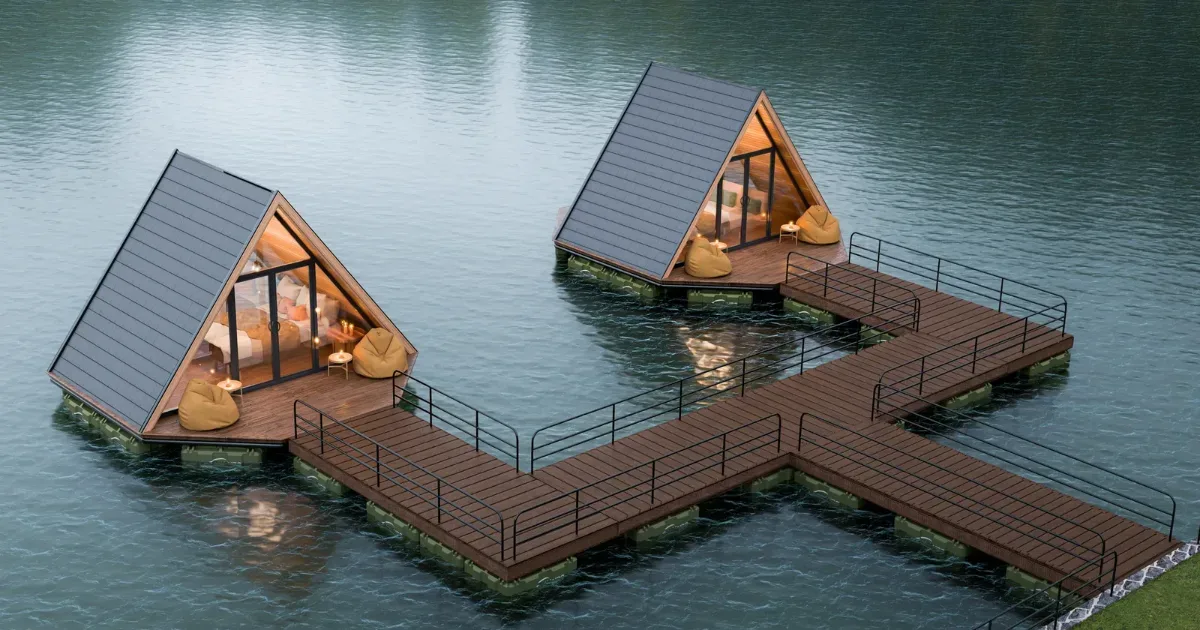
A zigzag path is longer, but offers a different walking experience at every turn and opens new views of the water. This shape is often considered for tourism areas, as in the glamping cabin concept visualisation in this article's featured image. Each bend needs enough room for people to pass and should ideally have a mooring point.
To try out different shapes before discussing them with the technical team, you can arrange modules in the Nusa Dock dock Drawing Tool and see an estimate of the number of units.
Frequently Asked Questions
What is the difference between a floating walkway and a gangway?
A floating walkway floats on the water surface and forms the main route between units or towards a dock. A gangway is the bridge connecting the shore or a fixed structure to the floating section, so its slope changes with the water level.
Does a floating walkway sway when people walk on it?
Every floating structure moves slightly with load and waves. The amount of movement is influenced by path width, module type, joints and the mooring system, so it needs to be discussed from the design stage according to the water conditions.
Can a floating walkway branch out to several units?
Yes. Nusa Dock modules can be arranged in a straight line or in L, T and U shapes, so the walkway can branch towards several cottages, gazebos or berthing areas. The final configuration is determined by technical calculations for each project.
Ready to design a floating walkway for your tourism area or dock? Start with a simple sketch, then send it to marketing@bajauindo.com or via WhatsApp 0878-5931-4314 to discuss it with the Bajau Indo team.
Written by
Tim Redaksi Bajau Indo
Tim Teknis & Redaksi
Tim teknis dan redaksi Bajau Indo — produsen dermaga apung, kubus apung, dan ponton modular LLDPE dari Sentul, Bogor.
Tags
Share this article: